Parental backlash to screen time in schools is spreading across the Philly region: ‘It’s not going to get better unless we get loud’
Galvanized by a surge of national attention to the issue and parental campaigns in neighboring districts, including Lower Merion, parents are pushing back against Chromebooks and iPads in schools.
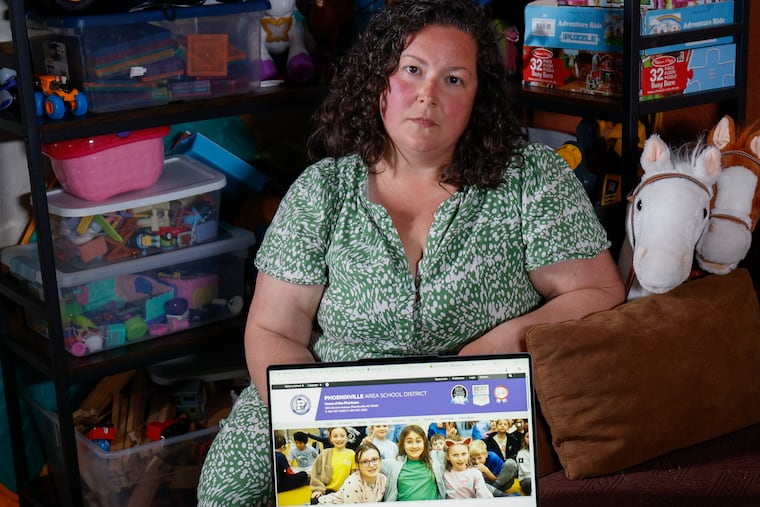
Alair Southerton knows her 6-year-old son listens to books on his school-issued iPad during kindergarten in the Phoenixville Area School District, watching pages flip on the screen.
He also sometimes plays a Wild Kratts game, based on a cartoon, Southerton said; she isn’t sure whether it’s tied to a lesson.
Southerton worries screens are creeping into her son’s day more than she realizes — to the detriment of his attention span and brain development, she said. She’s now organizing parents in Phoenixville to push back against the district’s use of electronic devices.
“It’s not going to get better, unless we get loud right now, and we use the momentum,” Southerton said.
Southerton is among a growing number of parents in school districts around Philadelphia who are speaking out against what they see as excessive technology use in schools — galvanized by a surge of national attention to the issue and parental campaigns in neighboring districts, including Lower Merion.
While schools have championed one-to-one devices as a tool to increase equity and personalize learning for students, parents weary of policing kids’ Chromebook usage and worried that schools are relying too heavily on screen-based instruction are asking their districts to produce proof of the benefits.
Some parents are also expressing deep frustration that, despite their efforts to regulate their kids’ access to the internet at home, schools may be inadvertently fueling screen addictions.
Rachel Cox, a parent in Wallingford-Swarthmore, has checked her sixth grader’s browser history and found he’s opening multiple tabs every hour at school, visiting sites like eBay, Amazon, and YouTube. She imagines him rushing through work, “frantically trying to look at something on the internet.”
During a back-to-school night event, one of her son’s teachers said she didn’t give homework, so that if kids brought work home with them, it meant “instead of doing work in class, they were playing games on the Chromebook,” Cox said.
“It’s just this open thing, that’s been like a boiling frog,” said Cox, who is among parents questioning the district’s use of technology, including at community meetings held by the superintendent last month.
“Parents were like … ‘If you think there’s no way you’re going to pull these Chromebooks, I need to list my house,’” Cox said, though she said she didn’t know where would be better.
Russell Johnston, Wallingford-Swarthmore’s superintendent, said the district has been reviewing its educational technology programs and was now moving to get feedback from teachers. The district is no longer letting kids use iPads during indoor recess, Johnston said.
“We really want to be sure we’re using technology in the most purposeful ways,” said Johnston, who said he was trying to respond to parent feedback as well as research highlighted by neuroscientist Jared Cooney Horvath, who argues that technology is undermining kids’ learning.
All eyes on Lower Merion
In Lower Merion, where hundreds of parents have signed a petition calling for the ability to opt out of one-to-one electronic devices, the district has said it’s considering changes to technology use for the coming school year, including not assigning elementary schoolers devices.
But the district has rejected the opt-out demands; parents are expected to turn out at a school board committee meeting Monday to oppose potential policy changes that would eliminate an opt-out option.
Parents in other districts are paying close attention.
“Whatever happens there is going to serve as a precedent for the rest of us,” said Karen Moore, who was among a group of parents in Springfield Township who pushed their Montgomery County district two years ago to ban Chromebooks during middle school lunch.
To Moore and like-minded parents, technology is still overused in district schools — particularly in middle school, as Chromebooks on kids’ desks present opportunities for distraction.
“The assumption is that an 11-year-old with ADHD is going to be like, ‘I can totally make the right choice here,’” said Moore, whose younger child is entering middle school this fall.
Danny Finnegan, another Springfield parent, said the district’s filters don’t adequately block inappropriate content. Finnegan, who works in software development, has blocked YouTube at his house, but he’s unable to stop his middle schooler from watching it at home on his school-issued Chromebook.
“He can bring in a device compelled by the school, and watch something I have banned,” Finnegan said.
MaryJo Yannacone, Springfield’s superintendent, said the district “had worked extensively with our staff and families to develop safe, responsible, and developmentally appropriate guidelines in our schools for the use of technology within our educational programs, while meeting standards for skill acquisition” aligned to state expectations.
She also said the district employs “the highest levels of security and filtering to safeguard our students,” and said concerned parents should contact building administrators.
Parents push to learn how screens are used in classrooms
While Springfield parents haven’t organized recently, Moore said a Facebook group that formed years ago calling for reduced screen time in district schools gained 20 new members in the last two weeks.
Some mobilization has happened, through groups initially organized in opposition to cell phones.
Lindsay Bacalles, a Wissahickon School District parent who in 2024 started a local group connected with the Wait Until 8th movement encouraging parents to delay giving kids smartphones, said she’s increasingly hearing concerns about educational technology.
“Parents are starting to feel the need to push and ask for information from the school district,” said Bacalles, who has daughters in fifth and second grades and has been surveying fellow parents on technology to gather information to share with the district.
A speech therapist, Bacalles said she’s most concerned with kids using devices during unstructured time and how that might inhibit social interaction. Her daughters’ teachers have reassured her about what goes on in their classrooms, but Bacalles hears from other kids about games they’re playing.
Parents are somewhat in the dark about how screens are used, Bacalles said: “You never know if you’re getting the full story from your kids or not.”
Starting in 2024-25, Wissahickon stopped assigning each kindergartner and first grader a Chromebook, switching to a two-to-one ratio — a decision “guided by current research” on how younger students learn best, “while still thoughtfully incorporating an opportunity to use digital tools,” said Superintendent Mwenyewe Dawan in a district response to questions. She said the district’s teachers plan lessons first, and then decide “if using traditional methods or technology will support that learning most effectively.”
Tools to monitor screen usage
Some districts are moving to give parents tools to monitor kids’ screen usage. Phoenixville, for instance, said it would launch an app this fall that would give families reports on what their kids accessed.
Parents who want to curb screens say that isn’t a solution. “It’s so after the fact — it’s such a Band-Aid,” said Katie Castiglione, a Phoenixville parent who has daughters in second and first grades. “I don’t want to monitor what the teachers should be monitoring.”
During a teacher conference in January, Castiglione learned that while her younger daughter was on her iPad as a reward, she had accessed something she wasn’t supposed to, and the device was taken from her.
Castiglione isn’t sure why iPads were used as rewards in the first place. “It was eye-opening … to learn this is happening here and there and in this circumstance,” she said.
At a school board curriculum committee meeting last month, the district announced it was eliminating technology from indoor recess.
Phoenixville spokesperson Nicole McClure said the district was reviewing how technology is used more broadly. “Our role is to teach and model responsible, intentional, and meaningful technology use, and this principle guides our evolving curriculum discussions,” McClure said.
Southerton, who helped organized Phoenixville parents to address the board, has been shocked to hear parents describing everything from inappropriate videos accessed by their kids to kids’ lack of engagement with educational apps they’re supposed to be using.
Volunteering in her son’s school, Southerton has been surprised at the prevalence of screens — from a video of someone playing an instrument in music class, to a video of someone reading a book in the library.
“It’s like he’s walking from screen to screen throughout the day,” she said.