Lower Merion is considering screen time limits in schools as parents demand to opt out of technology use
The school district is moving forward with a new technology policy that officials said could impose specific limits on the amount of time students spend on screens in classrooms.
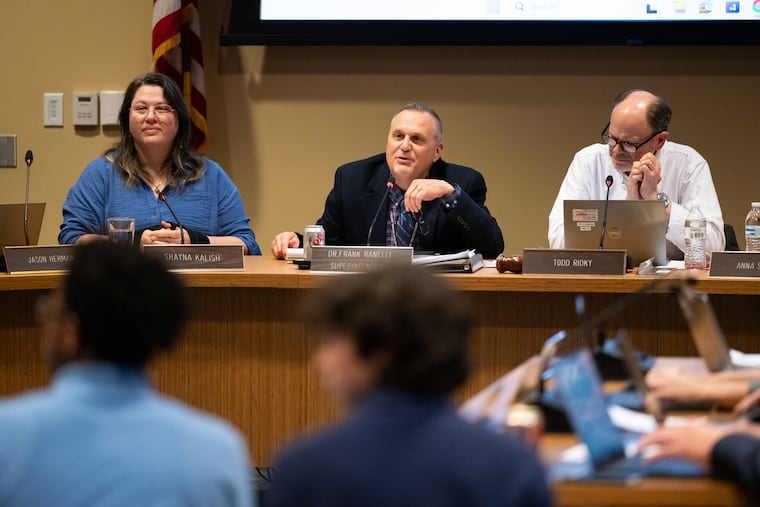
The Lower Merion School District moved Monday to advance a new policy that broadly defines how technology should be used in schools, while facing opposition from parents demanding to opt their children out of school-issued devices.
At a packed school board policy committee meeting, district officials reiterated that parents could not opt out — at times drawing shouts from the crowd.
But they suggested that they might impose specific limits on screen time in school.
Administrators ”need to work with teachers and staff to find out what is comfortable," Superintendent Frank Ranelli said. “This is a first step for us, and we have that on our minds as well.”
But parents who say the district is overusing technology said it was not moving quickly enough to curb practices impeding learning and kids’ development — pointing to school districts like Los Angeles, which made headlines last month for passing screen time limits, and states like Utah, which has banned screens for students in kindergarten through third grade, with exceptions for computer science and testing.
They also described harms their kids were experiencing at school and at home while on their school-issued computers, which they felt they had little ability to control.
“The fact that I can’t opt out to stop giving him a little bit of a drug, when he’s a drug addict, doesn’t make any sense to me,” said Adam Washington, who described battling with his 15-year-old son at night over the laptop.
Washington, whose son has an individualized education plan for special needs, said it was “extremely hard for me to believe” that Lower Merion did not have the resources to educate without computers.
“The screen is killing him. It is killing him, and me, together, with our relationship,” Washington said.
Deena Pack said her daughter, who has ADHD, tuned out of her classes by watching TV on her laptop.
“Rather than really engage in her government class, she’s watching a Netflix movie,” said Pack, who discovered her daughter had been accessing numerous streaming sites, like Hulu, Paramount Plus, and HBO.
Officials said the district has blocked more websites since a March community meeting at which parents described numerous examples of technology misuse in school.
But parents also say the ways the district is intentionally using technology are misguided, questioning why the district requires kids to spend time on math and reading apps on computers.
“Nobody’s ever been able to sit up and say, ‘This is why your daughter has to spend 20 minutes a day learning math through a Chromebook,’” said Sam Handlin, who said there was not a “convincing argument” for the district’s current use of technology.
Asima Ahmad, who has a 3-year-old daughter, said she emailed the district when her daughter was 8 months old “to ask whether it was possibly true that kindergartners get iPads.” She was directed to the district’s website, she said, and could not get an answer on how often the tablets were used.
Describing pictures posted online of young students using iPads for various classroom activities, Ahmad called them “dystopian in nature.”
Lower Merion outlines technology use for different grade levels
The district has said it is reconsidering whether to issue elementary students one-to-one devices. The policy introduced Monday, meanwhile, says the use of technology in kindergarten through first grade should be “minimal and highly structured,” used for “differentiation, feedback, and creativity.”
In grades two through four, the policy says, there should be “limited but increasing use” of technology “for research, creation, and practice,” while starting in fifth grade, “increasing academic responsibility and evidence of daily classroom use for collaboration, research, and organization.”
Draft administrative regulations that would guide schools in carrying out the policy were also presented Monday, though officials said they were continuing to develop them.
“We need to come up with reasonable expectations that we can understand with the best science,” said board president Kerry Sautner.
Administrative regulations connected to the current technology policy say principals must accommodate families who opt out of one-to-one devices for their kids. Hundreds of families have signed a petition seeking to preserve the opt-out option, though administrators say it is not possible to offer students a device-free pathway.
An ongoing fight over opting out
Some parents Monday also pushed back on the prospect of opt-outs.
Parent Seth Ruderman said those seeking to opt out — who have organized under a “Pencils over Pixels” slogan — had identified a genuine problem. “I wouldn’t want my kid on an iPad all day either,” said Ruderman, who said the district’s curriculum needs to be examined.
But he questioned the practicality of opting out: Would kids be in separate classrooms? If five kids in a grade opt out, would they be required to have their own teacher?
“Opting out is not a solution,” Ruderman said, but avoids “the hard work” of improving the district’s programs.
Sarah Eckert, an education professor at Eastern University, said there was a “legitimate, desperate need for more monitoring” of kids’ device use in middle and high school.
But allowing opt-outs risks creating a segregated educational system, Eckert said. She said the parental push was a waste of “administrative energy and community capital” that distracted from addressing inadequate technology oversight.
Peter Ormerod, a law professor at Villanova University who focuses on law and technology, said the district should not be stopping parents from opting out before it has fixed the problems they have identified.
“Please do not take away the seat belt before you build the airbag,” he said.

Inquirer Lower Merion