Lower Merion parents are continuing to confront the school board over opting out of technology
An increasingly organized parent group against screen time in schools, called Pencils over Pixels, has even hired a PR firm to help with their messaging and to reach more parents.
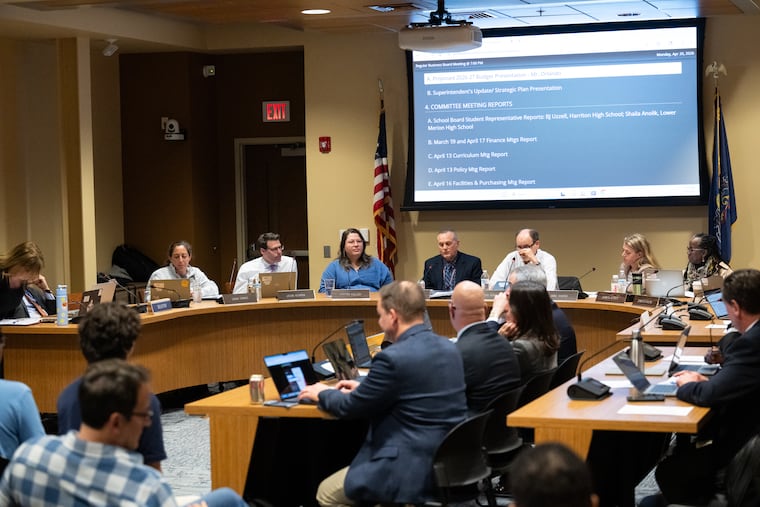
Parents continued to press the Lower Merion school board Monday to let them reject district-issued tablets or laptops, as policy changes advance that would repeal any accommodation for families to opt out of electronic devices.
Board leaders said they would revise a new technology policy that was unveiled last week to replace the current version — which says schools must work with families who don’t give permission for their kids to be issued devices — and present it again in June.
“I speak for many of us, that we are all directionally aligned with the majority of things that are being shared by the community,” Anna Shurak, the co-chair of the policy committee, told the crowd in the Lower Merion High School auditorium Monday.
But members of an increasingly organized parental movement — who have hired a public relations firm and say they’ve been contacted by parents across the country — implored the board not to move forward with repealing the current policy, arguing that it shouldn’t strip parents’ ability to opt out before it satisfies concerns about excessive screen time and technology misuse in schools.
“These devices are marketed as engaging, and we’re reassured that the educational aspect makes it safe, but the evidence overwhelmingly says otherwise,” said Theresa Elko, the parent of a kindergartner at Penn Wynne Elementary, who compared school-issued devices to an “addictive drug.”
“My role as a parent feels seriously challenged when the school insists she needs an iPad to learn,” Elko said.
The district’s superintendent, Frank Ranelli, has said administrators are reviewing the need to assign one-to-one devices to elementary students, among other possible changes for next year. He has also said the district is considering setting screen time limits.
But he and board members have repeatedly said it’s not possible for families to opt out of devices.
Ben Prusky, a parent of second and first graders in the district and a pre-kindergartener, told board members Monday that parents could “work through the logistics” of opting out.
“If we need to get textbooks, there’s no money for them — we can work with you,” Prusky said.
Meredith Brisco-Bacik, a parent of a second grader and two rising first-graders, asked the board to not repeal the opt-out language “until we have a policy in place that everyone in the room can really get behind.”
Differing visions
Parents in favor of opting out expressed different possibilities Monday for what technology access students should have: from elementary students having access to computers on carts, but not being issued personal devices; to going to a computer lab once a week to learn to type, to no technology before grade three.
Seth Ruderman, a parent who said he favors more restrictions on screens, but opposes calls for opting out, said there appeared to be contradictions in parents’ visions.
“No opt-out solution is going to make the people in this room happy, so we are left with addressing all students,” Ruderman said. He called for improvements to district-wide policy, rather than creating “two classes of students.”
Parents in the Pencils Over Pixels group that supports opting out have acknowledged some disparate views, and say they’re seeking to reconcile them.
While parents say a petition seeking the right to opt-out has more than 800 signatures, they’ve also started a new petition focused on “values and beliefs” around technology in schools, including that “technology is a tool — not a teacher” and that “gamified apps have no place in education.”
“Opt-out is a means to an end. It’s not the end goal itself,” said Subashini Subramanian, a parent of a second grader, and author of the new petition. “As a coalition, we need to start thinking a little more big” about what the district’s technology practices should look like, Subramanian said.
The group also wants to find common cause with parents who may not favor opting out, but have concerns about screens in school, Subramanian said.
“It’s about getting organized, and keeping the momentum up,” she said.
A PR firm and fundraising
Pencils Over Pixels, which has been distributing lawn signs, recently enlisted a public relations firm, Cozen O’Connor Public Strategies. The group organized a news conference before Monday’s board meeting.
The school board “has lawyers, communications teams, and a vast amount of resources at their disposal,” said Mike Balkin, a parent involved in engaging the firm. “We are simply trying to level the playing field.”
Balkin said the firm is helping with “cohesive messaging” and “will also help us coordinate publicity and reach as many concerned parents as we can in hopes of them joining the movement themselves.”
A GoFundMe for Pencils Over Pixels says it’s seeking money for “lawn signs, advertising, professional advocacy firms, and other resources that can help us stop the school board from removing our rights as parents.”
The message about Lower Merion parents’ fight is already reaching a wide audience. Girish Ramaswamy told the board the Pencils Over Pixels group had heard from people in Virginia, California, and even South Korea.
“Almost every single parent out there can relate to this topic. and they are all going through this right now in their school districts,” Ramaswamy said.
Elizabeth Lovett, a parent and self-described “computer nerd” who teaches computer technology at the University of Pennsylvania, called the online programs used by the district “the junk food of curriculums.”
Amid mounting recognition of kids’ shortening attention spans, Lovett said, the pendulum swinging back away from educational technology is inevitable.
“We are going to be pulling back technology, one-to-one devices out of schools, the same way we took lead out of gas,” she said. “Lower Merion has an opportunity to lead this.”
