Philly will close 17 schools and modernize 169. Meet the educator leading the transition.
Shakeera Warthen-Canty will manage the $3 billion facilities plan, helping families and staff with the transition.
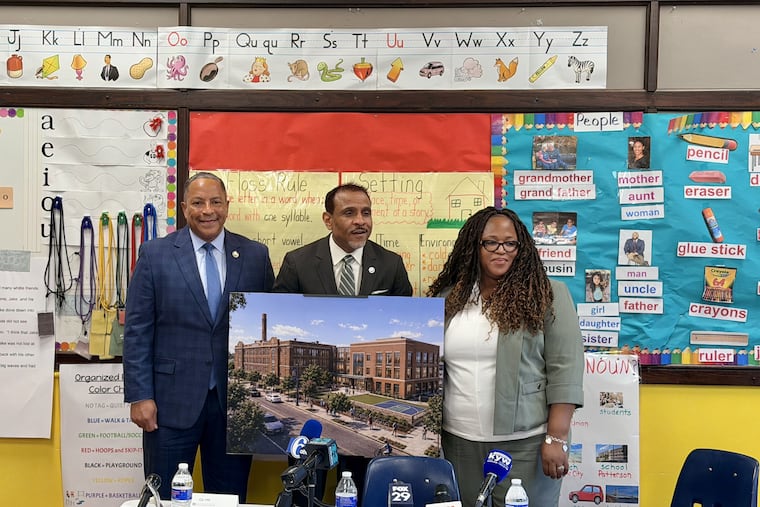
Superintendent Tony B. Watlington Sr. has promised “white-glove treatment” for families and schools affected by a facilities master plan that will close 17 schools and modernize 169 over the next decade. And he appointed a Philadelphia School District veteran to lead the charge.
Shakeera Warthen-Canty, formerly assistant superintendent of school operations and management, was recently named head of the new School Transition Office, tasked with implementing the $3 billion plan remaking schools across the city.
Warthen-Canty and four other employees will work in the new office, which will also pull in as-needed help from departments across the district — school safety, transportation, student placement, facilities, and more.

Wholesale changes are coming to the Philadelphia School District, with the school board passing a $3 billion facilties plan that aims to close 17 schools permanently, and renovate 169.
Superintendent Tony B. Watlington Sr. presented the plan to the school board Feb. 26 and it immediately faced strong opposition. After some amendments, the board passed the plan April 30. Here's what we do and don't know about it.
And to see the proposed list school closures and check how your school could be impacted, use our interactive charts.
Each of the schools proposed for closure has its own story. Find them all here.
“We know that this is going to be a big task, but it’s going to be met,” said Warthen-Canty, who’s spent decades in the district as a teacher and principal. “We know there have been some challenges, but we want to make sure our communities and families know that we have a place where you can get answers.”
Warthen-Canty officially assumed the new role Wednesday ahead of the 2026-27 school year, which Watlington has designated as a planning year for schools affected by closures and other major shifts.
Experts in their communities
Initially, the office will focus on schools closing, merging, and undergoing major renovations in the 2027-28 school year; other projects are slated to happen in subsequent years.
Though much emphasis has been placed on the 17 closures, which were the subject of much pushback from the community and City Council, much of the office’s work will center on modernization projects, ranging from additions to painting projects and handicap accessibility work.
Watlington announced the office’s formal launch at Patterson Elementary in Southwest Philadelphia, a school set to undergo a $45 million renovation as it grows from a K-4 to a K-8. It will take in some students from nearby Tilden Middle School, which is slated to close.
The transition office will be key as the complex work moves along, said Warthen-Canty. Patterson is slated to get 13 additional classrooms, a new gym or cafeteria, and an elevator.
“Some of the pieces of what that looks like, what elements need to be there, we need the Patterson team to work alongside of us,” she said.
Folks on the ground “know their communities, they’re experts in their communities. And that’s a part of the planning,” she said.
System-wide, how many projects can be completed and in what time frame is not assured.
The district will allocate $1 billion of its capital budget over the next 10 years to complete some of the projects, but it’s also banking on $2 billion from philanthropic and state sources — money that’s not guaranteed.
And while Warthen-Canty believes the facilities plan will ultimately expand opportunity and better position the district to advance students’ academics, she knows some of its transitions — particularly the closures — will be tough.
“My heart goes out” to affected families and schools, Warthen-Canty said. “Even people that are being co-located or merging, those are major changes.”
Part of the work, Warthen-Canty said, is going to be convincing families in schools where those major changes are happening that should they should remain in the district.
In the case of the school system forcing families to leave their schools and go elsewhere, “we want to make sure that there’s extracurriculars in these schools they’re going to. We’re increasing the art and music,” Warthen-Canty said. “What are the resources we can put in place so that we’re ensuring that when the students get there that they’re going to have that well-rounded education, increased opportunities?”