Letters to the Editor | Nov. 9, 2026
Inquirer readers on the midterm elections and a congressional report on antisemitism in Philadelphia public schools.
Midterm reactions
I am elated that Donald Trump and his minions have been kicked to the curb. But before we do our happy dance, let’s remember something.
Team Trump did not lose because Trump tried to silence journalists and labeled them the “enemy of the people.”
Voters didn’t abandon him because of his bromance with Russian President Vladimir Putin.
They didn’t care that he hid classified documents in his Mar-a-Lago bathroom.
They didn’t vote his team out because he treated taxpayer dollars like his personal slush fund.
Most voters did not kick him out for deporting thousands of Latinos.
The primary reason Team Trump lost was “the economy, stupid.” It wasn’t until Americans started choking on the high price of gas and groceries and health insurance that many people finally woke up.
The uneducated remain uneducated, and proud of it. Hatred of the Other is stronger than ever.
They say that those who forget the past are condemned to repeat it. So the next time a con artist comes gliding down a golden escalator looking for a presidential nomination, let’s remember what Trump did to this country. Let’s remember how, bit by bit, he stole our humanity, in broad daylight, as many voters just looked on. Let’s be smarter next time.
Rosemary McDonough, Narberth
. . .
During the past two years, Democratic politicians have seemingly ignored the almost daily reports of catastrophic floods, hurricanes, forest fires, tornadoes, and sea level rise caused by human-made climate change.
Will Democrats now be brave enough to tell voters that reversing climate change will require spending lots of money, making some sacrifices, and using the safe forms of alternative energy that are available today? Maybe we can finally start taking the necessary steps to ensure our grandchildren’s future is healthy and sustainable.
Reggie Regrut, Phillipsburg, N.J.
. . .
Who knew 2026 would become the year We the People would begin to turn away from authoritarianism and back toward democracy? But even early on, the signs were there. In April, Viktor Orbán lost his grip on Hungary in a landslide election defeat. That was followed by a turn toward pro-democracy leadership in Serbia and Brazil. And even now, Benjamin Netanyahu’s hard-line government in Israel is teetering as his opposition struggles to form a coalition.
Here at home, after the brutal murders of Renee Good and Alex Pretti by U.S. Immigration and Customs Enforcement, thousands of Minnesotans braved subzero temperatures to protest. The No Kings rallies sent a message that we were fed up with the Trump administration’s trade wars, corruption, and unapproved war in Iran.
Problems still persist. The rise in antisemitism must be addressed before we can succeed in the future. We cannot celebrate the midterm victory if Jewish people and members of other minority groups don’t feel safe in our schools and our places of worship.
Today, we celebrate. Tomorrow, we fix the problems that could tear us apart.
Elliott Miller, Bala Cynwyd
Classroom concerns
The congressional committee report accusing the Philadelphia School District of antisemitism describes the Great March of Return of 2018 and 2019 as “a Hamas campaign that featured deadly clashes.” No. The Great March of Return was a peaceful demonstration by Palestinians demanding their right to return to their ancestral lands. A United Nations report found “reasonable grounds to believe that the Israeli security forces killed and maimed Palestinian demonstrators who did not pose an imminent threat of death or serious injury to others when they were shot, and where their shooting did not thwart any such threat.” Human Rights Watch, B’Tselem, and Amnesty International all condemned Israel’s use of deadly force against peaceful Palestinian protesters. Omitting this context serves only to reinforce the outrageous accusations of the committee report.
Alex Braden, Philadelphia
. . .
Superintendent Tony B. Watlington Sr. has rebutted the study about antisemitism in Philadelphia schools. However, he is only able to control the curriculum, not what individual teachers are saying to their students. Many years ago, when I was a teacher, I asked a colleague her opinion on the Holocaust. Her reply was, “Holocaust, Holocaust — I am sick and tired of hearing about the Holocaust.” It seems that over the years, nothing has changed.
David Friedman, Conshohocken
Equal dignity
Jonathan Zimmerman’s attempt to combat anti-Muslim bigotry by promoting the accomplishments of Arab/Muslim scholars is well-meaning but deeply flawed. Zimmerman’s suggestion to counter falsehoods about Muslims or Arabs not contributing to science implies minorities are only valuable if they produce. Should we then look for minority groups who have not won awards and question their value to society?
If we want to address Islamophobia — which is itself a bigoted term because it implies people have a “fear” of Muslims when, in fact, it is just bigotry — then the well-meaning need to do more than educate the ignorant about Muslim scientists, past or present, but hold those in power, like Robert F. Kennedy Jr., to account when they say things about Muslims that would cause them to be canceled if they were said about any other minority community.
As long as there is a lack of consequences for the anti-Muslim bigotry that pervades American society across politics and media, the people Zimmerman wants to educate will continue to believe what they believe about Muslims when their politicians, religious leaders, and media pundits are telling them that we are the enemy.
Saif Hasan, Cherry Hill
Gratitude extended
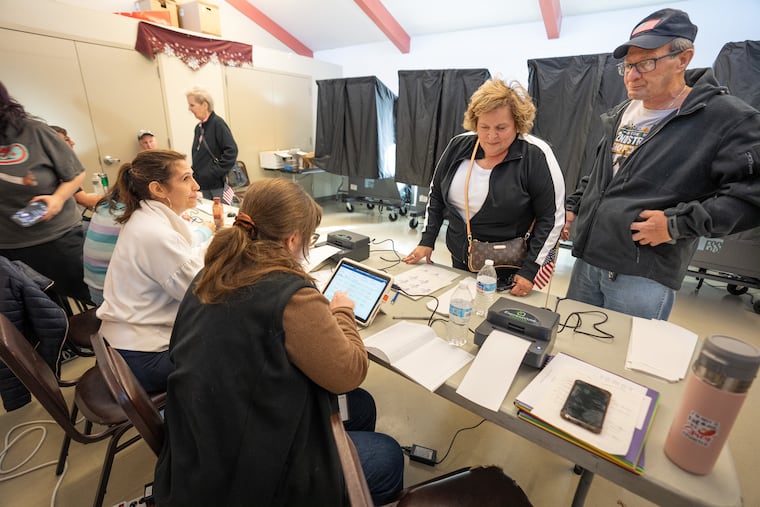
Many of us are still living in a state of amazement and unbridled joy because of the realization that democracy overpowered fear and dread in the midterm election. In Philadelphia, I want to express my sincerest gratitude to the underappreciated workers at the satellite election offices run by the City Commissioners. I voted at the District 8 center on Chew Avenue and experienced the care and competence each staff person gave to every voter. They did not rush us; they did not assume we would find the process easy. Instead, they took their time to ensure every ballot would be counted. Bravo to the City Commissioners, the employees who managed the centers, poll worker trainers, vote canvassers, and to all the people who served at the polls on Election Day.
This is our very own true homegrown democracy in action.
Tobie Hoffman, Philadelphia
Standard sense
There’s been a lot of talk about making daylight saving time permanent. That’s what Donald Trump wants, but if an idea or policy flows from his addled mind, I am skeptical, if not cynical. Living in South Florida, I am a victim of the crushing and energy-sapping heat (from fossil fuel-enhanced climate change?) that is especially draining during the long days we experience under DST. If you aren’t up and out of the house to run errands and back before 9 a.m., you quickly become a sweat-sodden mess. We often get 100-degree heat throughout the day, but not one iota of relief until the sun is close to setting. Making hot days longer is a big negative. Trump is only thinking of his own circumstances, and though he insists permanent DST is in everybody’s interests, it isn’t. Don’t forget, Trump, the supremely self-interested president with a “high IQ,” abandons Florida as soon as the heat of April descends. He doesn’t reappear until October or November when the temperature drops in Bedminster, N.J. Make standard time permanent — as Hawaii and nearly all of Arizona have done. That’s what scientists and medical experts recommend.
David Kahn, Boca Raton, Fla.
About letters to the editor
Letters feature a reader’s written opinion and are submitted in response to an article in The Inquirer or another topical issue. Submissions should be sent to letters@inquirer.com. Limit length to 150 words and include the writer’s home address and day and evening phone number. Letters are published in the Inquirer six days a week on the print opinion pages and online.