The woman who took down Jeffrey Epstein was forged in Philly
“Philly is in my bones. I would not be where I am right now if not for Philadelphia,” says the journalist Julie K. Brown.
The sordid Jeffrey Epstein saga is a Florida story, first and foremost.
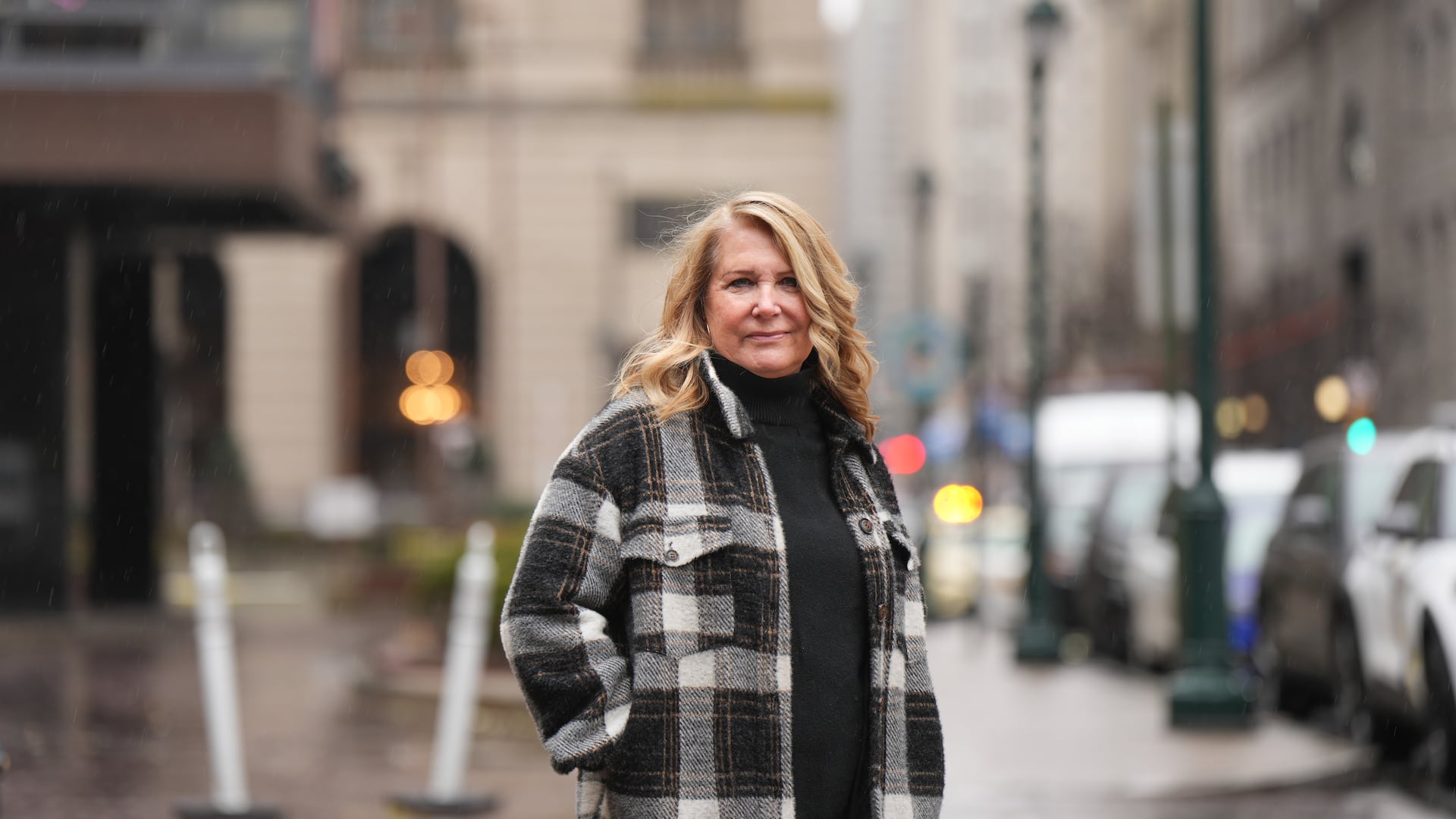
That’s where Julie K. Brown, a longtime investigative reporter at the Miami Herald, did most of the reporting that led to the Palm Beach billionaire’s arrest in 2019. She has a gorgeous apartment in Hollywood, Fla., overlooking the Atlantic, and temperatures were climbing into the mid-60s on this Tuesday afternoon.
But Brown is sitting at a dining room table in Old City — not in Florida — surrounded by redacted documents and lots of Eagles and Phillies memorabilia. Outside, cars are encased in snow on the cobblestone streets like ice-age fossils after another snowstorm. It’s late February, and temperatures hover around freezing.
“I decided this is a good place for me to come and get sane from Florida because Florida is insane,” she says. “Philly is in my bones. I would not be where I am right now if not for Philadelphia.”
Brown, 64, isn’t used to talking to reporters about herself more than Epstein, the man who will be mentioned in the first sentence of her obituary someday, but she’s doing her best, while keeping an eye on her cell phone.
She could miss a message from an anonymous source or one of her two kids, Amelia and Jake. Television producers from CNN or PBS could be trying to get her on to discuss Epstein, of course. That’s a constant, she says.
CNN’s Jake Tapper, who grew up in Queen Village and Lower Merion, has had Brown on his show multiple times.
“There is something in the water, or I should say ‘wooder,’ that makes us all particularly scrappy, and whether it’s being in between New York City and Washington D.C., or whatever, the chip on the shoulder that is part of Philadelphia DNA is very, very strong with Julie K. Brown,” he said.
“And I mean that in the best possible way, because the Philly chip is not hostile. It’s about loyalty, underdogs, and the work ethic.”
On one occasion, Brown’s cell phone offers up something seemingly less serious, via the Major League Baseball app: updates from an apropos spring training game in Jupiter, which is about 70 miles north of Hollywood.
The Florida Marlins beat the Phillies 6-1 that day, but the Sunshine State never beats Philly in Brown’s mind.
‘No one else could’
Brown’s friends, family, former editors, and media colleagues say her backstory — lean times with her single mother in Bucks County, a circuitous route to journalism via Temple University, and formative years at the Daily News on North Broad Street — made her tough enough to expose Epstein, and the prosecutors who gave him a sweetheart deal in Florida.
But there is a tenderness about Philly that’s often underreported, and Brown, who became an emancipated minor at 16 and went to work in factories — not straight to college — after high school, was uniquely qualified to connect with women abused by Epstein.
“I’m a product of a single mom. A lot of these girls came from the same place that I came from,” she says. “I always say, by the grace of God, I didn’t end up in a situation as they did.”
A single mother of two herself, Brown spent two years reading through court documents in Florida and reaching out to Epstein’s victims with Herald photographer and videographer Emily Michot. Their work culminated in the Herald’s 2018 award-winning series “Perversion of Justice.” Brown published a book by the same name in 2021.
In her reporting for the Herald, Brown pried open Epstein’s 2008 “sweetheart” plea deal, but her main objective was to give his victims, often underage girls who came from difficult homes like hers, a voice.
One of those victims, Michelle Licata, was 16 when she was persuaded to go to Epstein’s mansion in Palm Beach. Years later, when living in Tennessee, Licata received a packet from Brown in Florida that included details from Epstein’s plea deal. She was impressed with all the research Brown had done and believed she was going to see the Epstein case through.
“She had done the work,” Licata said last month.
Licata, now 38, says Brown still checks in on her, often. Not for interviews or favors. She has Brown saved as “Julie Brown shark” in her contacts because “she gets it done.”
“She’s a mentor,” Licata said. “She did something when no one else could.”
The Epstein story has only metastasized in recent months and, possibly, gotten more bizarre after the Department of Justice began releasing a trove of files just before Christmas.
Brown said she hasn’t really had a day off since, writing for both the Herald and her popular Substack. There’s a carousel of producers trying to book her to talk about it all, of course. (There are also film and television producers eager to talk: Laura Dern is slated to play Brown in a series based on the book.)
“That’s like a whole other job,” she said of television appearances. “And I already have a job.”
When we spoke, she was trying to reschedule with CNN’s Anderson Cooper, who wanted her on for the following night. Brown was already scheduled to do a Q&A with former Daily News colleague Dave Davies at Philly’s Pen & Pencil Club, America’s oldest continuously operating press club.
Cooper would have to wait. For Brown, Philly comes first.
A quest for justice
Throughout her career, Brown survived staff reductions, buyouts, and forced pay cuts, with hundreds of reporters rushing for a single opening at the nation’s most reputable newspapers.
Brown endured her own pay cuts at the Miami Herald, and her own disheartening interviews with the Washington Post in 2017, where she was a finalist for a job she didn’t get. At the Herald, Brown says, she was making about the same salary in 2016 as she was when she was hired there a decade earlier.
“I was constantly bouncing checks and being charged overdraft fees,” she wrote in the book. “My bills were always late, and my debt piled up.”
Brown did receive raises after an investigative series into abuse at a Florida women’s prison and the “Perversion of Justice” series both won prestigious George Polk awards.
The Herald entered the Epstein series for a Pulitzer Prize, but it was not a finalist. (She was one of the Herald staff members awarded a Pulitzer in breaking news in 2022 for coverage of the Surfside condominium collapse.)
“I’ve never done a story to win an award,” she says.
The publication of her book provided Brown with her first real financial boost. That money allowed her to stop renting and buy the apartment in Hollywood, which was a fixer-upper when she found it. She used the rest to pay off debts she had amassed over the decades. She was still solely responsible for two children in college. She also needed a new car, as hers had been repossessed.
She bought a Mazda.
“I never thought of it as a windfall. I thought of it as a lifeline,” she says.
Brown had witnessed her mother, Theresa, bear the same financial burdens while raising three kids alone in a split-level home on Diamond Street in Sellersville, Bucks County. Locals were cruel, and Brown recalls people in the neighborhood throwing dirt “bombs” at their house around Halloween because a single mother lived there.
“I know it’s hard for people to fathom this now, but we were bullied because we had a single mom. I was picked on in elementary school because of that,” she says.
One day, Brown came from school to find the house empty. Just bare floors. That memory would define her drive as a journalist, her quest for justice.
“So they’re not going to turn off the electricity in the winter because my mother has three kids, so what did they do? They took out all our furniture,” Brown says.
With no father around, and a mother who worked as a secretary by day and a waitress at night, Brown had a lot of time to herself and took to writing. She won an essay contest at Sellersville Elementary.
“I used to keep my stories in shoeboxes in my closet,” she wrote.
Brown hung out at local carnivals, the Sellersville Cinema, Dairy Queen, and Emil’s Diner. At Pennridge High School, she was an A/B student but was fired as the editor of the Penndulum, the school’s newspaper. She was devastated and said anxiety and ongoing struggles at home were distracting her at the time.
At 16, Brown emancipated herself and moved into an apartment with older friends. When Brown graduated, she took low-paying jobs, one at a lampshade factory and another at a bell factory.
Still, Brown didn’t want her greatest achievements confined to a shoebox.
“I realized that if I didn’t go to college, I was going to end up working at Walmart my whole life,” she said. “So I made a plan and still had lots of jobs and waitressed, and as an emancipated minor, Temple University was very kind, and they gave me a grant.”
(Decades later, in 2022, Brown took a sabbatical from the Herald to teach at Temple’s new Logan Center for Urban Investigative Reporting.)
David Boardman, the dean of the Klein College of Media and Communication at Temple, said Brown is the “quintessential Philly girl” and “quintessential Temple alum.”
“That bulldog spirit she has carried her through college and carried her through her career. And we’re all benefiting from that,” Boardman said. “I think 99% of America wouldn’t know who Jeffrey Epstein was if not for Julie Brown.”
The People Paper
While at Temple, Brown interned at NPR, but she aspired to work in the ivory tower on North Broad Street.
“I told everyone my dream job is to work for The Philadelphia Inquirer,” she says.
She spent years at the Bethlehem Globe-Times, where she recalls writing a quirky story about a “gym bag bandit” robbing banks. She had a long stint at the Bucks County Courier Times, but she never stopped trying to land a job at The Inquirer.
Brown says she applied to The Inquirer about four times and, eventually, interviewed there. When she wasn’t offered a position, she contemplated leaving the profession altogether to pursue public relations. A mentor talked her out of it.
Brown eventually made it to North Broad Street, just on a different floor. When she was hired by the Daily News in 1996, she promised managing editor Brian Toolan that he would never regret hiring her.
I told everyone my dream job is to work for the Philadelphia Inquirer.
Working at the scrappy “People Paper,” a tabloid that punched way above its weight, redefined journalism for Brown.
“That’s really where I started,” Brown says of the Daily News. “I learned so much there, too: about the world, about journalism, about writing, about competition, about people. I loved it. It had so much personality, and it also let you have personality.”
At the Daily News, Brown worked as both an editor and a reporter, and channeled the memory of her empty childhood home in Sellersville into her investigative work. She wrote about a hepatitis C outbreak among Philadelphia firefighters that led to mandatory national testing for public safety workers. Her first big stories for the Daily News centered on the 1996 disappearance of Anne Marie Fahey, an assistant to the former governor of Delaware. Brown says her work helped lead to the arrest of Tom Capano, a wealthy, politically connected Wilmington lawyer, for Fahey’s murder.
“I’ve always gravitated toward stories about the voiceless and the injustice,” she says. “I always remember them coming and taking the furniture from my mother’s house. That, to me, seemed so unjust, and it just affected me in a way I’ve never forgotten.”
Davies, who worked with Brown at the Daily News, says Philadelphia, in the ’90s, was a “tough town,” and the newspaper prided itself on putting reporters on the street, knocking on doors to interview residents who may have lost loved ones just hours earlier.
“It wasn’t just that the city was tough. The newsroom was tough, too. There were arguments all the time, and you had to hold your ground,” he says.
That level of street reporting, Davies says, required grit and compassion, qualities innate in Brown. That carried over to her work in Florida, he says, particularly on Epstein.
“She took the underdog mentality with her,” he says. “She was plugging away against the New York Times, the Post, and the Journal, and it requires a strong belief in yourself.”
“I always think about the Daily News because that was the best job I had,” Brown says.
“Make sure you put that in there: that it was the best job I ever had.”
‘The only thing missing is your voice’
In 2005, Brown was concerned about potential layoffs at the Daily News, and though she “didn’t really want to leave Philadelphia,” according to her book, she thought she had gone as far as she could at the tabloid. She was getting divorced, too, and her ex-husband was moving to Florida. Brown didn’t want her children, then in grade school, to be too far from him, so she started looking for jobs there.
Brown applied to the St. Petersburg Times, the Tampa Tribune, and the Miami Herald. She accepted a position as an editor at the Miami Herald’s Broward County bureau, which she described as “closer to the alligators in the Everglades than to Miami.” Still, the Herald was a legacy newspaper, having won 24 Pulitzer Prizes as of 2023.
Brown learned a few things about herself in Florida. First, that she wasn’t “born” to be an editor and didn’t quite have the patience for that job.
She also realized just how much she truly loved Philly.
“South Florida, in many ways, is the opposite of Philadelphia, so transient that as soon as my kids made friends, their families would move away. There’s no real public transit system, so you’re left on your own to get from point A to point B without getting killed by drivers who don’t have licenses,” she wrote in the book. “People come to South Florida to escape, to retire, and to die, and before dying, they spend a lot of time lying in the sun and drinking alcohol.”
Brown volunteered to return to reporting in 2009, taking a pay cut along with most other staffers. She had no savings at the time and was paying $2,500 a month in rent, always mulling over a return to waitressing to pick up extra cash.
Getting back on the street was invigorating for Brown. She was neck deep in documents and police reports, digging into stories about injustice. She spent years uncovering abuse in Florida’s correctional system, focusing on its women’s prison in Lowell. That series, “Beyond Punishment,” won Brown her first Polk award.
“There were a lot of women in prison who shouldn’t have been in prison,” she says. “They could have been my mother, had my mother taken a wrong turn.”
Brown says sex trafficking came up often in her prison reporting and, later, she decided to focus her attention on that crime. When she researched “sex trafficking” and “Florida,” Jeffrey Epstein’s name kept popping up.
Police began investigating Epstein, a former math teacher turned financial adviser, in 2005 when parents of a 14-year-old girl reported she had been abused at his Palm Beach mansion.
Dozens of girls, mostly high school age, said Epstein paid them a few hundred dollars to give him massages that usually ended in sexual abuse.
Ultimately, Alex Acosta, the U.S. attorney for the Southern District of Florida, let Epstein plead guilty to state charges of soliciting prostitution from an underage girl in 2008. Epstein was sentenced to 18 months in jail, but didn’t serve the full time. There were allegations that Epstein abused the work-release program, too, leaving jail daily and spending hours at a time at his Palm Beach mansion. It’s all referred to as the “Sweetheart Deal” in Brown’s book.
When Brown dug into the case, she thought of that stinging day in Sellersville when the family furniture was taken, about injustice and power. Though the story had been covered in the press before, Brown thought something was missing. She decided to look back into the Epstein case by focusing on the plea deal and the victims’ stories, mailing out dozens of letters.
“The only thing missing is your voice,” she wrote to them.
In pursuit of the story, Brown sometimes bumped heads with her editors.
“I was a little bit skeptical of the story,” Casey Frank, the former senior editor for investigations and enterprise at the Miami Herald, told The Inquirer.
“She was determined to do it, though. Her determination is off the charts. She is a throwback to a different time, and I saw my job was to explain it all to those above me.”
Emily Michot, the photographer and videographer who worked on both the prison and Epstein series, says Brown never worried about the dangers of reporting on Epstein. “She has a lot of compassion in dealing with the victims, but she’s also very persistent and has this drive and kind of fearlessness about her,” Michot says.
Licata, who says she was 16 when Epstein sexually assaulted her at his mansion, said she has grown used to reporters knocking on her door. Sometimes they left a business card or doughnuts, and then she never heard from them again. Brown was different.
“I could tell she genuinely cared,” Licata says.
The “Perversion of Justice” series led to the arrest of Epstein by the FBI-NYPD Crimes Against Children Task Force and the eventual resignation of Acosta, who was President Donald Trump’s labor secretary at the time. Ghislaine Maxwell, Epstein’s former girlfriend, who was accused of grooming young victims, was eventually arrested, too, and ultimately convicted.
One former colleague in Miami, Michael Sallah, says Brown was the perfect reporter to expose how Epstein used his money and power to shield himself. Her compassion for the victims is her greatest strength, Sallah says.
Now retired, Frank marvels at how big the Epstein story has grown over the years.
“It’s a ball that keeps picking up seed as it rolls downhill,” he says.
A Philly thing
Brown says Philly is where she wants to retire. But in late February, when the Epstein news cycle is spinning as fast as ever, Brown doesn’t seem anywhere close to her final story.
Her television is split into four screens. One channel is tuned to Friends, another to MS NOW, which has “Trump-related files missing from DOJ Epstein release” on the chyron.
There are evidence boxes in the bedroom, a Walt Whitman quote on the wall, and an iconic photo of Princess Diana in an Eagles jacket with “Dallas Sucks” written on it, sitting beside her book.
There’s a sign on the mantel above the television that says, “It’s a Philly Thing.”
Amelia, who lives in Delaware County, says her mother has gotten better at compartmentalizing amid all the craziness, at least about Epstein.
“We’ll go out to dinner, and all she’ll talk about is Philly sports, even though she spent the day looking up and reading horrible, horrendous things,” she says.
Brown says the Phillies are a consistent escape for her. She went to the home opener, trying to kill two birds with one stone.
“There has to be a future husband here somewhere…,” Brown wrote to her 362,000-plus followers on X from Citizens Bank Park.
(While she’s single and hopes to find a nice “Philly boy,” it’s hard to find time to date between the Epstein files — there are 3 million pages — fielding interview requests, writing for the Herald, her ever-growing Substack, and helping her daughter study.)
On some nights, Brown falls asleep with the files, only to wake up at 2 a.m. to start reading again, trying to piece together a puzzle she knows better than anyone, perhaps, in the world.
I’m from Philly. Nothing really scares us. But we are known for starting a lot of trouble.
In one of the documents, from Feb. 19, 2019, Epstein writes to his attorney, in an email, that Brown was going to “start trouble.”
“I’m from Philly. Nothing really scares us. But we are known for starting a lot of trouble,” Brown wrote about the email recently on her Substack.
“Sometimes that’s not such a bad thing.”
Later that year, Epstein was found unresponsive in his federal jail cell in New York City. His death was ruled a suicide by hanging, but Brown is one of many who believe Epstein didn’t take his own life. He had the money, she says, to mount a defense and the ego to think he’d win. She wouldn’t have been surprised if his case dragged on for years.
“People like Epstein think they’re above the law,” she says.
Brown talks about spending some time at the shore — Jersey, not Hollywood — in the coming weeks, her first break since Christmas. (She did return to Florida in early April.) In Philly, as the afternoon wore on, temps crested the freezing mark, and shovels could be heard scraping the sidewalks outside.
Suddenly, Brown’s phone rings in the condo. Someone wants to talk about Epstein.
“Oh, my God, is it 4 o’clock?” she says. “I have PBS at 4.”
Her ringtone is a Bruce Springsteen song. “Streets of Philadelphia,” of course.

- The woman who took down Jeffrey Epstein was forged in Philly
- How to have a Perfect Day in Philly, according to culinary power couple Phila and Rachel Lorn
- After getting burned by an HOA, a four-bedroom in Cherry Hill fit this homeowner perfectly | How I Bought This House
- The best things we ate this week
- Citywide Quest: Where were these outdoor photos taken?
- A stylish Hudson Valley weekend in Hudson, N.Y., with antiques, food, and design | Field Trip
- My roommate's girlfriend is basically living with us. At what point can I ask her to pay rent?
- A man spent eight nights chasing a Wawa hot dog. Philly had a week | Weekly Report Card
- The water is back on at LOVE park
- They’ve been happily married for nearly 20 years. They just live 3,000 miles apart.
- See it, hear it, feel it: All the Philly art we loved this week