Carney calls for EU-Canada pact amid ‘ferocious storm’
President Donald Trump, reacting Wednesday to the potential alliance between Ottawa and Brussels, said the move could be perceived as “a hostile act.”
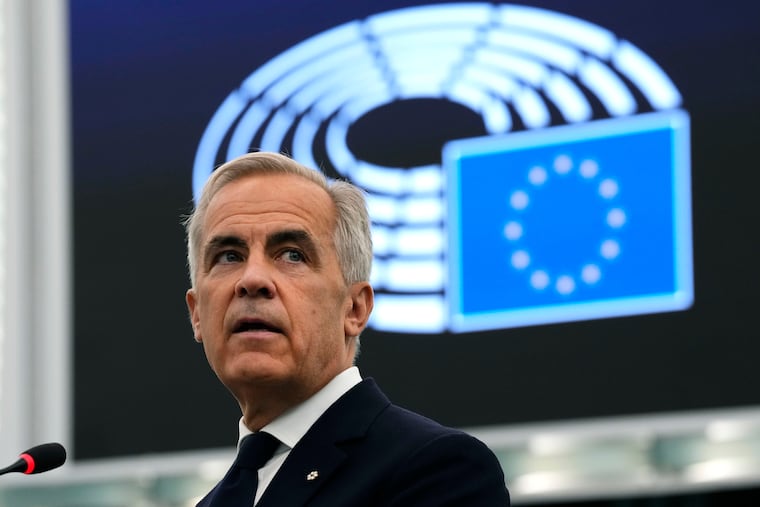
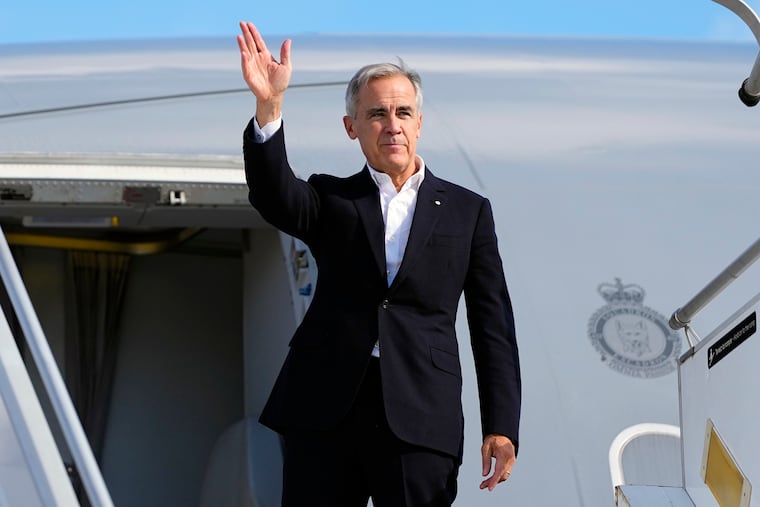
STRASBOURG, France — Canada’s newly proposed associate membership in the European Union will help to secure sovereignty and freedom for the country amid a “ferocious storm,” Prime Minister Mark Carney told the European Parliament on Thursday, adding that the move would also make his nation a better partner for the United States.
President Donald Trump, reacting Wednesday to the potential alliance between Ottawa and Brussels, said the move could be perceived as “a hostile act.”
“If it’s a bad intention, we’ll put very heavy tariffs on Europe,” he added.
Carney countered on Thursday. “This alliance is a positive process. That’s my response to the American president. It’s a positive thing,” he told reporters after his European Parliament speech.
“A stronger, more resilient Canada will be a more effective partner with the United States — same with the European Union,” he added.
Carney said the associate membership outlined by European Commission President Ursula von der Leyen on Wednesday would strengthen core areas of life on both sides of the Atlantic.
The push for closer links comes amid a historic low for U.S. ties with Canada and turbulence in the relationship between Washington and the European Union as Trump has upended traditional American alliances.
Carney said Canada and the European Union were not looking to become another superpower.
“I am not proposing a third bloc in order to become a great-power rival only with better manners,” he said during his speech to European lawmakers in Strasbourg, France. “We do not seek power to dominate others,” he added.
Associate membership for Canada in the European Union could be the closest linkup the bloc of 27 nations has with a nonmember state. The move highlighted a deep desire of traditional American allies to seek stability by banding together as Trump remakes the U.S. role in the world.
Carney suggested that Europe and Canada were seeking to band together “so that no one can control our open markets, impair our sovereignty, threaten our territorial integrity or undermine our freedoms, our democracies, our rule of law.”
Trump has instigated a trade war against Canada, the United States’ closest ally and second-largest trading partner, and routinely said he wanted the northern neighbor to become the 51st state. He has also pulled the United States away from the traditional close alliance with the European Union, imposing tariffs and barriers to trade, and he has weakened the NATO defense pact by threatening to drastically cut the U.S. contribution.
Carney did not mention the United States or Trump by name during his speech in Strasbourg, but he made clear allusions.
“Economic integration is now being used as a weapon, and tariffs as a means of leverage,” he said. “Financial mechanisms are employed for coercion. Supply chains represent vulnerabilities to be exploited.”
Carney said youth from both Canada and the European Union should be able to travel and study in each other’s territories through participation in the bloc’s student mobility program, Erasmus. That program is credited with building generations of young Europeans with joint identities and shared experiences.
Canada would most likely need to contribute financially to participate in Erasmus, as well as in any other EU programs the country might join, though the fine print of how the alliance would work has not yet been discussed.
Carney’s vision for how the European Union and Canada could work together also extended to major, foundational parts of their economies and society. He said the two should launch a “deep cooperation in the full range of strategic capabilities,” including industries involving critical minerals, defense, artificial intelligence and computing, and energy security. He also suggested that the bloc and Canada could work on managing payment systems.
Control over services such as payment mechanisms has been worrying policymakers in the European Union and Canada because many of those services are controlled by the United States or by American companies. That concern is front and center as the debate grows about the future of AI.
“Technology is transforming the nature of warfare, the structure of economies and the capacity of states to govern,” Carney said.
He also took aim at online platforms, of which the largest are American.
“Tech platforms aspire to sovereignty,” he said. “They seek to set the terms of access. They want to dictate regulatory rules — or even bypass them.”
“They want to control our data, spread disinformation and steal our children’s childhood,” he added.
Carney noted that Canada was endowed with major critical mineral and energy resources, which the country wanted to export to markets in the European Union. The two already have agreements in place for such collaboration. This year, Canada secured a major contract to sell liquefied natural gas to Germany.
The exact shape of the alliance between Canada and the European Union has been unclear because there is no formal or legal framework for an “associate member” of the bloc.
In Canada, the conservative opposition has raised concerns that an alliance might encroach on the country’s sovereignty. In Europe, officials from EU member states worry that the label could antagonize other countries with deep ties to the bloc, such as Britain and Norway, as well as those that are in the arduous process of becoming full members, such as Albania.
In his address, Carney touched on those issues, saying, “Canada is not in a position or seeking to become a full member of the European Union.”
“The precise nomenclature is a question for Europe,” he added.
Carney noted that the Canadian Parliament, which reconvenes next week after the summer recess, would get a chance to debate the future EU-Canada relationship and put the proposal to a vote.
During his speech, Carney made extensive references to the deep historical bonds between Europe and Canada, framing the new cooperation as existential. He was frequently interrupted by applause from members of the European Parliament as he harked back to past battles they had fought together.
“Freedom and life must be earned every single day,” Carney said. “Every day. Not once in 1945 or 1956 or 1989. Every day, including this one.”
The lawmakers, with the exception of many from far-right parties, gave him a lengthy standing ovation.