Clocks fall back Sunday in Philly. Standard time won’t last longer until 2099.
The shift from daylight saving time to standard time in the fall isn't wholly popular, but health experts say it prevents “circadian misalignment."
Two spectacular weeks have routed the carb-craving chill and the ocean-roar winds of early October, but this weekend we get a potent reminder from a wholly unnatural source that the seasons are in transition.
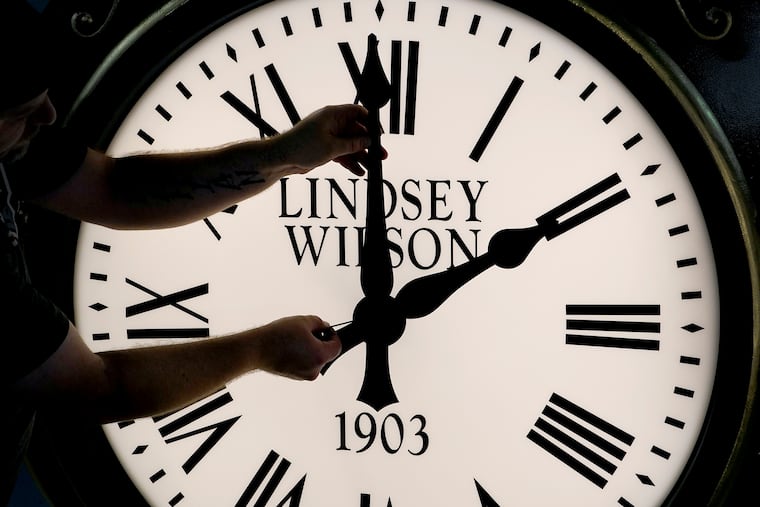
On Sunday, what would have been 2 a.m. Eastern Daylight Saving Time will become 1 a.m. Eastern Standard Time as we gain an hour during a precious 49-hour weekend.
This installment of the twice-a-year clock-change ritual is notable: It will be the longest stretch of the misnamed “standard time” in 20 years, with none longer until the very end of the century, congressional inertia permitting.
The change is not wholly popular, and if those earlier sunsets were on the ballot Tuesday, they probably would get trounced. But a phalanx of health experts argue that standard time is better for us. We should embrace the switch as a way to prevent “circadian misalignment,” says Robert Satriale, a Temple Health sleep-medicine specialist.
He and others advise getting out in the oblique morning sun as it transforms the lingering leaves to stained glass, and makes giants out of our shadows.
Here is a look at what we can expect before daylight “saving” — actually “shifting” — time resumes in March.
El Niño will be even bigger than LeBron
While seasonal forecasts speak to the limitations of scientists and their ever-evolving machines, one thing is certain.
The El Niño warming in the equatorial Pacific and its effects on upper-air winds from the west will influence Philly’s weather through the winter. Sea surface temperatures were running a near-record 4.5 degrees above normal in a key El Niño zone as of Monday.
The consensus is that El Niño will energize storms, some of which could become snow-producing nor’easters, should cold air be available. Buzz about an early invasion of the “polar vortex” already is in the air in the atmospheric science community.
Regardless, based on the behavior of other winters coinciding with strong El Niños, this will be an eventful winter — snow (a blizzard in the winter of 1982-83, a 2-footer in 2015-16) or no (nothing in 1972-73, 0.8 inches in 1997-98).
» READ MORE: Snow totals are up in the air, but forecasters say to expect a mighty strange winter in Philly
When can Philly expect its first measurable snow?
Measurable snow has occurred as early as Oct. 10 in Philly (1979), and as late as never (see above).
Philly’s first snow on average has arrived during the second week of December.
For what they are worth, the consensus outlooks are calling for a mild December. And for what it’s worth, December 1982 was quite warm and dry, but a half foot of snow fell on Dec. 11-12.
When might Philly get its first official freeze?
As is the case with the first snow, Philly’s first freeze, defined as the temperature dropping to 32 degrees at the freeze-resistant Philadelphia International Airport, is a movable feast.
The first freeze has occurred as early as Oct. 5, in 1961, and late as Dec. 11, in 1939.
In the period of record dating to the 1870s, the median date is Nov. 8, according to an Inquirer analysis. But in the last five years, it has not happened before Nov. 11, and not until Nov. 30 in 2022.
Be thankful for the moon ...
Meteorologists would be within their rights to envy astronomers, who do not have to fret about U.S. and European forecast models getting into snits over whether it’s going to snow.
Astronomers can say with certainty that the moon will reach its instant of fullness on Thanksgiving and that it will be a “supermoon,” looking big and sassy — about 15% brighter than October’s full moon — as it makes one of its closer approaches of the year.
Root for the trees to retain some of their yellow leaves: In the moonlight, they could be mistaken for spring blossoms.
... and for the shooting stars
The Perseids are the most popular meteor showers of the year, but the Geminids outshower them, and often offer better viewing conditions.
The gap in popularity is largely a matter of degrees, about 40 of them or more: The Perseids peak in mid-August, the Geminids in mid-December.
The latter will be visible from Dec. 4 to 17, according to NASA, peaking on the 13th into the 14th. The peak period begins around 9 or 10 p.m., hours earlier than the Perseids.
That erstwhile supermoon will be a mere crescent and in bed by 9 p.m. on the 13th, and December skies tend to have less of that veiling water vapor common in August.
You will want to get as far away from urban lighting as possible, which is becoming ever more challenging. In a truly dark sky light on water vapor, as many as 50 or more an hour may be visible.
And one more rock-solid forecast
Book it: We will be moving up the clocks on March 14, 2027. By law, standard time begins the first Sunday in November (Nov. 1 this year) and ends the second Sunday in March (the 14th next year). The standard-time interval won’t be longer until the 134-day period that begins Nov. 1, 2099, and ends March 14, 2100, a leap year.
For those wishing for year-round daylight saving time, you’ll have to settle for two-thirds of the year. Across the country, state lawmakers have introduced more than 800 time-change bills since 2005, according to the National Conference of State Legislatures.
States cannot opt for year-round daylight saving time unless Congress gives them the option, They can approve year-round standard, but those bills have not gone anywhere.
Satriale, a member of the American Academy of Sleep Medicine, would vote for standard time, which the academy argues is more in tune with bodily rhythms. That so-called circadian misalignment resulting from the March move-up “really affects your immune system,” Satriale said. When darkness occurs earlier, he said, “we get better quality of sleep.”
The clocks notwithstanding, therapist Tonya Ladipo, founder of the Ladipo counseling service, advises that one of the best drugs in the universe rises in the east every morning. She recommends getting outside “to access the natural vitamin D.”
The sun doesn’t take off on cloudy days, and doesn’t particularly care about the time.