U.S. military says it disabled another ship that tried to breach naval blockade on Iranian ports
The Pacific Archer is at least the 15th disclosed vessel to be disabled by the U.S. military since the blockade began in the spring and the sixth since it resumed this summer.
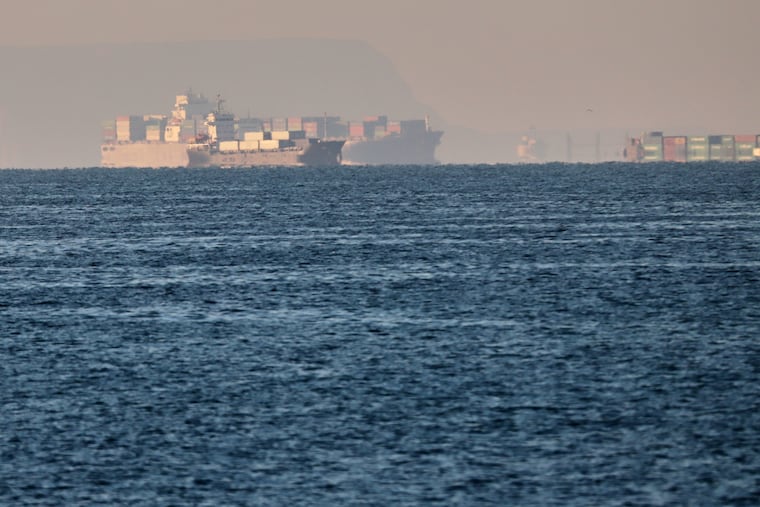
WASHINGTON — The U.S. military has disabled a merchant ship in the Gulf of Oman that was trying to run its blockade of Iranian ports, U.S. Central Command said Friday.
A military aircraft fired “precision munitions” at the stern of the Palau-flagged M/V Pacific Archer on Thursday, and the “ship’s propulsion was ultimately disabled and the civilian crew was unharmed,” it said in a statement.
According to U.S. Central Command, the Pacific Archer left the Iranian port of Bandar Abbas before it attempted to run the blockade. Ship tracking websites list the vessel’s destination as Singapore.
The strike comes as the Trump administration weighs its options in the long-simmering war with Iran, which began at the end of February and has settled into a quiet stalemate in the past several months.
Earlier in November, officials in the region told the Associated Press that Israeli Prime Minister Benjamin Netanyahu was pushing the U.S. to restart the war or allow Israel to launch airstrikes on Iran’s nuclear facilities and missile capabilities.
Meanwhile, government and security officials from the Persian Gulf countries, as well as Pakistan and Turkey, were engaged in a diplomatic campaign, which included phone calls with senior U.S. officials, to stave off a renewed war in the region.
President Donald Trump has oscillated between threatening additional large-scale strikes on Iran and insisting that the war “militarily is effectively over.”
The U.S. military has maintained a sizable naval force in the region, including a constant presence of two aircraft carriers and a host of other ships.
The U.S. has been blockading Iranian ports since April, though the blockade was lifted in the summer during talks with Tehran and resumed in July. Since then, the U.S. military says it has redirected 158 merchant ships and disabled those that refuse to comply.
The Pacific Archer is at least the 15th disclosed vessel to be disabled by the U.S. military since the blockade began in the spring and the sixth since it resumed this summer. The previous vessel was disabled on Nov. 7.
In June, the practice drew condemnation when a military strike on a Guinea-Bissau-flagged tanker attempting to evade the American blockade resulted in three deaths.
Three Indian sailors were killed when American forces struck the Palau-flagged M/T Settebello, officials in India said at the time. The leader of the International Maritime Organization, a United Nations agency, condemned the attack.
U.S. Central Command has consistently said that American forces issue multiple warnings before firing on the merchant ships.
Iran’s Revolutionary Guard said on Friday that two tankers attempted to transit the Strait of Hormuz through an “unauthorized” route, claiming that one of them struck a naval mine while the other was forced to turn back.
The claims could not be independently verified.
In a statement carried by Iran’s state broadcaster, the country’s Revolutionary Guard also said the number of oil tankers attempting to transit through unauthorized routes in the critical waterway has sharply decreased in recent days.
Iran continues to warn ships not to pass through the strategic shipping lane without approval from Tehran.
Oil flows in the first two weeks of November fell by around 20% to around 13 million barrels per day compared with October, when exports roughly equaled the prewar amounts of 15-16 million barrels per day, according to Rystad Energy.
Reasons for the November decline include Iranian attacks that discourage tankers from attempting the strait crossing and reduced flows through a key Saudi pipeline to the Red Sea port of Yanbu, which has also been attacked several times.
A report by U.N. Trade and Development finds that disruptions in the Strait of Hormuz, the Red Sea, the Black Sea, and the Panama Canal are lengthening voyages, raising fuel costs, driving port congestion, and adding to uncertainty. Alternative ports, inland transport, and logistics arrangements have kept trade moving, but at a higher cost.