Trump hands victories to Putin, who offers more war in return
With the American president focused on trying to bring down fuel prices before a difficult midterm election, he is pushing Kyiv to trade away its leverage for nothing in return.
BERLIN — The wins for Russian President Vladimir Putin came in rapid succession from Washington.
President Donald Trump proffered sanctions relief for Russian diesel fuel. He publicly called for Ukraine to get a new leader. And he pressured Kyiv to stop a strike campaign against Russian oil facilities that has damaged the Russian economy.
Putin, in return, offered more war.
Minutes after Trump announced the diesel deal, the Kremlin reiterated Putin’s stance that he would not negotiate with Ukraine at the moment, because he remained angry about Ukrainian strikes during last month’s Russian parliamentary election.
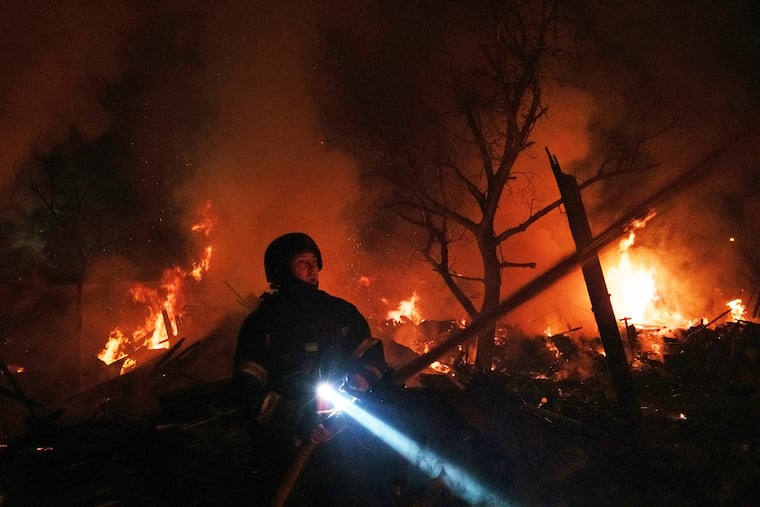
The next day, Russia launched an attack on the Ukrainian city of Zaporizhzhia that killed 22 people, including four children. It was the latest in a near daily drumbeat of devastating Russian strikes, which have dramatically increased the civilian toll in Ukraine as Kyiv sorely lacks air-defense missiles.
And Putin has signaled that he plans to escalate further, aiming to knock out Ukraine’s power and water infrastructure in what Ukrainians expect to be the worst winter of the war.
Putin is reaping his victories as Trump’s own domestic political needs align with his long-standing inclination to tip the scales toward Russia. With the American president focused on trying to bring down fuel prices before a difficult midterm election, he is pushing Kyiv to trade away its leverage for nothing in return.
Ukraine has said it would suspend its oil refinery strikes if Russia ceased attacks on Ukrainian energy facilities heading into the winter. But when Trump announced an “energy ceasefire” Sunday, he meant only a suspension of oil refinery strikes in both countries, the New York Times reported. Ukraine has only one major oil refinery, and Russian strikes took it largely out of service in 2022.
Trump has promoted his energy deal with Putin as an example of how he is tackling the United States’ diesel challenge, which experts say is more attributable to the war with Iran. But it was seen as a betrayal by Ukrainian officials, undercutting years of Western efforts to starve the Russian war machine of cash.
It may not even do much to lower diesel prices. Economists have said the amount of fuel discussed is not enough to move the needle significantly.
“The U.S. president is focused on one thing, which is himself and his reading of the world,” said Alexander Gabuev, director of the Carnegie Russia Eurasia Center.
That reading, Gabuev said, includes Trump’s stubborn denial that his own decision to go to war against Iran caused fuel prices to skyrocket.
“In his picture of the world, the Gulf war doesn’t play a role in the current diesel crisis, and there needs to be a magical solution with someone he is predisposed to, who is Vladimir Putin.”
Earlier this year, things were looking difficult for Putin. Expenditures on the war were rapidly expanding. Progress on the battlefield had slowed to a crawl. Global prices for oil, Russia’s top export, had slumped to around $60 a barrel.
Then Trump launched the war in Iran, alongside Israel. Oil prices jumped to more than $100 a barrel. The vast use of air defense missiles by the United States and its Gulf allies in response to Iran’s attacks dried up the supply for Ukraine, leaving it increasingly vulnerable. With Trump looking for a way out, Russia’s long-standing relationship with Iran offered Putin a new calling card with Washington.
As the Iran war accorded benefits to Russia, Ukraine tried to limit Moscow’s economic gains with increasingly effective strikes on oil refineries — the campaign that Trump is now demanding that Kyiv end.
Kyiv’s systematic targeting of Russian oil infrastructure brought the war home to Russia as never before, causing lines at the pump across the country and forcing Russia, one of the world’s largest diesel suppliers, to suspend exports.
As Ukrainian strikes decreased production, Russia’s tax revenue from oil and gas for the first three quarters of the year fell by 17% compared with the same period in 2025, even as fuel prices rose dramatically.
Now, the diesel deal could pour billions of dollars into the Russian economy. An extended suspension of Ukrainian strikes on oil refineries, if Kyiv agrees to one under the intense American pressure, could generate much more money.
The wins for Putin go beyond the diesel deal. Trump has also welcomed Russian ministers this year for Group of 20 events in North Carolina and Wisconsin, and he plans to host Putin in December at the G20 summit in Miami. His administration is also negotiating potential business deals with the Kremlin, in what Trump’s team has cast as inducements to a peace deal.
The Russians want even more from the U.S. president, analysts say.
When Trump returned to office in 2025, Moscow hoped that the United States would cut off all support for Ukraine and force President Volodymyr Zelensky into a capitulation largely on the Kremlin’s terms.
Trump’s Oval Office blowup with Zelensky in March 2025 made it seem as if Moscow’s dream was within reach. The Trump administration’s decision to halt weapons donations to Ukraine and suspend intelligence sharing stoked hopes even further.
But in the months since, U.S. intelligence sharing resumed. Trump brokered a deal for the Europeans to buy weapons from the United States for Ukraine. And U.S.-led peace negotiations fizzled as the Trump administration became distracted by the war in Iran.
Fyodor Lukyanov, a Russian political scientist who advises the Kremlin, wrote last month that Ukraine would be left with little defense if the United States completely ceased its military support.
“But Trump is unlikely to take that step,” Lukyanov wrote, “even if he were personally inclined to do so,” because a complete Ukrainian defeat would not win him any plaudits in the American political establishment.
Such a move by Trump might also invite more aggressive actions from Congress, particularly after the midterms. The Senate recently passed a Russia sanctions bill, named in honor of Sen. Lindsey Graham of South Carolina, with a veto-proof margin, though Trump retains the power to waive its provisions on national security grounds and will need to do so to import Russian diesel.
As Trump so far stops short of forcing Ukraine into a surrender, Putin is likely to continue his escalation, said Hanna Notte, an analyst at the James Martin Center for Nonproliferation Studies and the author of a new book on Russian foreign policy called We Will Outlast Them.
She said of Putin, “It’s quite clear that his intention right now is to inflict a really, really nasty winter on the Ukrainians.”
Although Russian forces remain largely stuck on the battlefield, Putin has long believed that he can achieve victory in Ukraine by outlasting Kyiv and what he sees as its fickle Western allies, analysts say. He believes they will eventually pull back their extensive support of Ukraine as their own domestic problems mount, analysts say.
The French presidential election next year could usher in far-right leader Marine Le Pen, who has advocated halting financial assistance to Ukraine. Chancellor Friedrich Merz of Germany is also under pressure from a surging far-right party that has pressed for ending support for Ukraine. And both Britain and France are struggling under huge government debts that are far more expensive to service at current interest rates.
“You could make the case that from the Kremlin’s perspective, the future looks better, more conducive to an outcome of the war that is closer to their terms,” said Sam Charap, a Russia analyst at the Rand Corp. “You have to change that perception of the future, diminish that optimism, to affect their calculus.”
This article originally appeared in the New York Times.