Cousin of a Raymond Horsch victim criticizes police for sharing graphic details at news conference before telling family
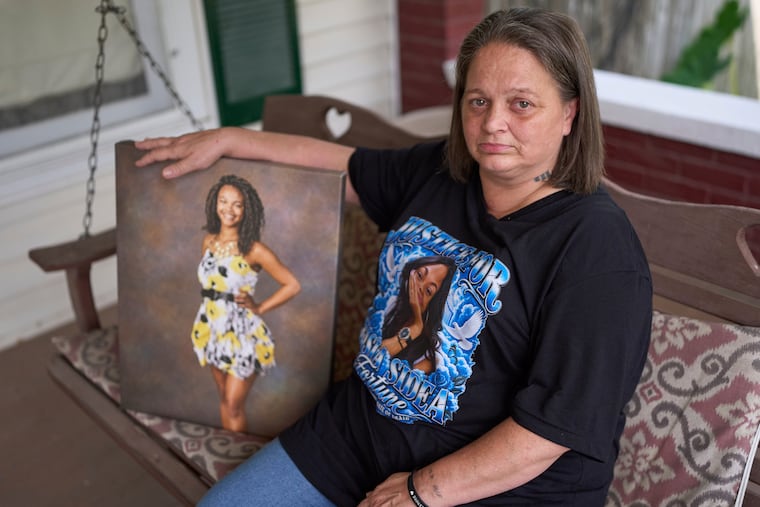
The cousin of Nicole Fusaro said he was disturbed by the level of detail police shared at the news conference with the public — but not in private with his family.

Jonathan Halloran-Koren said he watched with horror as Philadelphia police brass described the graphic details of his cousin Nicole Fusaro’s killing during a Wednesday news conference.
Deputy Police Commissioner Frank Vanore said investigators recovered videos that show Raymond “R.C.” Horsch giving her drugs and money, then handcuffing her to a bed. Horsch, naked and holding a camera, with another mounted in the corner of the room, then used pliers to put a zip tie around the woman’s neck until she fell unconscious, Vanore said.
None of this, Halloran-Koren said, had been shared when he and his mother had met with homicide detectives about her case just four hours earlier. All they were told, he said, was that Horsch had filmed himself strangling her.
“I didn’t need to know that. The public didn’t need to know that,” Halloran-Koren said of the details shared in the news conference. “I’ve seen some really graphic and horrible things in my life, but to turn around and hear how my cousin died in a press conference, all I could feel was deep sadness, sorrow, and rage.”
On Thursday, Halloran-Koren, a security consultant, sent a letter to Mayor Cherelle L. Parker and members of City Council, calling the action of city police officials “appalling.”
Sgt. Eric Gripp, a spokesperson for the police department, said detectives traveled to northern New Jersey to speak with the family members ahead of the news conference Wednesday, though he declined to discuss the details of a private conversation.
The department did not name Fusaro during the news conference, in deference to other relatives.
“Our deepest sympathy remains with every family whose loved one may be connected to this extraordinarily complex and deeply troubling investigation,” Gripp said, and police will “pursue every lead, work to locate the missing women, and provide verified information to their families as responsibly and compassionately as possible.”
Joe Grace, a spokesperson for the mayor’s office, referred questions to the police department.
Fusaro’s case is part of a sprawling local and federal investigation into the drug, sex, and porn operation Horsch ran out of his home on West Chew Avenue in Olney. Police now say Horsch, who died last year at 82 from lung disease, is linked to seven dead or missing women.
While sifting through more than a million photos and videos recovered on Horsch’s hard drives, police said, investigators have recovered footage that appeared to show five women lifeless, including Fusaro, Maribel Fresses, and Gabrielle Amarando. There are also two unnamed women: a 25-year-old whose identity relatives asked to remain private, and a woman in her mid-20s investigators are still working to identify.
Two other women — Blair Tonzelli, reported missing in 2023, and Amy McHale, Horsch’s ex-wife, who disappeared in 2016 — were also reportedly last seen at the Olney home, which Horsch shared with his son, Eugene. The younger Horsch is in prison on federal charges stemming from his June 19 arrest after a car stop near Independence Hall. In the car, a federal park ranger found a fake ID with Tonzelli’s name, which launched the investigation.
Fusaro, 27, was last seen in Kensington on July 19, 2018. Her mother, Diane, spent years searching the streets for her only child before she died in January 2020. Fusaro’s father, Thomas, died in 2009.
Halloran-Koren had fallen out of touch with his family after years living overseas, but reconnected with them in 2020 and learned his cousin was missing, he said. He started working with friends of his aunt and cousin to try to find her.
In 2024, he said, he filed a report with the National Missing and Unidentified Persons System, and Fusaro’s information was later entered into the national database.
In August, after police identified Fusaro as the woman Horsch appeared to have killed, detectives met with one of Fusaro’s paternal relatives to notify them of the discovery. The relative, who declined to speak with an Inquirer reporter, asked police not to publicly release her name.
Several weeks later, that relative told Halloran-Koren what police had told him: that they believed his cousin was dead. Halloran-Koren, a cousin on Fusaro’s mother’s side, then identified her publicly because he said he wanted her story to be known.
“Nicole deserved to have people fighting for her when she was missing. She deserves people fighting for her now,” he said. “I will make sure that happens.”
Halloran-Koren later contacted city police and requested additional information. Detectives scheduled a meeting with him and his mother on Sept. 16 to formally notify them of her likely death.
He learned more, he said, from watching his television several hours later.
In his letter to Parker and Council members on Thursday, Halloran-Koren said he understood the police department had “an obligation to provide information to the public and answer legitimate questions from the press.”
“But there is an enormous difference between legitimate public disclosure and providing a victim’s family with less information about their loved one’s death than is subsequently provided to the public only hours later,” he said.
He said he hopes to review the department’s handling of the case, and whether police violated any laws or internal policies in their communication with his family.
“Our family deserved better,” he wrote. “Nicole deserved better.”

The Inquirer’s journalism is supported, in part, by the Lenfest Institute for Journalism and readers like you. News and editorial content are created independently of The Inquirer’s donors. Gifts to support The Inquirer’s high-impact journalism can be made at inquirer.com/donate. A list of Lenfest Institute donors can be found at lenfestinstitute.org/supporters.