This Philly educator earned a national rep. He’s proudest of the students he inspired to be teachers.
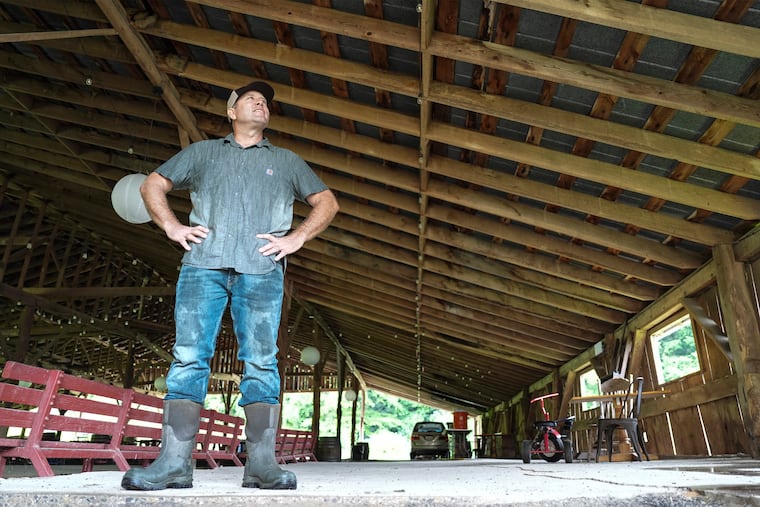
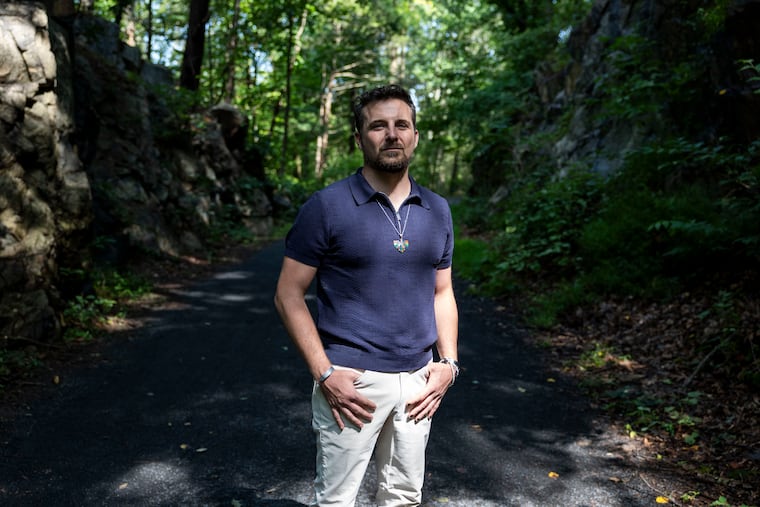
“We’ve got to invite young people into the profession,” said Sharif El-Mekki, a longtime Philly teacher and principal, now the founder and CEO of the Center for Black Educator Development.
This is a big month for Sharif El-Mekki. Philadelphia is naming a street after him, and a conference he conceived will draw over 1,500 people to the city to discuss issues that have put him on a national educational stage.
That’s all great, said El-Mekki, founder and CEO of the Center for Black Educator Development. But he keeps coming back to what really matters to him the most.
“We’ve got to invite young people into the profession,” El-Mekki said.
His invitations have worked.
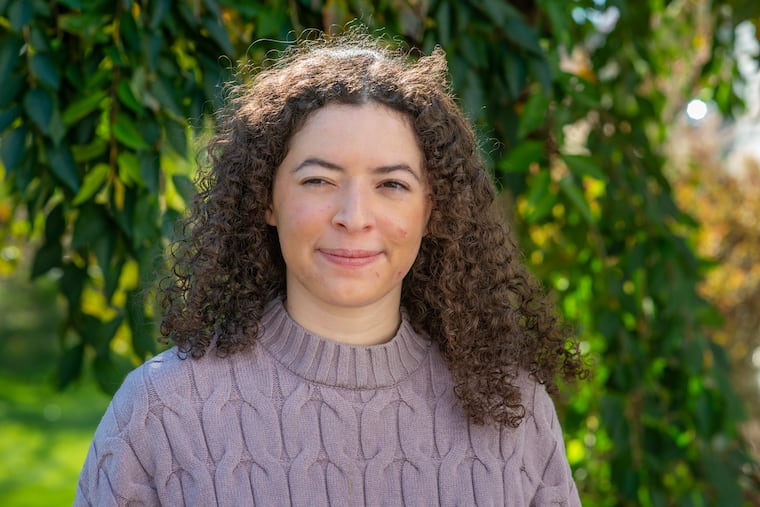
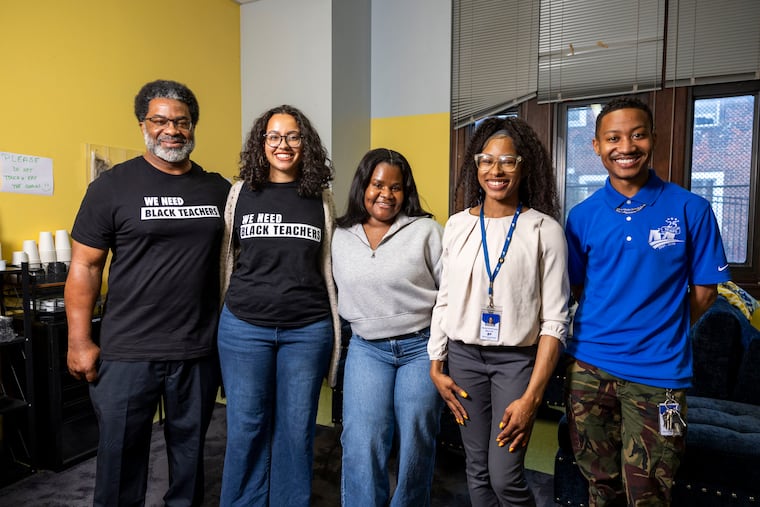
Makiah Burroughs, a first-grade teacher at Mastery Charter-Mann Elementary, loved the idea of becoming a teacher from the time she was a young child. But people kept discouraging her.
“They would say, ‘Makiah, you’re so smart, why don’t you be a doctor, a nurse.’ Teaching is not the most lucrative career path, and everyone’s trying to make it out the ‘hood to make the most money. But they’re not thinking about the impact you can make as a teacher,” said Burroughs, a 2020 Mastery Shoemaker high school graduate.
Burroughs vividly remembers when she was a Shoemaker 12th grader, completing her senior project about education.
“El-Mekki looked at me, and he was proud,” Burroughs said. “That’s the first time someone was excited when I said I wanted to be a teacher.”
The path to the work
El-Mekki didn’t grow up imagining a career in education. He graduated from Overbrook High School and Indiana University of Pennsylvania with a criminal justice degree.
After El-Mekki survived being shot while playing a pickup football game in the city, his career plans moved away from becoming a lawyer. He started working with young people like his shooter, who lacked opportunities and struggled with anger issues. El-Mekki became a counselor, got a teaching degree, and worked as a teacher and principal at Turner Middle School, Shaw Middle School, then Mastery Shoemaker.
He became a U.S. Department of Education principal fellow, and built a national reputation. He started an organization that eventually became the Center for Black Educator Development, focusing on diversifying the teacher pipeline in myriad ways.
The organization offers a fellowship that provides up to $40,000 for students who pursue teaching and stay in the profession for five years. It offers summer programs that work as training grounds for teachers of color and a year-round career and technical education course for high school students interested in teaching. And it runs the annual Black Men in Education Convening, which draws over 1,500 diverse educators to Philadelphia every November.
The work matters, research shows.
Having a diverse teaching force benefits all students, but particularly Black students, who are less likely to have educational and opportunity gaps when taught by Black teachers. Black students taught by just one Black teacher in the early grades are 13% more likely to graduate from high school, and 19% more likely to attend college. Having two Black teachers makes it 32% more likely they will attend college.
But 40% of all U.S. schools have no Black teachers at all. Many Black students around the country will go through 13 years of school without a single Black teacher.
Philadelphia’s teaching force is more diverse than most of the country, but still lacks in representation. About half of the Philadelphia School District student body is Black; a quarter of its teaching force is Black.
The teachers influenced by El-Mekki know that intrinsically. Shadae Hamilton, a 2019 Mastery Shoemaker graduate who now teaches Algebra I at her alma mater, “came back because of El-Mekki and the teachers who had that impact for me. I want to be that for my students.”
The students become the teachers
At a recent informal gathering of El-Mekki-inspired educators, the conversation was easy. It was about their students and their journeys to the classroom. It was about doing for others what El-Mekki and impactful teachers did for them.
If you asked Rasheen Hill what his future held when he was a student at Mastery Shoemaker, he’d tell you he wanted to go into business.
“I liked that businesspeople wore suits,” he said.
But even with degrees in management and in human resources, Hill felt an itch to mentor. He realized how impactful the adults at his schools were to him, even when he got in trouble for talking too much in class or not putting his full effort into assignments.
“There was a sense of pride and integrity that they instilled in us at such a young age,” said Hill. “They tapped into our community, they cared about us.”
Hill ran into his former dean, who told Hill: I think you’d be good as a dean.
That’s just what he’s doing now, working as dean at Mastery Prep Elementary.
“People poured into me, no how much I got sent to a dean’s office for talking,” said Hill. “It definitely makes the job easier, being able to relate to my students. I say, ‘It’s OK to mess up, but we’re not going to continue to mess up.’ El-Mekki had this lasting image on us, and it runs through us to pour back into our students.”
Tiera Sedden, a 2011 Mastery Shoemaker graduate now working as an assistant principal in Washington, D.C., and working on her doctorate, said like those who taught her, she’s focused on moving both her students and her employees forward.
“I’m always thinking, ‘How am I equipping you to take my place?’” Sedden said. “There is always room for everybody to grow, and everybody to win. Ultimately, I have not done my job if I haven’t helped develop someone to replace me when I’m gone.”
Dear Fatima
El-Mekki’s pride in his students now working in education was evident in a recent blog post he wrote to Fatima Ponzo, a former Shoemaker alum now in her own seventh-grade math and science classroom in Philadelphia.
Ponzo wrote to El-Mekki asking for advice as she started her school year. His message back to her and the dozens of his former students whose trajectories led them into classrooms of their own, encapsulates his why.
“We’ve been passing your news around like proud grandparents — your deans, your coaches, the teachers who wrote your recommendation letters,” El-Mekki wrote. “You were leaders in our classrooms long before anyone handed you a roster or a caseload, and now your students get what we got.”
Content knowledge matters deeply, El-Mekki told Ponzo and her peers, but that’s not everything. Relationships matter more. He urged them to find mentors, enmesh themselves in their students’ community, and avoid outside battles that bring them down. He told them to tend to their joy and stay in the profession, even through the rocky first years.
“Teaching is how a people builds itself, generation by generation,” El-Mekki wrote. “When you stand in front of those seventh graders, you are not just delivering math and science. You are shaping the adults who will raise the children who will inherit whatever we leave behind. You teach the child in front of you, and you teach that child’s grandchildren. That has always been the assignment.”