Repaired pipeline resumes service as jet fuel cleanup continues in Upper Merion
The spill occurred Thursday when a third-party contractor working for Peco ruptured Energy Transfer's 14-inch Twin Oaks line.
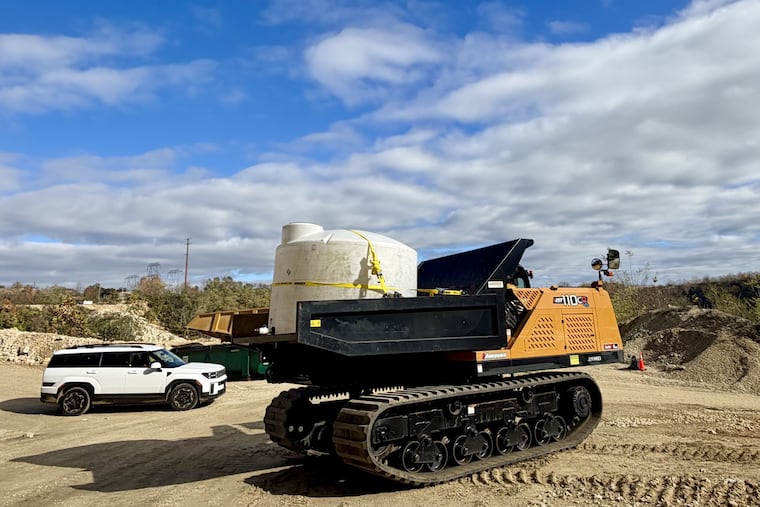
A ruptured pipeline that spilled 60,000 gallons of jet fuel last week in Upper Merion is back in service, though some cleanup continues.
The pipe has been repaired, and the federal Pipeline and Hazardous Materials Safety Administration (PHMSA) approved refilling it for service.
That’s according to a statement issued Monday by a joint command that includes the U.S. Environmental Protection Agency (EPA), the Pennsylvania Department of Environmental Protection (DEP), and pipeline owner Energy Transfer.
The spill occurred Thursday when a third-party contractor working for Peco ruptured the 14-inch Twin Oaks pipeline.
The fuel leaked near Colbert and River Roads in the township’s Bridgeport section adjacent to the Schuylkill and into a quarry owned by Glasgow Inc.
No one was injured, and no one was evacuated, but the pipeline was shut down. Cleanup began Friday.
» READ MORE: Peco contractor strikes jet fuel pipeline, causing 60,000-gallon spill in Upper Merion
Energy Transfer said in a statement Friday that it had “mobilized the appropriate personnel and equipment for the cleanup and restoration of the area, which is underway.”
Over the weekend, crews used vacuum trucks to transfer fuel and water from critical areas into temporary holding tanks. The mixture was taken to be processed for reuse, according to the joint command’s statement.
Responders also used long tubes and absorbent pads to contain and soak up the fuel from paved surfaces, stormwater ponds, and affected ground.
The absorbed mixture was taken for testing and disposal that meets state and federal standards, the statement said.
Responders used drones to track progress, assess conditions at the quarry, and inspect the Schuylkill.
For safety reasons, the continuing quarry cleanup is restricted to daylight hours.
Officials said monitoring wells in the quarry showed no detection of volatile organic compounds (VOCs), and the spill has caused no impact to the Schuylkill or public drinking water supplies. VOCs are gases that evaporate into the air and can be harmful, depending on the chemicals, concentration, and length of exposure.
The joint command also oversaw installation of an air monitoring network to track vapors, VOCs, and benzene, a component of fossil fuels that can be harmful and is linked to cancer.
The network contains 20 roving monitors placed in residential communities, 10 stationary monitors along the site fence line, and four specialized monitors in active work zones.
No elevated readings have been detected in the community or at the perimeter, officials said. But they noted wind shifts could produce odors of fuel.
Peco, whose third-party contractor struck the line, said Monday that its immediate goal was to support “Energy Transfer, EPA, and PA DEP as they lead remediation and recovery efforts.”
It further said that “safety is Peco’s highest priority, and we expect every contractor working on our behalf to meet rigorous standards for safety, quality, and performance.”
The company said it would provide any information required in support of an investigation and would “conduct a full and thorough review of the incident.”
IBEW Local 614, which represents some Peco workers, said it would press the utility “for full transparency and answers.”
The statement issued by the union’s president, Larry Anastasi, said, “Serious questions remain about the safety protocols, oversight, and partnership in place before and during the work.”
Anastasi asked, “Who was responsible for overseeing this contractor’s work, what safeguards were in place, and how did those safeguards fail to prevent a strike of this magnitude?”
Peco responded that it rejects any “suggestion that we would put schedules, cost, or any other consideration ahead of safety. Safety is our highest priority.”
The company said the contractor, which it did not name, was chosen for its expertise.