At a partially restored President’s House, Philly honored Ona Judge’s daring escape from slavery
Mayor Cherelle L. Parker signed an executive order designating May 21 "Ona Judge Day" on the 230th anniversary of Judge's daring escape from George and Martha Washington.
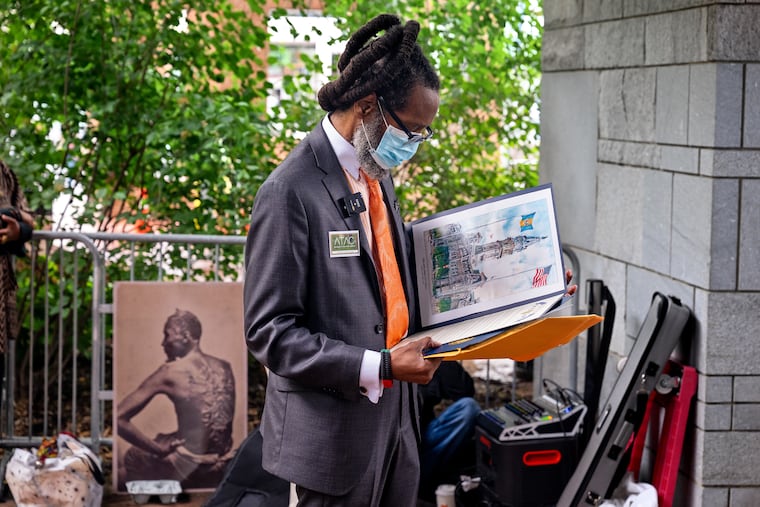
Michael Coard has been making a pilgrimage to the President’s House on Independence Mall on May 21 for more than two decades.
On that date 230 years ago, while George and Martha Washington were having dinner, Ona Judge escaped from slavery.
Coard and community members have been gathering yearly to commemorate Judge’s courage, and Thursday’s rain wasn’t enough to break the tradition.
There were some differences this year.
The President’s House site stands half-bare after President Donald Trump‘s administration abruptly removed the exhibit commemorating Judge and the eight other people enslaved by Washington in Philadelphia. The interpretive panels telling their stories, the “soul” of the exhibit, as Coard called them, are gone.
But the effort to educate Philadelphians about Judge’s epic journey got a boost from City Hall, as Mayor Cherelle L. Parker signed an executive order declaring May 21 “Ona Judge Day.”
The executive order follows a resolution designating the day in Judge’s honor that City Council adopted in April.
“Happy Ona Judge Day, y’all,” Councilmember Cindy Bass, who introduced the resolution, told the crowd at the President’s House on Thursday.
Designating the day was only the beginning, Bass said, emphasizing the importance of spreading the word about Judge’s courage, passion, and determination to younger generations.
Coard shared he was outraged when he learned, more than two decades ago, that George Washington enslaved nine people while living in Philadelphia.
The attorney was born and raised in Philadelphia. He attended Masterman High School and Cheyney University, and got his law degree from Ohio State.
“And despite getting this great education,” Coard said, “I never heard about slavery in Philadelphia at America’s first White House.”
He funneled his rage toward community organizing and advocating for a memorial for the people Washington enslaved — an effort that resulted in the President’s House exhibit and the annual gathering in Judge’s honor.
Outliving Washington
Judge was born into slavery in Mount Vernon, Washington’s Virginia plantation, around 1773.
As Martha Washington’s attendant, Judge spent time in Philadelphia with the first lady in the early 1790s. But she was rotated back to Mount Vernon every six months as part of George Washington’s scheme to evade Pennsylvania’s gradual abolition law.
In spring 1796, Judge learned Martha Washington planned to pass her on to the Washingtons’ eldest granddaughter as a wedding gift, according historians. The granddaughter was known for a “fierce temper.”
“Whilst they were packing up to go to Virginia, I was packing to go, I didn’t know where; for I knew that if I went back to Virginia, I should never get my liberty,” Judge said, according to the historians. “I had friends among the colored people of Philadelphia, had my things carried there beforehand, and left Washington’s house while they were eating dinner.”
Judge made her way to New Hampshire but she lived in fear because of Washington attempts to recapture her.
Washington was “relentless” and went to “great lengths” in his effort to return Judge, according to John Garrison Marks’ book Thy Will Be Done: George Washington’s Legacy of Slavery and the Fight for American Memory.
But Judge never returned to bondage, and lived as a free woman until 1848.
“She actually outlived George and Martha by 50 years,” Coard told the crowd. “Please shout out to Ona Judge for that.”
Attendees heard Judge’s story from four Science Leadership Academy at Beeber students, part of the effort to engage future generations.
Endangered historic site
The efforts to rewrite the President’s House history, and minimize the connection to slavery at the nation’s first executive mansion, put a spotlight on the type of work that Coard’s advocacy group, Avenging the Ancestors Coalition, has been doing for years.
Earlier this month, the National Trust for Historic Preservation included the President’s House on its “11 most endangered” list that aims to bring widespread awareness to historic sites in jeopardy.
“This place exemplifies that tension and also the threat of erasure, which comes when the government dictates what any site can say, but also when the process of freedom of inquiry is interrupted,” Carol Quillen, president and CEO of the National Trust for Historic Preservation, previously told The Inquirer.
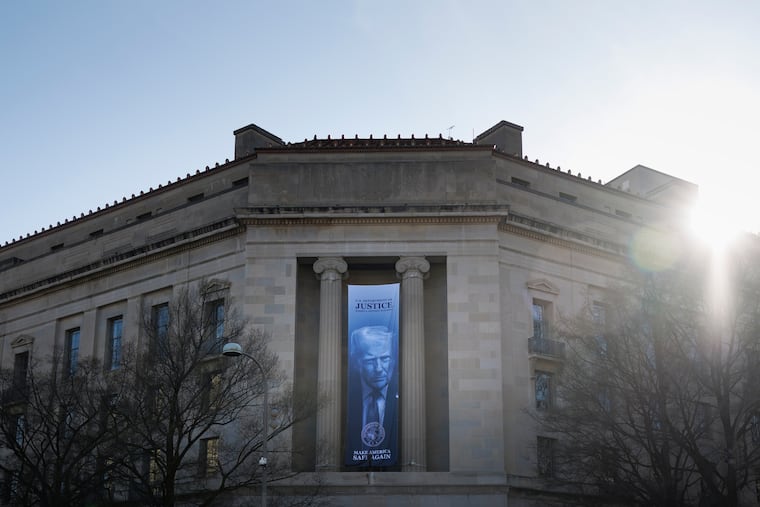
National Park Service staff in January abruptly dismantled the exhibits, in accordance with Trump’s 2025 executive order on “restoring truth and sanity to American history” that prohibited content that “inappropriately disparage Americans past or living.”
Philadelphia sued the administration, and in February a federal judge ordered the site to be fully restored. The administration began restoration, but appealed the injunction to the Third Circuit Court of Appeals. The higher court prohibited the government from making changes to the site but did not require the Parks Service to complete the restoration while litigation plays out. A hearing is scheduled for June 2.
“Last time I checked,” Coard said, “the truth doesn’t inappropriately disparage anyone.”