As Eagles know, fewer whistle stops now during NFL games | Early Birds
Why are NFL games lasting more than three hours? It has something to do with officiating.
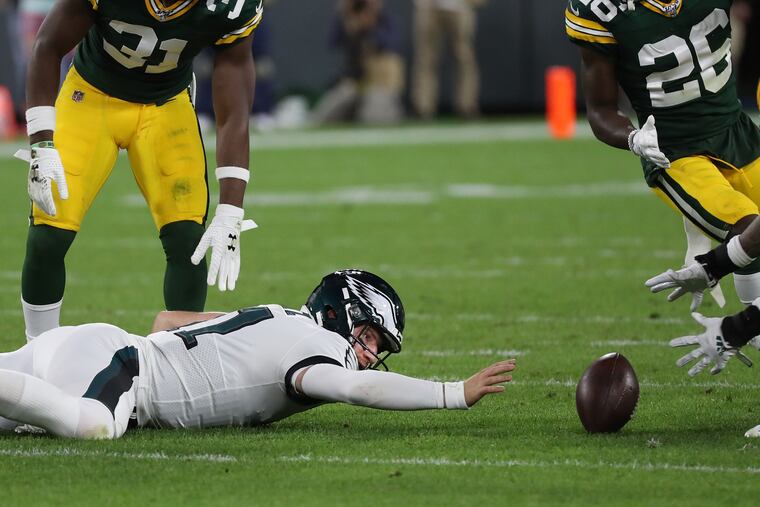
The Eagles-Packers game last week took 3 hours, 27 minutes to play, longer than all but two of Sunday’s 13 NFL contests. Part of the reason was the two awful interludes when stretchers came onto the field to carry off players — Green Bay’s Jamaal Williams, on the first play from scrimmage, and the Eagles’ Avonte Maddox, with just 1:06 remaining. But on an evening when the teams combined for 53 clock-eating rushing attempts, there was more to it than that.
Before we go into that, if you like what you’re reading, tell your friends it’s free to sign up here. I want to know what you think, what we should add, and what you want to read, so send me feedback by email or on Twitter @lesbowen.
— Les Bowen (earlybirds@inquirer.com)
It was worth Breeland’s while to keep going
One of the reasons the Eagles-Packers game took so long to play was the officiating. There were long discussions of penalties, and things the officials sometimes eventually decided weren’t penalties, such as the near-offensive pass interference call that would have negated Alshon Jeffery’s touchdown. And then there was the play midway through the second quarter. Carson Wentz got a first down on a quarterback sneak, but as he bounced on the Lambeau turf, he lost the ball. Green Bay’s Jaire Alexander picked it up and ran 52 yards to the end zone. Then he did the Lambeau Leap. Then all his teammates celebrated with him. Then the stadium crew set off fireworks.
One problem: There was no chance whatsoever that Alexander had scored a touchdown. It was obvious Wentz hit the ground, then fumbled. But the ruling on the field was fumble and touchdown. So we had to wait for video review to overrule this. Across the NFL, this approach was hailed, because earlier this season New Orleans lost a touchdown when the whistle blew erroneously on a turnover, killing a return. So now, apparently, we have to wait and watch people pick up dead balls and run around the field with them.
I have to admit, the whistle not blowing Sunday afternoon in the Kansas City-Detroit game showed why this absurdity might be a necessary evil. Detroit runner Kerryon Johnson tried to reach the ball out, well short of the goal line, as he went down. (Players need to stop doing this, in most instances.) The Chiefs clawed the ball out, and it went under the pile. You could argue that a K.C. defensive lineman actually had the ball pinned long enough for it to count as possession, but the whistle never blew, Bashaud Breeland grabbed the ball, and he ran 100 yards for a touchdown that did indeed count in a 34-30 Chiefs victory.
What you need to know about the Eagles
I wrote about how another ridiculous run of injuries has pushed the Eagles into having to contemplate giving up whatever it takes to get Jalen Ramsey.
Jeff McLane wrote about Derek Barnett, whose aggressive style really pushed the envelope at Green Bay.
Marcus Hayes says Barnett should have been ejected for his hit on Jamaal Williams, like Oakland’s Vontaze Burfict was Sunday against the Colts.
Bob Ford asked whether the Eagles’ solid running game is here to stay.
Paul Domowitch detailed the crucial improvement of the Eagles’ run game in the Green Bay game.
From the mailbag
Steve, I would say that’s an exaggeration, but we are on the wrong path here. The rules have become incredibly arcane, and replay is used for so much more than correcting really obvious mistakes. I sometimes wonder if the people running the league really understand that five minutes of discussion over whether that thing that happened was OK or not is not at all entertaining. Officiating crews are overmatched as the league tries to achieve an unattainable standard of perfection.
Does anybody think that Ezekiel Elliott fumble Sunday night would have been a fumble 20 years ago? Now, a player can have both hands around the ball but if someone reached in and caused it to “move” marginally before he was down, it’s a turnover.
To me, it seems that Al Riveron and the New York replay folks are making a stand on this year’s new initiative to allow review of pass interference non-calls. In the Eagles-Packers game, you saw two such reviews. In both cases, I would say pass interference occurred, but the officials didn’t change the call on replay. I think they realize that if you slow down pretty much any pass breakup, you can find a still frame that looks like pass interference. That doesn’t mean there should have been a flag.
In fact, on a lot of stuff that happens out there, there shouldn’t be a flag. Flags should be for when someone does something dangerous or obviously unfair, such that a clear advantage is gained. Use that standard next week and penalties drop 50 percent, I guarantee.