City Hall failed the school district. Now Philly’s kids will pay for it. | Editorial
Students have been reversing pandemic-era learning declines. An impasse over how to close a $300 million budget gap puts that progress at risk.
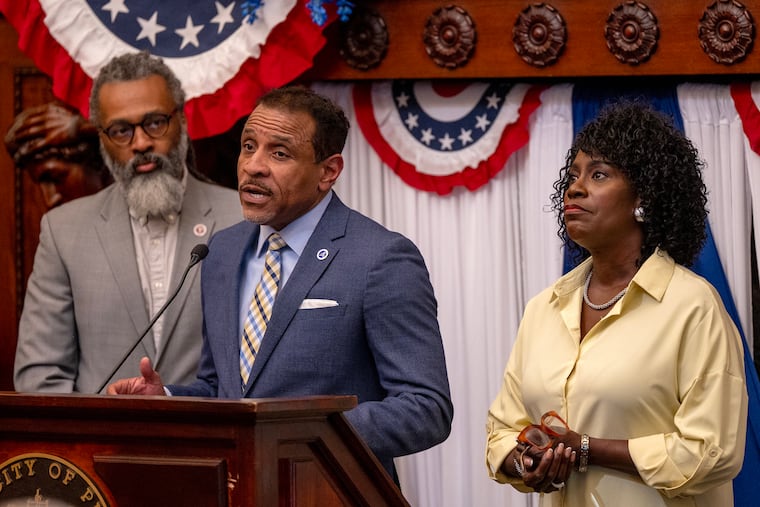
Mayor Cherelle L. Parker and members of City Council could not agree on how to bridge the Philadelphia School District’s structural budget deficit. Now, students and staff will bear the brunt of a political failure.
In some ways, the scope of the deficit seemed to catch policymakers off guard. The mayor’s initial budget proposal included a 20-cent per-trip tax on rideshare services, which then ballooned to $1 per ride. Neither figure came close to filling the $300 million hole in the district’s financial plan.
While both the mayor and City Council have strong oversight powers when it comes to school spending, neither seemed to anticipate the size of that gap — even though Superintendent Tony B. Watlington Sr. had warned of a looming fiscal crisis during the last budget season.
The ripple effects of the deficit are already clear. Principals and teachers have described this hiring season as chaotic. Some district employees whose positions are slated for elimination have begun looking for jobs in suburban school systems, many of which are facing their own budget issues.
The cuts to Philadelphia’s schools come at a time when students are making progress, although pandemic-era declines have yet to be fully reversed. According to the Education Scorecard, the school district’s “learning rate” outpaces other big cities. That could be undermined by shedding hundreds of staff positions and shuffling teachers around to fill the gaps.
Magnifying the impact of the staffing cuts is the scheduled closure of 17 schools across the city. The closure plan — which was finalized in April after a long and contentious process marked by City Council’s opposition — eroded support for the district with both residents and lawmakers. Council members did little to hide their fury over the inclusion of Paul Robeson and Lankenau High Schools on the district’s closure list, despite their efforts to preserve them.
It did not help matters that some of the mayor’s plans seemed somewhat haphazard. Closing the gap between internet retailers and their brick-and-mortar competitors through online taxes makes a lot of sense, as does taxing delivery services in order to fix potholes. But many of Parker’s other proposals were unconventional.
For example, most cities that tax rideshare services use the funds to support public transportation. That use of the revenue may feel more intuitive to taxpayers: If improved transit access allows current rideshare users to take more trips on SEPTA, they’ll save money overall. Instead, the proposal was to send money from the rideshare tax to the school district, and at a level that was still significantly below its needs.
Whatever the details, the proposed tax did not pass. In a news conference last week, Parker said there were just three votes for the plan from the 17-member council. Instead, Council members approved a one-time payment of $50 million in an attempt to forestall the district’s job cuts.
Despite the windfall, Watlington announced that the planned cuts would go through. He has spent weeks citing the need for a recurring source of revenue for the district, and the school system found itself facing the reality that a one-time payment of $50 million simply isn’t enough to stem a $300 million annual shortfall.
This episode has lessons for everyone involved.
For Parker, it is a sign that she must find a more effective way to work with Council. Mayors in Philadelphia tend to lose momentum over time, but she is still in her first term. If she’s already failing to “get to yes” with City Council over such relatively straightforward proposals, it may not bode well for the balance of her tenure.
For Council, there must be a recognition that there is more to governing than just saying no. At some point, inaction is itself a choice. Philadelphia’s students cannot afford another year of this.
