‘Phillies Extra’ Q&A: John Middleton on All-Star Game highlights, firing Rob Thomson, and the trade deadline
Middleton also talked about his and president of baseball operations Dave Dombrowski’s futures at the top of the Phillies’ organization.
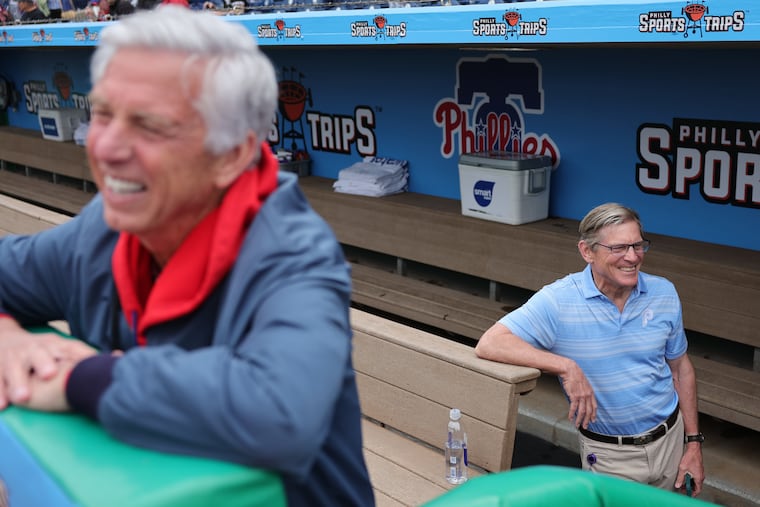
John Middleton spent months overseeing preparations for Philadelphia’s first All-Star Game in 30 years.
“I think of it like my daughter’s wedding,” the Phillies owner said in February. “I’m excited; I’m looking forward to it. And I know I’ll be really happy the day after when I wake up and it’s done.”
Well ...
After the baseball world left town, Middleton sat down with Phillies Extra, The Inquirer’s baseball podcast, to recap how the city did during its week at the center of the baseball universe.
But he also talked about the upcoming trade deadline (Aug. 3), Wall of Fame ceremony for Chase Utley (Aug. 7), and Field of Dreams Game in Iowa (Aug. 13), in addition to his and president of baseball operations Dave Dombrowski’s futures at the top of the Phillies’ organizational masthead.
Watch the full interview below and subscribe to the Phillies Extra podcast on Spotify or Apple Podcasts.
Q: Now that it’s over, is there a lasting memory that you will take from the first All-Star Game in Philadelphia in 30 years?
A: I don’t think I have one in particular … if this were a one-day event like it was in ’76, where they came in, flew in on Sunday evening or Monday morning, and had fielding practice and batting practice Monday afternoon, and played the game on Tuesday and left, maybe you have one. But it’s a five-day event now, and so I’ll just kind of give them to you chronologically, the ones that really stand out.
For me, the standard I use is what’s quintessentially Philadelphia. … you could have great experiences in any other city, any other ballpark during those five days, but they’re not Philadelphia-based driven experiences. The first one was the attendance at the All-Star Village. I’m told that we blasted every attendance record they had. I know in terms of recent attendance figures, I mean, we did [25,000]-plus the first day, 25-plus the second day, nearly 23 the third day, and over 22 the fourth day. We were at 93,800 and some odd attendees over the four days, and if you looked at the more recent history, they were all kind of in the [12,000] to 15,000. So, this is an enormous increase … And I’m told that it is literally the largest attendance they had over the course of an All-Star Village in any year. So that’s, to me, quintessentially Philly. The fan base responding to that opportunity was extraordinary.
I think the Home Run Derby was incredible … I doubt they’ve ever had a Home Run Derby like this. What [Cardinals slugger Jordan] Walker did was extraordinary. The finals between the two of them [Walker and Kyle Schwarber] was unbelievable. You couldn’t have scripted it frankly any better other than Kyle winning, but you’ve got to take your hat off to Jordan Walker. He hit six consecutive home runs absolutely on his last ball. Any one of those that he didn’t hit would have resulted in a different outcome. But the fans were so electric. The stadium was electric. It felt like a late postseason-clinching game in a postseason series. It was just wonderful, and that was quintessentially Philadelphia.
I think the third one I would point to is the red carpet. The way they had it set up, you were in the backstage area and you couldn’t really see anything out there. And you kind of came through the pathway, and you walked through a door, and staring in front of you was a red carpet laid out. There were thousands of fans, and rising above it all was Independence Hall and the steeple, and that was an emotional moment. And you couldn’t have that in any other place in this country but in Philadelphia. And frankly, you could have it in Philadelphia in five or 10 years, and it wouldn’t be quite the same because it wouldn’t be the 250th birthday of the country. You won’t have that chance to have that moment again, in my opinion, until the tricentennial, and I’m not planning to be around to experience that one.
And I guess the last one I would point to is the entire pageantry surrounding the All-Star Game itself. I think Miles Teller’s moment, his speech was extraordinarily moving. I think the recreation of the Sandlot moment after the fifth inning was unbelievable, and that again is just kind of quintessentially Philadelphia.
Q: Just because I haven’t talked to you since it happened, could you take me through the emotions of the day Rob Thomson was fired, from your perspective?
A: I, personally, find terminating someone the most difficult and the most unpleasant part of being an executive. I’ve been doing this for over 45 years … and it was horrible the first time I had to do it, and I can’t tell you that it’s particularly better or easier nearly 50 years later. You’re really disrupting somebody’s life significantly, and you never can forget that.
I think the hardest part about doing something like this is the judgment between how much time you give something. Do you let it go further? And when do you draw the line and say, ‘Enough time has passed. We have to make the decision?’ And frankly, as the old expression goes, not to decide is actually to make a decision. You’re deciding not to decide, and Dave and I talked about this a lot and have talked about it a lot. And we kind of finally reached the same point. And we obviously had done that in the past with Joe [Girardi in 2022], and I really trust Dave’s judgment on these things. And that’s not just the two of us talking. It’s a whole bunch of people talking, and it took awhile to get to consensus. But the consensus was that we needed to kind of do something.
» READ MORE: Baseball celebrated itself with All-Star Week. Next up: Avoiding self-destruction with a looming labor fight
Rob was great about it. … Rob knows he’s always got a place in the organization. It’s really up to Rob to decide where and when and how, and we’ll work him in. I made the point to Rob, I said, ‘Look, Rob. Charlie Manuel got fired in August of ’13.’ And I said, ‘Look at him; he’s back, and everybody loves him, and everybody from in the organization, the fan base loves to have him back, loves to have him around. Gets a huge ovation every time he’s introduced. Ruben [Amaro Jr.] was fired. He’s back, albeit he’s an announcer, but he’s welcomed back. He comes to all our alumni events, and we love having him around. And I told Rob, I said, ‘It’s going to be the same thing with you. It’s just when you’re ready for it.’
A decision like this is never so black and white that everybody’s going to agree with it. There are people who are going to say that we waited too long. There are people who will say that we didn’t wait long enough. There are people who say that other people should have been fired. I’ve read all those comments. I don’t agree with them, but that doesn’t mean that I’m right and they’re wrong. But I get paid to make a decision. Dave gets paid to make a decision, and that’s kind of when we thought we needed to do it. And I will tell you, the aftermath [under interim manager Don Mattingly] more or less supports the decision. You can argue that we maybe should have moved earlier. Maybe we would have had a better record today had we moved a week earlier, five days earlier, or three days earlier. But the reality is, you just need to set the organization on a path that’s going to hopefully result in the best season you can possibly have. And I think we’re on that. We’ve got to be healthy. But if we remain healthy, we’ll be in good shape.
Q: The trade deadline is roughly two weeks away, and this one is especially intriguing because nobody knows what the rules are going to be beyond 2026 in terms of whether or not there’s going to be a salary cap. How do you and Dave go about doing what you have to try to do to win right now when you don’t know what the landscape is going to look like next year?
A: … I think you have to be aware of it. You have to ask questions about it. But at the end of the day, because the range of outcomes is so wide, I think you have to kind of just do what’s in your judgment is in the best interest. And philosophically, Dave and I approach these things as kind of maximizing our ability to win today with maximizing our ability to win in the future. And reasonable people can disagree about how you actually implement that philosophy and how you think about an individual trade, the players you’re getting, who the players are that you’re giving up, what the salary is you’re taking on, and all of that. But that remains our philosophical construct, and we’re going to move down that path.
That kind of also gets you back to health. Because obviously if somebody gets injured, an important player gets injured in particular, that changes your understanding of the team and what you have to do to maximize the rest of the season in the postseason. So, all of those things are out there and they’re playing.
» READ MORE: Phillies trade deadline preview: Bullpen is becoming a top priority, and maybe the Mets can provide answers
… there’s like four or five teams in the National League that are within say three games of the final wild-card spot. It’s really hard to trade away players if you’re one of those teams and say ‘I’m going to give up and try to get some younger players.’ Most of those teams are going to turn out to try to be pushing to add players to kind of bridge that gap and get into the playoffs. I mean we were there in ’22. It’s exactly where we were, and so I think that makes it very difficult because if you look in the National League and the American League, there’s a handful of teams that are quote unquote out of it. So I think most teams are kind of in it, and that really shrinks the pool and rise prices up.

Phillies Extra is your deep dive into all things Phillies on Gameday Central! Hosted by Scott Lauber, each episode brings you insider analysis, exclusive interviews with players and experts, reader emails, and more to cover the hottest topics with the Phillies and across Major League Baseball. Don’t miss it — the conversation starts here!
You can also subscribe to the podcast version of Phillies Extra on Spotify or Apple Podcasts.