Alex Cora did the smart thing. The Phillies will be fine with Don Mattingly. But, really, who cares?
Whatever the marginal difference between Joe Girardi and Rob Thomson and Mattingly and Cora, it is fractional orders of magnitude compared to the impact of a star who emerges from the minor leagues.
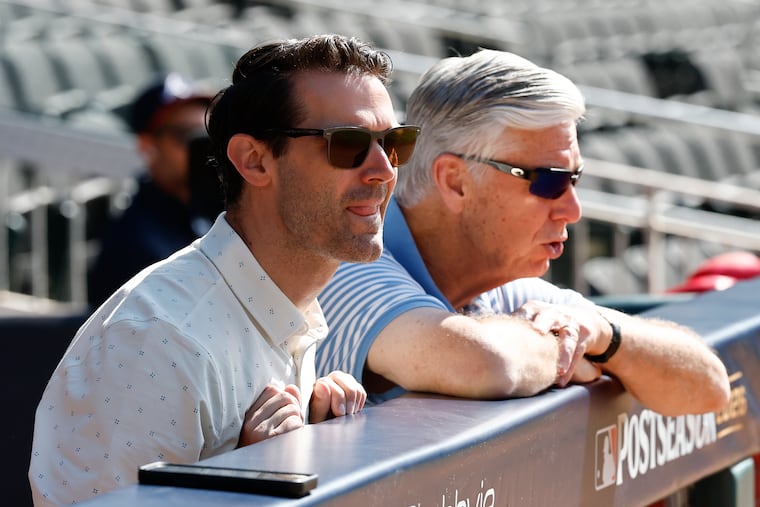
Pay no attention to the Phillies’ palace intrigue.
Everyone should be laser focused on one simple fact. This year’s World Series will likely feature two teams that spent nearly $60 million less combined on their 2026 rosters than the Phillies spent on theirs. I know that sounds absurd. It is absurd. But that is the math.
The Brewers enter Game 3 of the National League Championship Series with a 2-0 lead on the Dodgers and a $142 million payroll, according to FanGraphs.
» READ MORE: The most imaginative changes the Phillies can make begin with moving Trea Turner off shortstop
The ALCS features twof teams with the 28th and 29th largest payrolls in the majors: the Rays at $90 million, and the Guardians at $87 million. That’s almost as much as the Phillies paid to Zack Wheeler, Trea Turner and Bryce Harper alone.
Maybe Dave Dombrowski thinks these facts are an indictment of his manager. I’m not sure Alex Cora would agree.

David Murphy alerts
Whatever you think of Cora’s dugout acumen, he clearly has some street smarts. The former Red Sox manager is well aware of who takes the blame for an underperforming roster: It sure ain’t the guy who built the thing. Boston somehow managed to go 77-58 after firing Cora in April, but did not win a playoff game. That sounds suspiciously like the situation he would have been inheriting with the Phillies. Lo and behold, another year of rest and relaxation sounded nice.
It’s possible that Cora unwittingly sent a message to John Middleton by so quickly letting it be known that he would not be managing the Phillies. That’s the most hopeful scenario for anybody who thinks the team is in need of a broader change in direction. In another scenario, Don Mattingly is conducting his own personal life cost-benefit analysis, or at least using it as leverage.
Whatever the reality, one question remains.
Does any of it really matter?
Was Rob Thomson’s 9-19 record at the start of April any more a product of managerial misconduct than Mattingly’s 9-15 record at the end of July? And what about the 11-16 finish, including those two wild-card losses to the Braves?
It is commonly said that some guys can’t manage their way out of a paper bag. Can anybody do it when the paper bag is his roster?
» READ MORE: Which Phillies Should Stay or Go?
Mattingly tried, and he did all the same things the previous guys did, and got all the same results. That’s not to say that there isn’t some level of skill and feel in managing a bullpen. Or filling out a lineup card. But most of it comes down to evidence-based decision making. The things we swear a different manager could do better are the things you can train a machine to do. Sure, there’s a human element to it. If Dombrowski had asked ChatGPT to manage the bullpen in Game 1 against the Braves, it would’ve flattered him and lied.
The hope is that Dombrowski isn’t doing the same thing with Middleton. The path of least resistance is to convince oneself that every dollar that has been invested is one that still might pay off. A tweak here and there. The issue isn’t staying the course. The issue is who is steering the ship from the dugout. All is well.
And, hey, that might be the right strategy. A baseball manager is like a seat belt on an airplane. It’s mostly there for the illusion of control. The biggest issue facing the Phillies is far more structural than deciding the least bad option in the lineup and bullpen. It’s the same issue they’ve faced since the Rollins-Utley-Howard-Hamels talent cycle matured. The more money you have to spend, the more money you can throw at the least bad option on the free agent market. The real differentiators end up coming from somewhere else.
One way or another, the guys who will determine the next one to five years of the Phillies’ competitive integrity are Aidan Miller, Francisco Renteria, Gage Wood, Bryan Rincon, and whoever else the Phillies can find a reason to believe in each draft and development class. Whatever the marginal difference between Joe Girardi and Thomson and Mattingly and Cora, it is fractional orders of magnitude compared to the impact of a star who emerges from the minor league system.
It was true at the beginning and it remains true today. However much credit you give Dombrowski for the positives of the last five years, his real legacy has only begun to reveal itself. He drafted Andrew Painter in his first year on the job. He added Alex McFarlane in the fourth round the next year. The year after that, he drafted Miller in the first round. Just as important as the drafting and developing of players is the decision-making about who they really are. Who is untouchable? How touchable is everybody else? How do these judgments compare to those of our competitors?
Those are the decisions that end up defining an organization. Their magnitude is heightened at both ends of the revenue spectrum. The easiest thing to be is a team with a rapidly expanding payroll. The Brewers, Rays and Guardians have done the most with the least. The Dodgers have done the most with the most. The decisions that will determine the Phillies’ immediate fate have already been made. As for the manager? Whatever happens, happens.

The Phillies haven't won a playoff series since 2023, and their postseasons keep getting shorter and shorter. How can they fix it? Radio play-by-play announcer Scott Franzke joins Phillies Extra, The Inquirer's baseball podcast, to discuss Trea Turner's future, the managerial uncertainty, whether the Phillies can get "creative" to change the mix of the roster, and more. Watch here.
You can also subscribe to the podcast version of Phillies Extra on Spotify or Apple Podcasts.
Previous episodes: Larry Andersen | Matt Klentak | Jeff Francoeur | Luke Murton | Mike Hazen | Tony Gwynn Jr. | Kevin Stocker | Bobby Dickerson | Jim Bowden | John Middleton