Addiction report questions doctor's prescriptions
In the heart of Camden's Bergen Square section, a medical facility on Broadway was open for business Thursday morning as a steady stream of patients arrived.
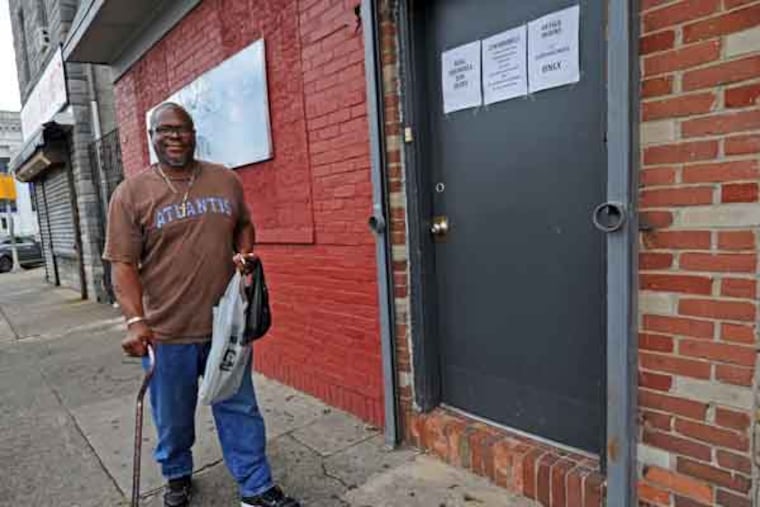
In the heart of Camden's Bergen Square section, a medical facility on Broadway was open for business Thursday morning as a steady stream of patients arrived.
The tattered brick building with second-story boarded windows appeared unassuming.
On Wednesday, however, a state report had ignited a controversy over whether an office at the medical facility had been used as a "drug emporium" to feed addicts, or was a legitimate practice unfairly singled out.
"It illustrates a problem," said Lee Seglem, assistant director of the state's Commission of Investigation, which released a 74-page report, "Scenes From an Epidemic," detailing a growing number of addictions and overdoses from opiates and heroin across New Jersey.
Seglem said that more than 3,100 prescriptions in 19 months written by one doctor, working one day a week, and nearly all for oxycodone, "raises a red flag." It also raised questions about whether the pills - with a $10 million street value - were contributing to a drug epidemic the scale of which, the report said, has never been seen before.
The doctor, Randy Zeid, is not charged with any crime and disputes the allegations. He has declined to be interviewed by reporters since the report's release.
Before the report was issued, Zeid had left the Camden practice. He has since been suspended, pending investigation, from Virtua Family Medicine in Browns Mills.
"It was really unfair the way they wrote it up," said Zeid's attorney, Charles H. Nugent Jr. of Marlton. "This is a doctor with an excellent reputation, and they decided to make him a sacrificial lamb."
On Broadway between Mount Vernon and Newton Streets, patients, neighbors, and businessmen complained of parking issues and loitering by patients. Most praised the medical services in the impoverished area.
Zeid's office, however, did have a reputation for liberally writing prescriptions, said some people who asked not to be identified by name. Although Zeid is no longer there, the other doctors and medical employees with practices in the building posted a warning: "Buying or selling prescription medication is illegal. Any suspicious activity will be immediately reported to the authorities."
Page 30 of the commission's report starts a five-page description of the activity on Broadway near Mount Vernon. It's a "desolate patch of nearly deserted sidewalks and shabby buildings," says the report, until "Tuesday, and the doctor is in - that would be Dr. Randy Zeid."
Zeid finished his medical training at the Philadelphia College of Osteopathy in 1988, did a residency in Ohio, and was licensed in New Jersey in 1990.
Although the report said Zeid had been with Virtua for 20 years, Nugent said Zeid initially worked part time and opened the Camden office about nine years ago, where he practiced "once or twice a week."
The report said he worked there at the invitation of Adam Benn, a chiropractor. Chiropractors are precluded from writing prescriptions. Zeid's practice was called Sprain & Strain and rented office space for $750 a month.
An employee at Benn's office Thursday said that Benn was not available and that Zeid no longer practiced there.
Patient Michael Carroway of Paulsboro said he has seen several professionals who have treated him for chronic pain after back surgery since he injured his spine in a 2011 car accident.
Carroway said his attorney referred him to the Camden facility, where he was treated for several months. Initially, he could not walk. Now, he walks with a cane. He takes Percocet twice a day for back, hip, and neck pain, he said, adding that he hoped to ease off the medications.
Asked whether he had ever seen questionable practices, Carroway put his hand to his heart and responded, "Me personally, I have never seen anything like that."
Sandi Bizzell, 40, who lives around the corner on Newton Avenue, said she has had problems parking when the practice was open.
About two years ago, she said, she received whiplash from a car accident and decided to see the chiropractor, who gave her heat therapy.
"He asked about the pain, but I didn't want to get involved with pills," Bizzell said, adding that she was not pressured to take a prescription. She spoke highly of the practice.
Another patient said she had been treated by Zeid and was upset because the doctor refused to keep prescribing medications after a urine test raised concerns. He had security turn her away.
Nugent said Zeid declined to write prescriptions for more than 200 patients he suspected were abusing medications. In fact, he said, Zeid had patients sign a contract acknowledging that they were subject to random urine screenings to ensure they were not abusing prescriptions or other drugs.
"He complies with all the laws. He's never been cited by the medical board, and there are no irregularities in his practice," Nugent said. "As far as we're concerned, [the report] is fictional."
Zeid had since started working full time at Virtua and, in the past year, had stopped working in Camden, Nugent said.
After the commission's investigation, reports were sent to the state Attorney General's Office, U.S. Attorney's Office, and Board of Medical Examiners.
Virtua did a review of Zeid's patients there and found no evidence of abuse in dispensing prescription drugs, said a Virtua spokeswoman. She said Zeid was suspended pending an investigation.
The state report said Zeid "prescribed prodigious amounts of pain medication." The document does not specify that Zeid did anything illegal, but details "questionable circumstances" surrounding treatment and noted prescriptions linked to "criminal activity."
A search warrant turned up a prescription written by Zeid in possession of a person other than the patient. A public works employee was arrested for distributing pills prescribed by Zeid. Known drug users were seen standing outside Zeid's Camden office.
Zeid told investigators that "it gets a little crazy" at the practice, and Benn hired security to maintain order, the report said.
Nugent said that patients did get irate when Zeid refused to write prescriptions and that it was not unusual that Zeid, whose practice specialized in treating afflictions that caused pains, would write such prescriptions. He had no control if patients sold pills, Nugent said.
Zeid was subpoenaed to appear before the commission, but declined to answer questions based on Nugent's advice. Instead, he wrote a letter to the commission, saying the report contained "exaggerated, unverified allegations intended to sensationalize and alarm, but which is short on facts which prove that anything wrong happened."