Lawyer plays dual role in court deal
Chief justice said he did not know adviser was also a developer in $200 million project.
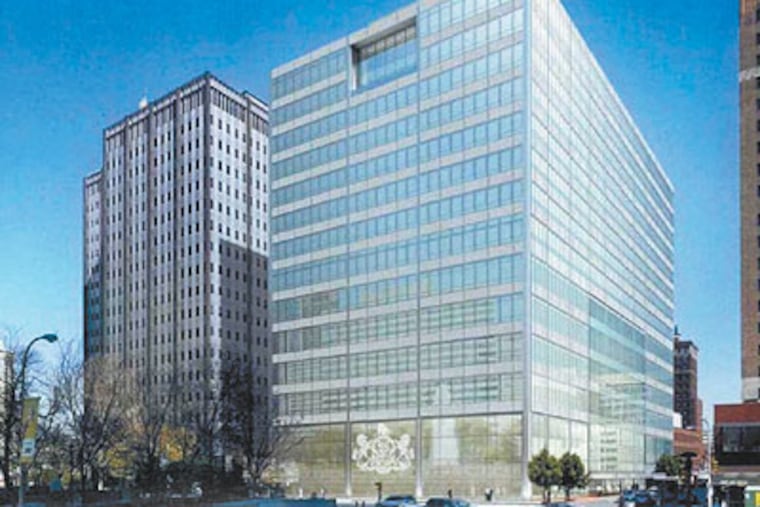
When Pennsylvania's top judges struggled to find a way to build a new Philadelphia Family Court building, they turned to a lawyer with political savvy and real estate experience.
Jeffrey B. Rotwitt, a longtime real estate attorney and developer, spent months scouting for locations, and urged state officials to approve $200 million to build the courthouse. For his efforts, he is poised to earn a handsome fee from the courts: $3.9 million.
His firm, the politically powerful Obermayer, Rebmann, Maxwell & Hippel, has received more than $1 million already - with the rest due by the end of June.
But Rotwitt found a way to make even more money from the courts project, a 14-story tower planned for 15th and Arch Streets. It would be the largest current public works project in Philadelphia after the Convention Center expansion.
He made a separate deal with Donald W. Pulver, the Conshohocken developer who has development rights at the site. For more than a year, he and Pulver said, Rotwitt has been splitting the monthly development fees paid by the courts, fees that Rotwitt proposed in the first place. So far, that arrangement has earned Rotwitt close to $500,000.
"It was all open and above board," Rotwitt said.
State Chief Justice Ronald D. Castille, who has been working closely with Rotwitt on the courts project for two years, said he had no idea about that arrangement until The Inquirer's architecture critic, Inga Saffron, reported it and started asking questions about how Rotwitt could be on both sides of the deal.
Because he was relying on Rotwitt's advice, Castille said in an interview in his Philadelphia office, there's no way to know whether the public has gotten a good deal thus far on the $200 million Family Court project.
Meanwhile, Pulver, Rotwitt, architects, and other consultants have already been paid more than $11 million in public funds - even though there is still no development deal signed, and state officials say they are considering whether to boot both men off the project.
"He's the one we're depending on to say these prices are good," Castille said. The dual roles, he said, might be a conflict for Rotwitt.
"If I was in the Marine Corps, the guy would be stripped of his rank, he'd be drummed out," said Castille, a former Marine who lost his leg in Vietnam.
'Roll of the dice'
As for the $11 million: "I took a roll of the dice," Castille said, saying he gambled by committing money without a final construction agreement to keep the project moving.
Rotwitt and Pulver have a different account. They said Rotwitt never tried to hide his co-developer role from Castille or anyone else, and that Castille and other court administrators have known about it all along.
"There was nothing at all secretive," Rotwitt said.
Rotwitt released documents that he said support his account - including minutes of a 2008 meeting about the courts project that Castille attended in which Rotwitt was listed not as the courts' lawyer but as the representative of his development company, Deilwydd Property Group FC L.L.C.
There was no conflict at all, he said in an interview, because his work for the courts was completed by the time he started working with Pulver. Pulver also said there was no problem with Rotwitt's two roles.
"There's no hidden agenda anywhere," Pulver said. "Everybody was just trying to get a building built here. There's no bad guy. This is all for the good of the project."
On Friday, Gov. Rendell, Mayor Nutter, and Castille are scheduled to hold a news conference to announce that Rendell has agreed to release the money to build the Family Court building.
Rendell controls the project's fate: Although the state legislature has already approved the $200 million, the governor has the power to decide whether to release the money.
He had heard questions
Last week, Rendell's spokesman said the governor was sitting on the money because he had heard questions about Rotwitt's double roles. "He told me to tell you this: Given the allegations that The Inquirer is working on, he's going to wait and see your story," the spokesman, Gary Tuma, said.
Rendell declined requests for an interview. Donna Cooper, state secretary for policy and planning, said the governor was committed only to a new Family Court building - not to the site or the deal with Pulver and Rotwitt.
The land is owned by the Parking Authority; Pulver's development deal expires July 1.
The controversy surrounding Rotwitt is not the only unusual thing about the Family Court project, documents and interviews show.
From the start, the project was handled directly by the state's top judges - with help from two of the state's most politically connected law firms - with no bids and only the barest form of written contracts.
The money for the fees came from a special surcharge on divorces, custody cases, and other Family Court filings, part of a little-noticed law that went into effect in 2006. The fees have generated millions in an account under the control of the Supreme Court.
James P. Creedon, head of the Division of General Services, the state agency that usually supervises such projects, said he had never heard of Pulver's arrangement. He said he was not sure the project would even be permitted under rules governing state capital spending.
When Saffron started asking questions about Rotwitt's role in the deal last month, court officials had trouble providing immediate answers.
Early on, a spokesman for Castille provided her a copy of a Pulver letter that seemed to say there was no such partnership. Later, Philadelphia court administrator David C. Lawrence, who works under Castille, defended Rotwitt's dual roles.
In order to maintain the traditional journalistic separation between critical writing and news reporting, Inquirer editors then decided to assign the story to reporters on the paper's metropolitan staff.
Finally, in an interview this week with Inquirer reporters, Castille said Rotwitt kept court officials in the dark about a potential conflict of interest.
But Rotwitt believes he's owed the rest of his $3.9 million if the project is built. He said he feared he was being made a scapegoat.
"I may have to take it on the chin," he said. "At the end of the day, do I want to fight with the governor and the chief justice?"
The strange tale
The strange tale of Rotwitt's involvement with the Family Court project began in December 2005, with a conversation with then-Supreme Court Justice Sandra Schultz Newman.
"I had met him at parties," Newman said, explaining that they ran into each other at Republican political events. "I knew he had great experience and great connections in real estate."
Rotwitt, 59, has been involved in a number of high-profile real estate deals, owns the Kixx indoor soccer team, and is a partner in an $85 million deal to build a movie studio in Chester Township.
His 1912 Radnor home, Deilwydd, has been on the social circuit for years as a venue for benefit parties held by upper-crust Main Liners and the city elite.
He was involved several years ago in a controversy while trying to find a developer for the Haverford State Hospital site. He and Obermayer had agreed to work on commission, but Haverford Township commissioners agreed to pay $600,000 to the firm on New Year's Eve 2003 without a public vote, according to a state grand jury report.
After a furor, Rotwitt returned the money; he said he did nothing wrong and had taken the fee for additional work, not as an advance.
In Philadelphia, judges and court administrators have been trying to get a new Family Court building for years. The city's Family Court hears a range of cases - juvenile crimes, divorces, adoptions. The courtrooms are split between outdated buildings - at 1801 Vine St., a signature building that replicates one in Paris; and a dingy and cramped converted office building at 34 S. 11th St.
Everybody agreed a new building was needed, but no one wanted to pay for it, Newman said.
"I was ready to bang my head against the wall," she said.
In Pennsylvania, all court matters are ultimately controlled by the Pennsylvania Supreme Court. Newman, a former divorce lawyer, had the role of overseeing Philadelphia's courts.
Newman said she considered no other lawyers. She said Rotwitt had another big selling point: He was willing to work "on the come," agreeing to work without payment from the courts and to take his fee out as a commission when and if a deal was done.
In February 2006, the courts retained Rotwitt with a brief, vague letter. It says only that Rotwitt will represent the courts "as it relates the acquisition of a Philadelphia Family Court facility."
"Additionally, it is our mutual understanding that your fee will be satisfied by the party (ies) providing the facility," says the letter, which was signed by Joseph A. Cairone, then administrator of Philadelphia courts.
At the time, Newman had ties to the Obermayer firm. Her son Jonathan Newman, then chairman of the Pennsylvania Liquor Control Board, was of counsel at the firm, though Sandra Newman said he was not a partner and did not share in the profits.
In July 2006 - five months after she hired Rotwitt - Newman began to date Martin Weinberg, Obermayer's chairman. They were married a few months later, as she was leaving the court; the marriage was subsequently annulled.
On Nov. 1, 2005, Newman had received a $10,000 contribution from Obermayer for her retention campaign.
Newman said the hiring had nothing to do with the campaign money or the personal connection to Obermayer and could not say whether Rotwitt was acting as a lawyer or as a broker. She said she never bothered to write an agreement spelling that out because the courts weren't paying the fee.
"I thought it was brilliant," she said. "I was getting a great deal."
Throughout 2006, Rotwitt checked out a number of properties and potential deals, including the office building at 1500 Spring Garden St.; the former Strawbridge's store at Eighth and Market; and a building at 4601 Market St. All fell through.
At the end of 2006, Newman left the court. Castille, a former Philadelphia district attorney, became chief justice and took over the job of liaison with the city courts.
In the end, Rotwitt did not actually find the site for the new building, according to Rotwitt and Castille.
Instead, Vincent J. Fenerty Jr., executive director of the Philadelphia Parking Authority, called Castille and pitched the site at 15th and Arch, an authority-owned surface parking lot.
Since 2003, the authority had had a deal with Pulver to build offices or a hotel and an underground garage there but couldn't make a deal happen.
"So Fenerty calls me and says, 'I got this thing here at 15th and Arch,' " Castille said. "I said, 'That is the perfect location. Come on over.' "
Before long, Castille and Rotwitt began lining up support at City Hall for that spot and backing in Harrisburg for the money. Still, at Rotwitt's urging, the courts checked out one more potential site: the Inquirer Building at Broad and Callowhill Streets.
Those 2007 talks didn't go far. The building was too expensive, and court officials wanted a new facility.
In his role on the Senate Appropriations Committee, former State Sen. Vincent J. Fumo had placed a $200 million line item in the state capital budget.
When Fumo heard that judges were looking at the Inquirer Building, Castille and Rotwitt said, he changed the law to require that the money be spent at 15th and Arch Streets.
"I'm sure it wasn't done for noble reasons," Castille said of the change.
Brian P. Tierney, publisher of The Inquirer, said he pitched the building to a number of potential buyers and knew nothing of any such power play by Fumo.
"I'm sure there's more than a few people whose feathers we have ruffled over the years," he said.
Fumo is now serving time in federal prison on corruption charges.
By early 2008 - both men are unclear on the exact timing - Pulver and Rotwitt say, they had already made their handshake deal. They would be co-developers, and split the fees 50-50.
"Pulver and I chatted," Rotwitt said. "He said, 'Look. We make a good team. Why don't we do it together?' "
Pulver said Rotwitt had provided invaluable help because of his real estate experience and his connections to government officials.
"It's hard to explain how hard it is to get a building off the ground in Philadelphia. It's a labyrinth," Pulver said.
"He knows all the politicians. . . . And it helps to get things done. You can't do it all by yourself. You have to be in the swing, if you will, in the city."
Through most of 2008, Rotwitt and Pulver worked together on the project without pay. Rotwitt and others say it was hardly a secret.
Proposal sent
In April, Rotwitt sent a proposed development agreement to Lawrence and Family Court judges. He wrote that he had become partners with Pulver and was serving as "co-developer."
They also were side by side during meetings in March 2008 with builders.
"I never heard him say he was representing the court. I always had the belief he was a partner with Don's," said John Bremner, a senior vice president at Intech Construction.
Intech has been paid $293,320 for preconstruction consulting on the project, now completed, Bremner said.
When told that court officials said they never knew the two men were partners, Bremner said: "That's very strange."
Rotwitt attended nearly every project meeting as a developer's representative, he said.
Rotwitt's original deal with Justice Newman said he wouldn't get paid until a deal was signed. But in fall 2008, Castille agreed to start making payments out of the Family Court fund. He said he was trying to keep the project going.
Rotwitt and Pulver proposed a fee schedule of monthly payments. Rotwitt would get $55,000 a month as "tenant representative," as a sort of advance on his set fee of $3.9 million.
Pulver would also get monthly payments toward a total developer fee of $2.6 million, and the same amount for "general and administrative fees" - for a total of $5.2 million. Other fees went for taxes, for Intech, and for lawyers. Most of the money - about $5.3 million so far - went for the design work, led by the architectural firm Ewing Cole.
Land costs
The court is also paying $50,000 for land costs, even though the Parking Authority isn't charging Pulver anything for the development rights. Pulver said that accounted for his costs since 2003.
Castille said the fees were presented by Rotwitt; he relied on his advice that the fees were reasonable.
"He's our lawyer. He's our guy," Castille said. "Whatever role he was playing, we were relying on him for his loyalty to his customer, the First Judicial District, and to me, the chief justice."
Castille said he agreed to pay Rotwitt directly because he thought he deserved it for all his hard work.
"The guy did a tremendous amount of work to get us to the point where you could, as they say, see the light at the end of the tunnel," Castille said.
Castille said he was paying Rotwitt as an attorney. The payments went to his firm, Obermayer, he said.
Attorney ethics rules say lawyers should not have a business interest in a matter on the other side of a client. It's not strictly forbidden, but the rule says lawyers must inform their clients clearly in writing and get written permission from the clients in return.
That didn't happen with Rotwitt, Castille said.
"If I'm the tenant who wants that building to be everything I need it to be for the least amount of money, my interests are not necessarily the same as the developer," said Mary T. Robinson of Chicago, an expert on legal ethics.
"That's where the divided loyalties are," she said.
Rotwitt says that rule doesn't apply for a simple reason: He was never serving as the court's attorney.
Likewise, tenant representatives have an obligation to tell their clients when they are on both ends of a deal, said Glenn Blumenfeld, a lawyer and principal at Tactix, a firm that represents major commercial tenants.
Rotwitt said the monthly installments he has been receiving on his $3.9 million tenant's representative fee were for work that had been completed by the time he agreed to become Pulver's co-developer. He also noted that Castille already had other lawyers: Starting in 2008, Castille hired the politically influential firm Ballard Spahr to help monitor the project. Ballard Spahr is the firm Rendell joined between the time he was mayor and governor.
The main Ballard Spahr lawyer on the case was John Estey, Rendell's former chief of staff - hired for his knowledge of state government, Castille said. Estey had been involved with the court project in 2006 and 2007 while working for Rendell, discussing how the city and state would share costs in the project, documents and interviews show. As of May 3, Ballard Spahr has been paid $430,000.
In November 2008, Rotwitt created a corporation, Deilwydd Property Group FC L.L.C. The payments he receives as co-developer from Pulver go to that company, he said.
After that, Deilwydd repeatedly showed up on documents sent to court officials and to Ballard Spahr. In July, Lawrence, the courts administrator, signed a letter from Pulver that said payments were going to Deilwydd - though Rotwitt's connection to that firm isn't spelled out.
"That was one of the things that slipped by us," Castille said.
Another unusual turn came in March, after Fenerty said he heard talk that Rotwitt was Pulver's partner. He said he asked Pulver.
"He emphatically said he had not had a business relationship with Jeff Rotwitt," Fenerty said.
Fenerty and a Parking Authority lawyer said they asked for that in writing.
Pulver's response, sent to the Parking Authority and the courts: "To avoid any potential misunderstanding or possible uncertainty, please note that Mr. Rotwitt does not have an ownership interest in or control over" his company, Northwest 15th Street Associates.
It says nothing about Deilwydd, Rotwitt's company, or their handshake development deal, only that Pulver was "working with" Rotwitt on the project. Fenerty said the letter was "misleading"; Rotwitt said that he agreed and that he couldn't explain why Pulver wrote it that way.
"Amazing," Pulver said of Fenerty's criticism. "I don't try to mislead anyone." Pulver said he believed he was answering the question he was asked: whether Rotwitt shared his development rights.
Castille said he first learned about Rotwitt's deal in The Inquirer.
Saffron, the paper's architecture critic, had already written one column in February criticizing the design. In April, after covering an Arts Commission presentation on the project, she asked Rotwitt about his role; he said he and Pulver were 50-50 partners, she said.
Saffron reported that, along with the fact that Rotwitt also was paid by the courts. And she began to ask questions about how he could be on both ends of the deal.
She got a copy of Pulver's March letter, which was presented to her by Castille's spokesman as evidence that Rotwitt was not a partner in the development. Saffron continued to ask questions. On April 21, e-mails show, she got a statement attributed to Castille from L. Stuart Ditzen, a spokesman for the courts and a former Inquirer reporter.
The statement confirmed that Rotwitt was a development partner, but it didn't raise any ethical concerns. It mirrored Rotwitt's account: He was acting "much like a broker," and became partners with Pulver only after the search role with Obermayer was over.
It turns out that Rotwitt actually wrote that statement, e-mails provided by Rotwitt show. One shows that he sent Castille a draft - describing it as "a clear statement of the facts" - after meeting with Castille about how to handle Saffron's inquiries. Castille never raised any objections then to his developer's role, he said.
Ditzen sent out the statement with no changes.
A week later, Ditzen sent an e-mail that said Lawrence, the court administrator, saw no problem. "In his view there is no conflict of interest in Rotwitt's current role as co-developer," Ditzen wrote.
Since then, Lawrence has not responded to several requests for an interview. Ditzen said he and courts officials were doing their best to figure out what was going on and provide the answers.
"I don't know the details of this situation and have not known them," he said.
Cooper, Rendell's planning secretary, and Castille said they were still trying to figure out how to get the building done. Usually, Cooper said, the state takes title to the property, gets bids from developers, supervises construction, and turns it over at the end of the deal.
It's not clear whether the arrangement with Pulver is even permitted by state law, she said. Lawyers are trying to figure it all out.
"I don't know what's going on," Pulver said. "It seems to me we're in a pretty good position to build something that a lot of time and effort has gone into."
The letter with the courts says Rotwitt and Pulver are owed their full fees by June 30 - about $6.5 million in all. The deal can be called off on three days' notice. But Rotwitt said he believed that if the court building goes up at 15th and Arch, he would be owed his full fee, no matter who builds it.
Another Ballard Spahr partner, Henry E. Hockeimer, a former federal prosecutor, has now been retained by Castille to determine the exact nature of the ties between Rotwitt and Pulver. Hockeimer declined to comment.
Newman, the justice who hired Rotwitt in the first place, said she had no idea he would stand to have that kind of payday, which she likened to hitting the lottery.
"I don't know I'd call it a conflict. I'd call it a hell of a Powerball," Newman said.
"I'm going to be honest with you: I can't believe they let the guy have his hands dipped in both sides. Can you?"