In Pakistan, Taliban bars soldiers from area
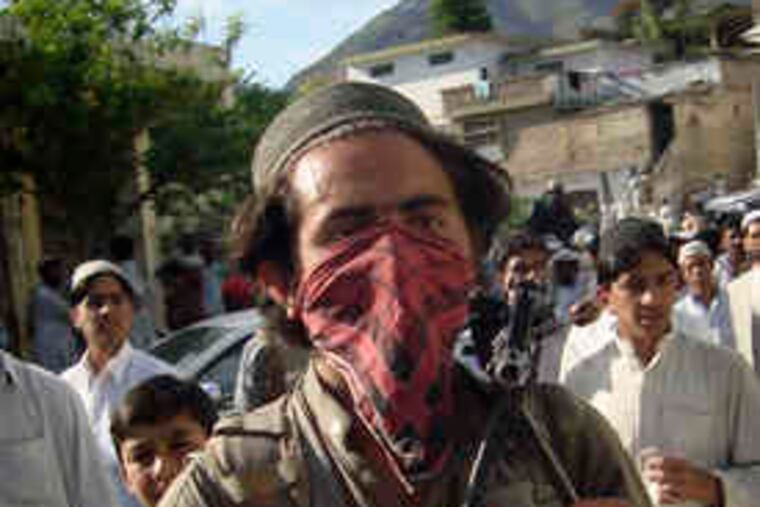
ISLAMABAD, Pakistan - Taliban gunmen stopped an army convoy from entering their valley stronghold yesterday, casting a U.S.-criticized peace deal back into doubt a day after the militants called off a move closer to the Pakistani capital.
ISLAMABAD, Pakistan - Taliban gunmen stopped an army convoy from entering their valley stronghold yesterday, casting a U.S.-criticized peace deal back into doubt a day after the militants called off a move closer to the Pakistani capital.
About 50 militants blocked the main road leading into the northwestern valley of Swat, halting a column of six army trucks and two jeeps, Taliban spokesman Muslim Khan said. The vehicles were carrying extra troops as well as supplies, in violation of the peace accord, Khan told the Associated Press by telephone.
A military official confirmed the incident and said the convoy returned to the nearby town of Bari Kot. He declined to give details and spoke on condition of anonymity because he was not authorized to discuss it publicly.
Pakistani authorities agreed in February to impose Islamic law in Swat in return for a cease-fire after nearly two years of bloody fighting in the former tourist haven.
U.S. officials and many Pakistani critics view the pact as a capitulation before extremists who have beheaded opponents, burned girls' schools, and said they would welcome and protect Osama bin Laden. It also grants the militants effective immunity from prosecution.
Western officials worry that Swat could turn into an expanding haven for al-Qaeda allies. The trouble also diverts Pakistan from tackling more established militant sanctuaries closer to the Afghan border. But the deal's supporters argue that the concession on Islamic law robs hard-liners of any justification for continuing to bear arms.
The pact has been under huge strain since President Asif Ali Zardari signed the bill this month introducing Islamic law in Swat and the surrounding Malakand region, an area of about 10,000 square miles near the Afghan border.
Taliban gunmen used the deal as a pretext to sweep over the high passes from Swat into adjacent Buner, a rural district just 60 miles from the capital, Islamabad.
They began pulling out on Friday after officials warned that they could review the peace deal - and amid talk that the army was preparing for action. Malakand's top administrator announced yesterday that all the militants had left Buner.
But Buner's police chief, Abdur Rasheed Khan, estimated later yesterday that at least 100 of the original 1,000 Taliban forces remained, and that the brief militant takeover had emboldened local sympathizers.
A spokesman for the army, which has thousands of troops in Swat currently confined largely to their barracks, said all armed Taliban fighters had to leave Buner. "If we get the confirmed news that they are still present, then they will be expelled from the area, and for that maybe we have to move the forces there," Maj. Gen. Athar Abbas said.
The Buner advance triggered strong condemnation from the United States, where lawmakers are considering a bill that would grant Pakistan $1.5 billion in aid each year to help it battle extremism.
"We're certainly moving closer to the tipping point" where Pakistan could be overtaken by Islamic extremists, Adm. Mike Mullen, chairman of the Joint Chiefs of Staff, said Friday.
The extremists, including Pakistani elements of the Taliban, are not a homogenous force; some elements are focused more on infiltrating Afghanistan to contest control of that country, while others are oriented toward destabilizing Pakistan. But in either case, the trend is worrisome for an Obama administration that has decided the Afghan problem cannot be fixed without progress in Pakistan.