Cornell’s rape scandal is the latest chapter in a centuries-long fight against the sexual double standard
Their efforts have aimed to erode this double standard and make it easier to hold men accountable for sexual assault.
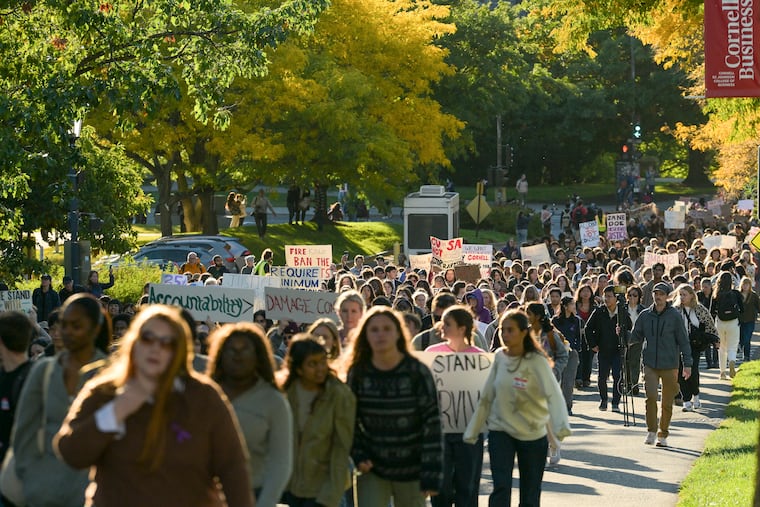
In the aftermath of revelations about an alleged gang rape at Cornell University — and subsequent cover-ups — sexual assault is back in the headlines. So too is women’s anger. Even before news about Cornell broke, popular culture was saturated with women’s rage over sexual violence, as depicted on the popular show “Furious.”
This pent-up fury now being unleashed reflects not only modern-day activists fed up with contemporary rape culture but also generations of accumulated resentment at the sexual double standard. It has long celebrated men’s sexual “conquests,” while “slut-shaming” sexually active women. That double standard has both encouraged sexual assault and enabled perpetrators to avoid legal or social consequences.
Perhaps less known is how, dating back to the 1830s, generations of women activists have pushed back against the sexual double standard and the “rape-prone society” it perpetuates. They transformed feminist fury into public outrage, thereby undermining the sexual double standard and building popular support for holding men accountable for their actions.
The first organized campaign to address the sexual double standard emerged in the 1830s, when a group of white evangelical Protestants formed the New York Female Moral Reform Society to protest prostitution. They did more than combat commercialized sex, however. They also launched “a crusade to establish their right to define — and limit — men’s sexual behavior.”
They denounced what they saw as a clear double standard: sexually active women were outcasts, while society condoned — and even celebrated — men’s sexual prowess. In one of their first public statements, the group declared “Resolved, That the licentious man is no less guilty than his victim.”
While the women read Bible passages outside of brothels, the group’s publication of The Advocate of Moral Reform had a far greater impact. The newspaper denounced the duplicitous “deceiver” who “ruined” erstwhile respectable women and called on women to unite to purify the nation’s morals, punish men’s perfidy and protect women’s virtue.
While the Society denounced both individual men and male privilege more generally, it reserved its most outspoken criticism for the sexual double standard itself. Its editors and contributors lamented how women could be “spurned from society and driven from a parent’s roof” for falling “into sin,” while “common consent” treated men as not guilty for engaging in the same vice.
The Society’s members publicly shamed men who patronized brothels. But they did not stop there.
The activists recognized that many sex workers were the victims of sexual coercion and that achieving justice in court was difficult. An extremely high standard of proof, a lack of witnesses often leading to a “he said-she said” situation and a pattern of “victim-blaming” related to the sexual double standard all made it nearly impossible to successfully prosecute rape cases.
In response, the Society launched a lengthy — and eventually successful — campaign to persuade the New York Legislature to adopt a new “Anti-Seduction Act” in 1848. The law built upon preexisting civil codes, which allowed the fathers of wronged women to demand compensation, effectively criminalizing coercive sex. Crucially, the new law had a lower burden of proof than rape laws — and it allowed survivors of sexual violence to make claims on their own behalf.
The Society’s success fueled a push to enact similar laws across the country. By 1885, 27 of 38 states had such statutes; by 1921, 37 of 48 states did.
Anti-seduction laws were just one example of “heart balm” statutes, which allowed women to demand compensation for damages in civil cases, in which the burden of proof was lower than in criminal ones. Such laws helped women pursue both criminal and civil actions for things like “alienation of affections,” “breach of promise” and seduction. These laws were essential to “redefining rape” at the turn of the 20th century.
These legal reforms primarily benefited white women, giving them an avenue to prosecute powerful men.
While they were fighting to enact these laws, a prominent Black activist, Ida B. Wells, was turning an unrelenting spotlight on a different sex-related double standard in the South.
During and after Reconstruction, white people falsely accused Black men of raping white women to justify lynch mob violence. While they purported to protect white women’s purity, their true purpose, Wells charged, was to uphold white male supremacy. That was clear from the fact that Black women continued to face sexual violence — and whites never threatened to lynch anyone for these crimes, whether committed by white or Black men.
Wells excoriated the racial and sexual double standard and pushed for a federal anti-lynching law. “True chivalry respects all womanhood,” she asserted. The brand of Southern chivalry that was made available only to white women, however, deserved “little respect from the civilized world.”
Some southern white women agreed, recognizing that the southern rape-lynch complex subordinated white women, as well as African Americans. The Association of Southern Women for the Prevention of Lynching staged a “revolt against chivalry” and campaigned to combat lynching — though other white women, both North and South, defended lynching in the name of protecting white women’s virtue.
As (some) southern women crusaded against lynching, Progressive Era feminist activists devised another way around the difficulty of meeting the evidentiary standard to obtain a rape conviction: “age-of-consent” laws. They worked to revise pre-existing age of consent laws to raise the age of consent, which made prosecuting predatory men more feasible since there was no need to prove that they had used force.
Reliable evidence about sexual assault helped advance these campaigns for legal reforms.
By the early 1910s, social scientist Katharine Bement Davis stood at the forefront of this push. She was the inaugural superintendent of New York State’s Reformatory for Women at Bedford Hills. In 1913, she released a study of the inmates there — most of them incarcerated for “sex crimes,” meaning sex work. Her analysis revealed that more than one in five female inmates reported forced sex as their first sexual experience.
The study also exposed the sexual double standard: women were far more likely to face legal consequences for engaging in nonmarital sex than men were for committing sexual assault.
Davis’s subsequent work as Gotham’s first female Commissioner of Correction and the founder and leader of the city’s parole board convinced her of the need for both women’s suffrage and legal reform. In 1916, invoking examples from her experience in law enforcement and prison reform, she observed: “The laws are not equal, nor equally enforced.” She argued that women voters would enact legal reforms.
After ratification of the 19th Amendment, women activists and feminist organizations such as the League of Women Voters, pushed for additional reforms, including making women eligible for jury duty to increase the odds of holding male offenders accountable.
Once the generation of suffragists passed away, however, the push for new laws to punish sexual predators and pass fairer laws relating to sex subsided.
Yet, the problems did not, and subsequent waves of feminists picked up the fight. In the 1970s, for instance, feminists campaigned to criminalize marital rape. Simultaneously, activist and author Susan Brownmiller called attention to “date rape,” launching a campaign against intimate partner violence that persists to this day.
As with the earlier advocacy campaigns, this work produced tangible results. By 1993, marital rape was a crime nationwide. The next year, Congress passed the Violence Against Women Act, which created a federal agency to combat both domestic violence and sexual assault.
Today, another generation of women activists, equipped with social media platforms and national audiences, continue the struggle, building on these earlier efforts by using a combination of legal strategies, educational campaigns and public messaging to combat the sexual double standard and hold perpetrators accountable.
One clear example is how activist Tarana Burke launched the #MeToo movement in 2006 to highlight the issue of sexual harassment. Over the next decade, that campaign helped topple many prominent men who preyed on women. Most recently, the movement fueled popular pressure on the federal government to release portions of the Epstein Files, documenting an extensive network of sex trafficking and resulting in several criminal prosecutions.
But two centuries of efforts by women activists has not ended sexual violence against women, as the case of the Cornell Seven makes clear. And, once again, women’s rage is pushing the U.S. toward change.
Many women, and a growing number of men, are seeking answers and demanding to hold men accountable. They are following the centuries-old playbook of feminist activists who turned private rage into public outrage. Like Davis and others before them, they’re deploying statistical evidence — more than one in five women on college campuses experiences sexual assault — to fight back against the sexual double standard and the sexual violence it excuses.
This history suggests that feminist activism can hold male perpetrators accountable. Indeed, feminist fury may even produce legal and social changes that creates new ways to challenge the sexual double standard and curtail sexual violence.
Anya Jabour is Regents professor of history at the University of Montana, Missoula, and author of Matters of Sex: Katharine Bement Davis and America’s First Sexual Revolution (NYU Press, 2026).
Made by History takes readers beyond the headlines with articles written and edited by professional historians. Opinions expressed do not necessarily reflect the views of The Inquirer.