Ex-Argentine leader Kirchner dies suddenly
The husband of the current president was 60. He might have followed her back into office.
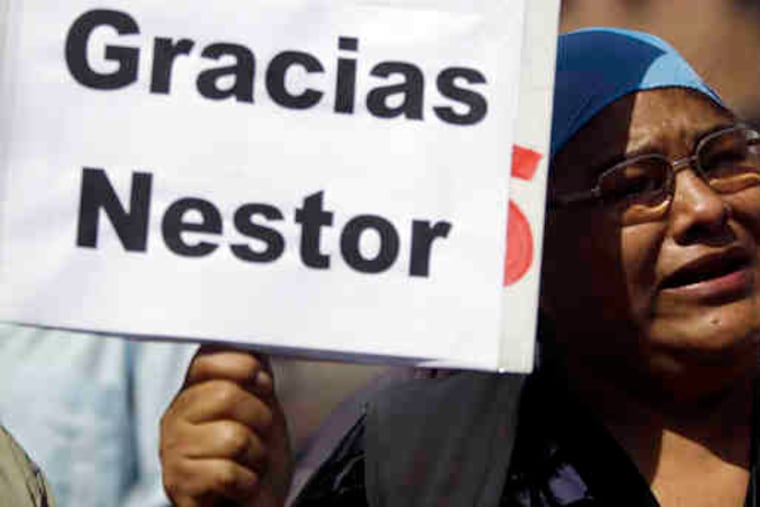
BUENOS AIRES, Argentina - Former President Nestor Kirchner, 60, the husband of Argentina's current leader and a frequently mentioned possible candidate to succeed her, died suddenly Wednesday, apparently from a heart attack.
Kirchner, who guided the country from 2003 to 2007, was a sitting congressman and leader of President Cristina Fernandez de Kirchner's Justicialist Party at the time of his death. He also was secretary-general of the recently formed Union of South American Nations.
Kirchner collapsed at the family home in El Calafate, about 1,500 miles south of Buenos Aires, and was rushed to a hospital, where he was pronounced dead. Fernandez was at his side.
The former president had been hospitalized for heart problems twice this year, and had undergone an operation to ease the blockage of his carotid artery and place an arterial stent.
The government declared three days of mourning, with a funeral to be held Thursday at Casa Rosada, the presidential palace in Buenos Aires.
The Argentine Football Association called off all of the country's weekend matches.
Kirchner's death comes at a difficult time for his wife and poses questions about her ability to lead. He was widely seen as wielding the real power through her, according to Rosendo Fraga, director of the New Majority Union Studies Center think tank based in Buenos Aires.
Kirchner's death prompted an outpouring of condolences from heads of state. President Obama noted Kirchner's role in the Union of South American Nations, which was formed in 2008 and modeled after the European Union. And Venezuela's Hugo Chavez said via his Twitter social networking account: "Ah Cristina, what sadness. Viva Kirchner forever!"
Kirchner, then a little-known provincial governor, was elected president in 2003 with only 22 percent of the vote after first-place finisher Carlos Menem withdrew after the first round. Although Kirchner was described by one magazine writer as "the president nobody knows," he left office immensely popular, smoothing the way for his wife's election four years later.
Kirchner gained approval during his presidency for stripping former military officers of immunity, allowing them to face prosecution for human-rights abuses during the country's 1976-83 dictatorship.
Estela Carlotto of the Grandmothers of Plaza de Mayo, an advocacy group of dictatorship victims, said Kirchner "gave his life for his country."
Many economists said Kirchner helped clean up Argentina's finances, in disarray from a 2001 bond default and devaluation.
Kirchner was at odds with President George W. Bush, however, for loudly speaking out against the war in Iraq. Bush was reportedly offended by Kirchner's treatment of him during the Summit of the Americas in the Argentine city of Mar del Plata in 2005, and for having facilitated an alternative "summit" in Buenos Aires at which Chavez criticized U.S. policies.
With the onset of the global financial crisis in 2008 and the controversial taxes Fernandez imposed on producers of beef, soy and other commodities, she has faced greater difficulties in office than her husband did, analysts agree.
Nestor Kirchner was born in 1950 to parents who were descendants of German and Croat immigrants in Rio Gallegos, capital of the southern province of Santa Cruz in the Patagonia region. He met Fernandez at law school in La Plata, and both became active in populist politics tied to former leader Juan Peron.
Kirchner was detained twice by the dictatorship for his political activities. His first elective office was mayor of Rio Gallegos in 1987. He was elected governor of Santa Cruz state three times from 1991 to 2003.
His death came on a national holiday when most Argentines were at home awaiting the arrival of census takers. A massive rally of support for Kirchner was scheduled Wednesday night in front of the presidential palace.
Besides Fernandez, the former president is survived by their two adult children, Maximo and Florencia.