Eagles not getting much from wide receivers
If you want to know what Chip Kelly really thinks of his wide receivers, particularly the collection of players who line up primarily on the outside, look at how the Eagles' passes have been distributed this season compared with the previous two.
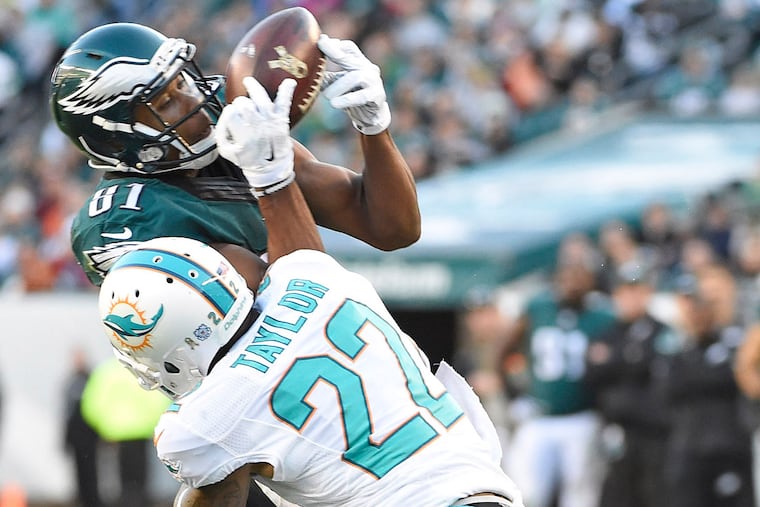
If you want to know what Chip Kelly really thinks of his wide receivers, particularly the collection of players who line up primarily on the outside, look at how the Eagles' passes have been distributed this season compared with the previous two.
In 2013, outside receivers were targeted 45.4 percent of the time, while inside "receivers" - the slot, tight ends and running backs - saw 54.6 percent. In 2014, outside receivers were targeted 43.6 percent of the time, while inside receivers were targeted 56.4 percent.
Through the first nine games this season, the Eagles' outside receivers - Riley Cooper, Nelson Agholor, Josh Huff and Miles Austin - have been targeted 27.7 percent of the time, while inside receivers - slot Jordan Matthews, tight ends Zach Ertz and Brent Celek and running backs DeMarco Murray, Darren Sproles and Ryan Mathews - have seen 72.3 percent of the targets.
Kelly is clearly playing to his strengths, as any good offensive coach would. While he likes to talk up mismatches and defensive schemes - and those certainly play a part in his play calling - the Eagles' passing offense has morphed into one that is more middle-short than outside-deep.
"I think we do have them," Kelly said when asked Monday if he thought he had outside receivers who could get the job done if called upon. "I think everything we do is dictated on who we play. So if we can throw for 300-plus yards by throwing to our tight ends and backs, then we'll continue to do that. And if they take them away, then we need to go to our outside receivers."
One only has to look at the quarterbacks' yards per attempt over the last three years - a sliding scale on the downward tilt - to understand how the departures of DeSean Jackson and Jeremy Maclin have affected the passing game. The average has gone from 8.7 yards in 2013, to 7.4 yards in 2014 to 6.8 yards this season.
There was always something unrealistic about the first number - that it was in part a product of NFL defenses still adapting to Kelly's new offense. But it existed nonetheless, and the 2014 number, while significantly lower, was still above the league norm.
It's difficult to say for certain how Kelly feels about the value of receivers. He released Jackson, but he saved the Eagles about $7 million in salary-cap space for 2014. He let Maclin walk via free agency, but $11 million a year was a steep price to pay.
And Kelly has expended first-, second- and third-round selections on receivers (Agholor, Matthews and Huff, respectively). But their rookie contracts are nowhere near as costly and Kelly has a few years before he has to consider if any are worth a second contract.
But the offense, as Kelly has it constructed now, de-emphasizes the outside receiver position. He wouldn't be the first NFL evaluator to give the position less weight. The Patriots and Seahawks got to the Super Bowl last season without a "No. 1" outside receiver.
Those teams, of course, can compensate with their quarterbacks (Tom Brady and Russell Wilson) and transcendent players at tight end (Rob Gronkowski) and running back (Marshawn Lynch).
Kelly has an average quarterback (Sam Bradford), and after trading away running back LeSean McCoy, a handful of talented pieces (Matthews, Ertz, Murray, Sproles, Mathews) that give him options, but no one that is currently at an elite level.
The other problem with concentrating the strength in the middle with the tight ends and running backs is that Kelly's personnel packages always have at least two receivers on the field at the same time. And he often has three.
He has employed more two-tight-end groupings over the last month, but still nowhere near his use of three-receiver sets, and he hardly ever gets two running backs on the field at the same time. The result has been a lot of outside receiver routes run and little to show for it.
The Eagles have the most inefficient receiver group in the NFL. They're the only team with four in the bottom 30 of 97 receivers with 150 or more routes run in yards per route run. Cooper is 67th, Austin 76th, Huff 85th and Agholor 93d. Only the Titans and Browns have three receivers in the bottom 30.
And it isn't just Kelly's play-calling that is responsible for the lack of production. Bradford has struggled with some of his deep throws - when he has gone there. And the offensive line hasn't always protected long enough. But mostly it's the personnel.
When Bradford has gone to the outside receivers, save perhaps for the Redskins game, they have often let him down with dropped passes and poor routes. In Sunday's loss to the Dolphins, Kelly dialed up a game plan that featured his tight ends and running backs. And there was great production.
But when Austin, for instance, was called upon, he came up small. He dropped a deep ball, wasn't looking for the pass on two targeted throws and another when Bradford had to eat a sack, and he couldn't drag his second foot in when Mark Sanchez hit him deep in the end zone.
"From the angle we saw on film, it was extremely close, but his foot was out, so it was out," Kelly said.
Cooper played 52 snaps and was not targeted at all. The only time he showed up on the stat sheet was when his illegal shift penalty negated an Ertz touchdown pass. Cooper hasn't had a pass come his way in four games.
"Sometimes that's not the receiver's fault in terms of where his production is," Kelly said. "He can't do anything except run his routes and run his plays."
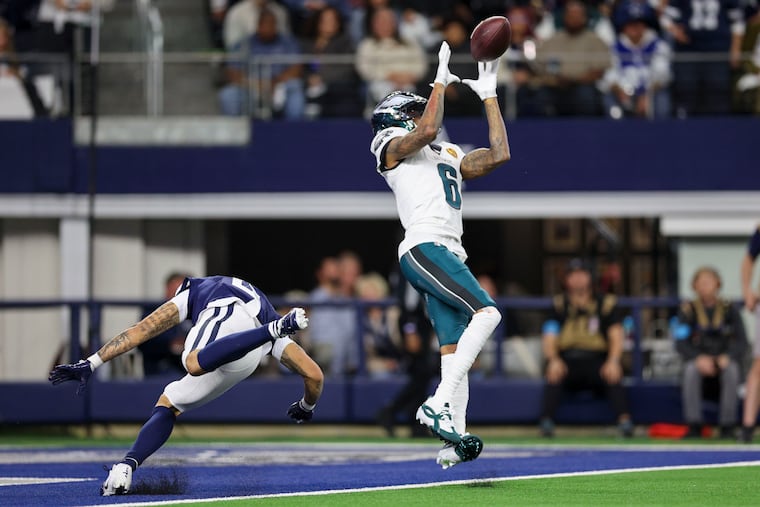
Huff actually had a solid game. He caught a high pass for a touchdown and had several other plus plays. But drops and miscues have marred his two seasons in the NFL. Agholor was playing far too many snaps before he injured his ankle.
And despite what Kelly said, Matthews is still running the great majority of his routes (92.2 percent) out of the slot.
"Jordan is moving in and out of there," Kelly said.
As is often the case with Kelly, his actions speak louder than his words.
@Jeff_McLane