Judge dismisses Jan. 6 seditious conspiracy charges against Oath Keepers
The ruling by U.S. District Judge Amit P. Mehta is the last step in the legal process to wipe out penalties from the Jan. 6 riot.
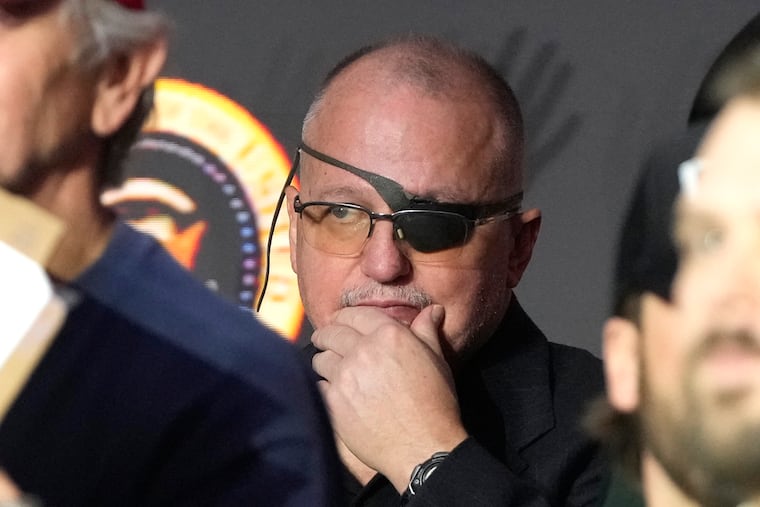
A federal judge on Tuesday agreed to dismiss the seditious-conspiracy case against the leader of the Oath Keepers, Stewart Rhodes, and seven other members of the extremist group who planned to storm the U.S. Capitol on Jan. 6, 2021.
The ruling by U.S. District Judge Amit P. Mehta is the last step in the legal process to wipe out penalties from the Jan. 6 riot, cementing President Donald Trump’s bid to unravel the largest federal investigation in U.S. history.
Mehta had sentenced Rhodes to 18 years in prison and imposed lesser prison terms on other top Oath Keepers who were convicted at jury trials. Trump commuted those prison sentences on his first day in office last year, and he pardoned more than 1,500 rioters.
In a written ruling Tuesday, Mehta said he was dismissing the Oath Keepers’ charges reluctantly at the request of the Justice Department. He criticized prosecutors for claiming in a court filing that wiping out the most serious convictions from the Jan. 6 riot was in the public interest.
“The government does not say that the charges were legally deficient or that the evidence presented is insufficient to sustain Defendants’ convictions,” Mehta wrote. “It confesses to no prosecutorial misconduct, nor does it assert any denial or compromise of a defendant’s rights.”
The Justice Department, Mehta said, was simply bestowing the ringleaders behind the riot “unearned grace by wiping their records clean” after juries found them guilty of committing “crimes against the United States itself.”
The riot, during a joint session of Congress that was being held to certify Joe Biden’s victory over Trump in the 2020 presidential election, left more than 140 police officers injured and caused an estimated $3 million in damage.
Rioters marched on the Capitol after a rally in which Trump repeated his false claims that he had won the election. Lawmakers were forced to evacuate, delaying Biden’s certification as the winner.
In his ruling, Mehta recounted how the Oath Keepers stocked firearms at a hotel outside D.C. and exchanged encrypted messages about using violence to thwart the congressional proceedings. The Oath Keeper with the guns, Edward Vallejo, was not called into action, Mehta added.
When the rioters breached the Capitol, about 10 members of the Oath Keepers wearing military gear entered the building. One half of that group ended up in then-House Speaker Nancy Pelosi’s office. The other half headed to the Senate chamber, where they tried with other rioters to “storm past a line of police officers,” wrote Mehta, who was nominated to the bench by President Barack Obama.
A second contingent of Oath Keepers later entered the Capitol and clashed with police trying to clear the building, according to the trial evidence Mehta cited in his ruling.
In addition to Rhodes and Vallejo, the other Oath Keepers whose charges were dismissed are Kelly Meggs, Kenneth Harrelson, Jessica Watkins, Roberto Minuta, Joseph Hackett, and David Moerschel. Harrelson and Watkins were acquitted of seditious conspiracy but convicted of other riot-related offenses.
An attorney for Rhodes, James Lee Bright, said in a post on X that Mehta’s ruling to dismiss the Oath Keepers’ case “personalizes his reasoning.”
Rhodes, he said, was convicted of a “thought crime” that “should never have been charged.”
“This chapter is now over,” the attorney wrote. “Congrats to the remaining defendants.”
In a court filing Tuesday, attorneys for Vallejo maintained that he was not guilty of a crime. “The Court correctly granted the motion to dismiss with prejudice based on the government’s exercise of discretion but incorrectly injected advisory opinions that are contrary to the presumption of innocence and unfair to an innocent man,” the attorneys wrote.
Trump pardoned nearly all the rioters — more than 1,500 — who were charged by the Justice Department in the wake of Jan. 6. But that blanket pardon, issued on the president’s first day in office last year, did not extend to about a dozen leaders and prominent members of two extremist groups behind the violence, the Proud Boys and the Oath Keepers.
Those defendants were convicted of carrying out a seditious conspiracy against the United States or related offenses. Trump initially commuted their prison terms, stopping short of a full pardon. But this year, while those cases were being appealed, Justice Department officials filed legal papers to vacate the convictions altogether.
The D.C. Circuit federal appeals court granted that request in May. U.S. Attorney Jeanine Pirro, a Trump ally who serves as the top federal prosecutor in D.C., then filed motions to dismiss the underlying charges in U.S. district court.
Judge Timothy J. Kelly similarly ruled last month to dismiss seditious conspiracy charges against the Proud Boys. Like Mehta, Kelly said judges are constrained to dismiss charges once prosecutors ask to drop them.
Under Supreme Court precedent, prosecutors have “exclusive authority and absolute discretion to decide whether to prosecute a case,” and they may drop charges “in the interests of justice” even after defendants have been convicted.
Trump’s efforts to reframe the riot have continued. Even in recent days, he has asserted that those charged in the case “were treated so badly.”
“This is the last of the prosecutions seeking to hold accountable those responsible for the events of January 6,” Mehta wrote in his 15-page order dismissing the charges Tuesday.
“That book is now closed. Today’s epilogue diminishes the gravity of that day, denigrates the work of the prosecutors and law enforcement officers who secured these convictions, and excuses criminal acts that caused a centuries-long pillar of our democracy — the peaceful transfer of presidential power — to buckle.”
He added, “The court cannot write a different ending.”