The candidates vying to succeed Dwight Evans got a chance to ask each other questions. Things got tense.
The candidates' questions offered hints as to which rivals they view as most threatening in the crowded Democratic primary congressional race.
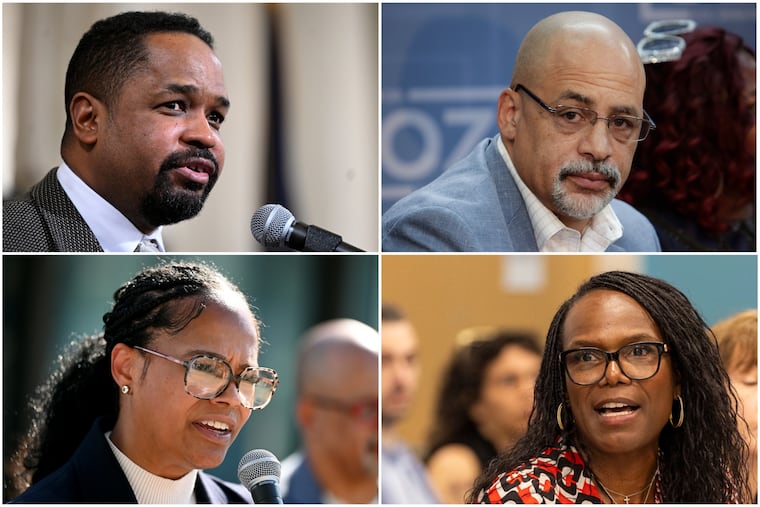
With a crowded field of Democrats who largely agree on policy issues, it’s been difficult to differentiate the candidates in this year’s race for Philadelphia’s open congressional seat.
But at a forum Monday night, the top candidates for the 3rd Congressional District, which is being vacated by retiring Democrat Dwight Evans, began to make clear where the battle lines are — by taking shots at one another.
At the end of the event, the moderator, 21st Ward Leader Lou Agre, allowed the candidates to ask one another questions. Their choices offered hints as to which of their rivals the candidates view as most threatening.
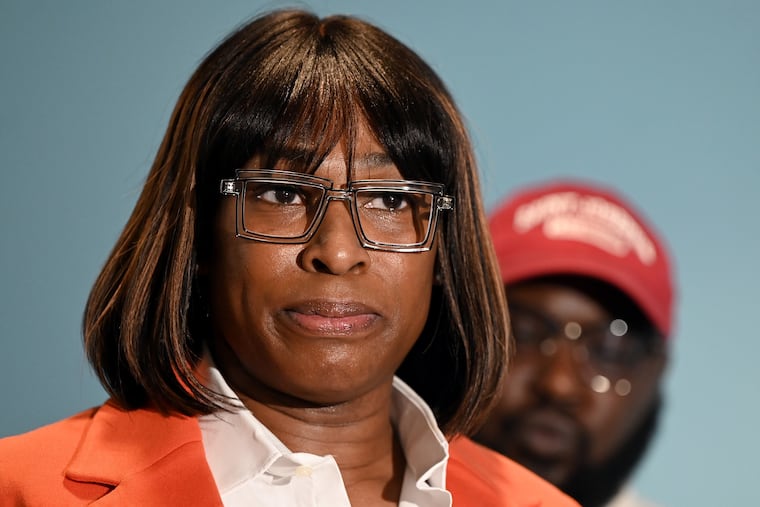
Dr. Ala Stanford, who appears to be the strongest candidate among the non-elected officials in the race, questioned the accomplishments of State Sen. Sharif Street, who is seen by many as a frontrunner after being endorsed by the Democratic City Committee and building trades unions.
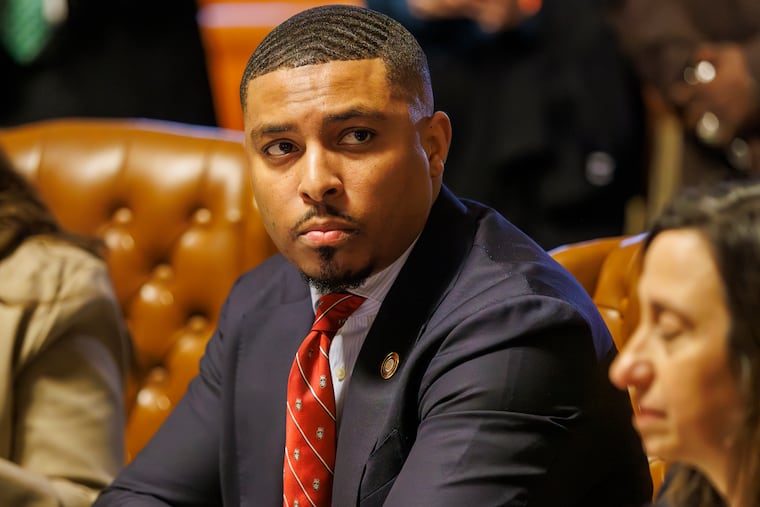
Street, in turn, fired a question about hate crime legislation at State Rep. Chris Rabb, a progressive who could counter Street’s hold on the Democratic establishment if he consolidates support from left-leaning organizations.
Lastly, State Rep. Morgan Cephas came after Stanford, prompting a tense exchange about the physician’s government contracts.
» READ MORE: Here’s who is funding Philly’s crowded race for Congress
The 3rd District covers about half of Philadelphia and is, by some measures, the bluest seat in Congress. The Democratic primary is May 19.
The forum was initially scheduled to be held in-person at the Polish Legion of American Veterans’ Adam Kowalski post in Roxborough, but it was moved to Zoom due to the blizzard on Sunday and Monday.
Here are the issues the candidates debated Monday night.
Stanford questions Street’s accomplishments
Stanford, a pediatric surgeon, has been widely celebrated for founding the Black Doctors Consortium to help reach underserved communities during the COVID-19 pandemic.
She began the candidate-on-candidate questioning on Monday by asking Street for instances in which his work has helped constituents in tangible ways, setting up a juxtaposition with her record.
“In a time when the people are asking for new leadership, they’re asking for innovation, they’re asking for not the same politics as usual ... can you tell the people a time when the seas were rough and you stepped up and delivered for them that they felt it?” Stanford asked, adding: “Can you share what you can do during the chaos that people can feel — and where was it during COVID?”
Street began by saying that, as the top Democrat on the Senate Banking & Insurance Committee in Harrisburg, he boosted Stanford’s work during the pandemic by pressuring insurance companies to reimburse her fledgling organization, which provided testing and vaccinations for thousands of Philadelphians in disadvantaged neighborhoods.
“Independence Blue Cross was not moving forward with the reimbursement rates for the Black COVID Doctors Consortium,” Street said. “I spoke with you, and I helped, and I reached out to them to make sure that [the Medicaid plan] Keystone First would begin to pay the reimbursement in an immediate way.”
He also said his office distributed food to constituents and helped process rent rebates during the pandemic.
In the run-up to the 2020 election, Street, as chair of the Pennsylvania Democratic Party at the time, repeatedly fought in court against President Donald Trump’s campaign over election administration issues. In her question, Stanford asked Street to focus on what he delivered for his constituents — “not that you sued Donald Trump 20 times and won every time, because how do the people feel that?”
But Street said those legal victories resulted in tangible results, as well.
“Donald Trump wanted to challenge people’s ability to vote in some of the most vulnerable communities,” he said. “I went to court, I stopped him, and I made sure that they had the right to vote, and that was why we were able to pass the vote to remove him from office.”
Street and Rabb clash over hate-crime legislation
When it was his turn to pose a question, Street pressed Rabb on why the progressive was opposed to hate-crime legislation, an issue the two had sparred over at a forum last week.
“You and I have worked to fight for regular folks, for disadvantaged people, for a long time. I was shocked that you ... want to prevent hate-crimes legislation,” Street, a centrist Democrat, said to Rabb. “I’ve heard from so many trans women of color, who are most likely to be victims of hate crimes, and they don’t understand.”
Rabb responded by saying that Street’s line of attack was “shameful and unnecessary.”
“I know you want to win. I just thought you would do it with honor,” Rabb said. “I am an active member of the LGBTQ Equality Caucus. I am the father of a queer son. I represent an active queer community. ... To use this as a political punching bag is just — man, it’s beneath you.”
At the end of the forum, Street clarified that he has no doubts about Rabb’s commitment to the LGBTQ community.
“I had a policy dispute about hate crimes,” Street said. “I did not mean to question your commitment to the trans community or to your kid.”
The dust-up got in the way of a meaningful debate over hate-crime laws, which increase sentences for people convicted of crimes that prosecutors prove were motivated by prejudice against particular groups.
Such laws are common across the country, but they have long faced criticism from the libertarian right, which fears that such regulations could be used to target citizens for political views. The laws have also faced pushback from some on the progressive left, who contend that they contribute to mass incarceration.
“Politicians tout hate-crime laws as proof they care about the marginalized,” Rabb wrote in an op-ed for PennLive last fall. “In reality, the main outcome is more policing, more prosecution, and more incarceration.”
Street said last week that people who oppose hate-crime laws on the “far left ... don’t want to address the antisemitism on the left or the right.”
Rabb has been the 3rd District candidate most critical of Israel’s war in Gaza. Street has also been critical of Israeli Prime Minister Benjamin Netanyahu’s handling of the war, but holds a more centrist view on the conflict in the Middle East.
The Pennsylvania House in 2023 approved a bill to expand the state’s law that criminalizes ethnic intimidation to include sexual orientation and disability status. Rabb voted for the bill, which ultimately died in the Senate amid GOP opposition, but said he had “considerable reservations.”
“We should collectively focus on structural violence and hatred that has been cultivated by the very institutions that have been asked to address this legislation,” Rabb said at the time.
Cephas presses Stanford about her government contracts
Cephas, who represents a West Philadelphia district and chairs the Philadelphia delegation to the state House, questioned how much money Stanford’s nonprofit organization has made from government contracting since the onset of the pandemic.
“You oftentimes quote that you, as a private citizen, came in and saved Philadelphia from COVID, and, you know, there are a number of people on this [Zoom] call that stepped up during COVID,” Cephas said, noting that she worked with Stanford to set up clinics in her district during the pandemic.
“We all did it in our own individual capacity, and we didn’t receive government contracts for it. ... How much in government contracts did you receive during the COVID-19 period?”
Stanford noted that she initially launched the Black Doctors Consortium with her own financial resources to serve neighborhoods that were not being reached by existing healthcare and government institutions. She said her first $1 million city grant for testing came months after she began her work.
In 2020 and 2021, Stanford’s groups received $2.5 million in grants and contracts from the city, state, and federal governments, according to Stanford campaign manager Janée Taft-Mack. That money covered costs including supplies, staff, mobile medical units, personal protective equipment, and facility rentals, Taft-Mack said.
Since then, Stanford has continued partnering with government agencies to address healthcare inequality. She has opened the Dr. Ala Stanford Center for Health Equity in Swampoodle and secured a $5.38 million contract for the Black Doctors Consortium to work at Riverview Wellness Village, the city-owned drug recovery home.
The total amount Stanford and her organizations have received for work since 2021 was not immediately clear.
Cheesesteaks, of course
Dr. David Oxman, an intensive care physician at Jefferson University Hospital who lives in South Philadelphia, closed the open question session by asking his fellow candidates what cheese they order on their cheesesteaks.
Philly’s most famous culinary offering has proven politically hazardous over the years, such as when John Kerry catastrophically asked for Swiss cheese while visiting Pat’s King of Steaks during the 2004 presidential election.
This year’s congressional hopefuls were better prepared than the Massachusetts senator.
Agre, the moderator whose ward includes much of Roxborough, interjected to insist that Dalessandro’s served up the best steak sandwiches in the city.
Cephas said she orders Cooper Sharp at Angelo’s Pizzeria. Stanford’s go-to is American from Dalessandro’s. Street, a vegetarian, said he gets non-meat cheesesteaks from Hip City Veg and enjoys the cheese they use. (Mozzarella, per Hip City’s website.)
And Rabb shouted out the cheesesteak egg rolls from Black Dragon, a West Philadelphia establishment offering a “unique fusion of Black American cuisine presented with the familiar aesthetics of classic Chinese American takeout,” according to its website.
Still tense from the previous questions and perhaps a bit peckish, the candidates declined Agre’s offer to deliver closing remarks.
Staff writers Max Marin and Ryan W. Briggs contributed to this article.

- Meet the Democrats vying to replace Dwight Evans in Congress
-
Ala Stanford is banking on a healthcare message to break through crowded Philly primary for Congress
-
Big money is flooding into the Philly congressional race as all three front-runners hit the airwaves
-
How two Philly congressional candidates are quietly guiding super PACs in plain sight