Sharif Street, Ala Stanford and others vying to replace Dwight Evans in Congress make their pitch in Mt. Airy
Nearly a dozen candidates are competing to represent a district that is among the most Democratic in the nation.
Philly’s first competitive congressional primary in more than a decade is officially underway.
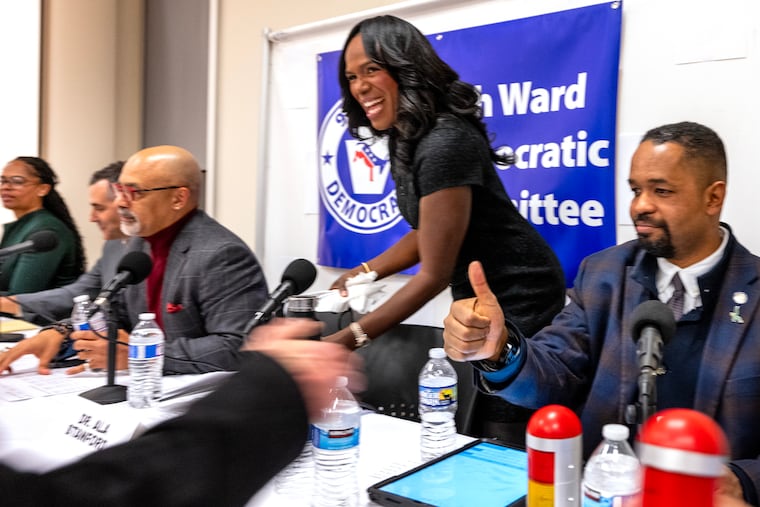
On Thursday night in a standing-room-only auditorium in Mount Airy, State Sen. Sharif Street, State Reps. Morgan Cephas and Chris Rabb, and doctors Ala Stanford and David Oxman made their opening pitches to voters for why they should represent the 3rd Congressional District, which stretches from Northwest Philadelphia to parts of South Philly.
The candidates are vying to replace retiring U.S. Rep. Dwight Evans in a district that is among the most Democratic in the nation. Thursday’s packed forum, hosted by the 9th Ward Democratic Committee, was largely an opportunity for candidates to introduce themselves to a heavily engaged community more than five months before the May primary.
The five candidates represent only a fraction of nearly a dozen declared in the race. They were invited based on fundraising and endorsements, ward chair Jeff Duncan said in opening remarks.
Here are some takeaways from the evening.
Why are they running for Congress?
It’s tough to run for office without a compelling “why,” and each candidate made a personal pitch to the crowd.
Cephas talked about being a toddler in a stroller while her mom picketed with American Federation of State, County, and Municipal Employees District Council 47, the union representing many of Philly’s city workers, back in 1986. She said she wants to bring a family history of activism and her experience in Harrisburg, where she has championed maternal health, to Washington.
Oxman, a medical professor and intensive-care doctor, said Philadelphians are in the midst of a health crisis — not just because of deteriorating physical wellness, but also from mental and financial strain. He talked about building trust with patients and colleagues and taking an outsider approach in Congress, where there are only a handful of doctors serving.
Rabb, on friendly turf in Mount Airy, an area he represents in the state House, separated himself from the Democrats sitting beside him by arguing he is the only true progressive in the race who would bring needed energy to Washington, “not another establishment ally.” Throughout the forum, he called out Democrats who take money from corporations and who he argued have been unwilling to fight for progressive causes.
Stanford gave a compelling rundown of her personal backstory: born to a young mother in poverty and going on to be the first Black female pediatric surgeon trained in the United States. Stanford played a key role in responding to the COVID-19 outbreak in Black and brown communities in Philadelphia and now operates a health center in North Philadelphia. “I’m running because I lived it and I understand it, and I won’t wait for permission in Washington,” she said.
Street, the son of former Mayor John F. Street and the former chair of the Pennsylvania Democratic Party, opened by talking about the scourge of gun violence in Philadelphia and how it has affected his family and staff. He also said he has experience sparring with President Donald Trump in defending voting rights in the state when Trump sued to try to overturn the outcome of the 2020 election here after losing to Democrat Joe Biden.
Frustrations with ICE
On the topic of immigration, candidates were unanimous that U.S. Immigration and Customs Enforcement needs to be reined in, if not totally abolished.
Street called the agency “corrupt to its core” and one that recruits “racists and neo-Nazis,” a reference to scrutiny over the imagery used in ICE’s recent campaign.
Cephas said there needs to be better oversight of immigrant detention centers. Democratic lawmakers have been turned away from facilities in recent months when they have attempted to review conditions.
Rabb thinks those centers should be dismantled altogether and took the opportunity to contrast the moment with Trump’s first administration. “Yes, ‘abolish ICE’ is popular these days,” he said. “But when I was leading families into sanctuary in 2017, people weren’t talking then. We have a bigger villain now.”
Oxman said he didn’t know if ICE was “salvageable.”
“If you have to wear a mask at work to hide your identity, maybe you should be asking a few questions,” he said.
Rabb and Oxman vow not to take pharmaceutical, insurance PAC money
Only Rabb and Oxman said they would commit to refusing corporate donations from pharmaceutical or insurance firms.
Rabb said he has never, since his first election in 2015, taken corporate PAC money.
Oxman told a story about colleagues at the hospital getting wined and dined by pharmaceutical companies and insisting they were unaffected by the gifts. “I asked them, ‘Why do you think they do it?’” Oxman said. “Because it works.” He added he’s a “hell, no” on taking pharma and insurance PAC money.
Cephas, Street, and Stanford all promised to work to hold those industries accountable without committing to forgo their money on the trail.
Rabb comes out strongly against sending arms to Israel
Candidates were given one minute to say whether they would support a bill that would prohibit sending more weapons to Israel, two years after the start of its war in Gaza following the Oct. 7, 2023, attack. Street said it was an insufficient amount of time to cover an exceedingly complex topic.
He said violence is correlated with poverty — noting the disproportionately high homicide rate in his neighborhood, where people are struggling to afford groceries — and stressed the need to get humanitarian aid flowing in Gaza.
Cephas said she would want to have conversations about the proposal. Oxman said that the enemy is “extremism on both sides” and that any country receiving arms from the United States has to live up to certain standards.
Stanford said that as a mother and a surgeon who cares for children, she believes there is “no justifiable reason for a child to lose her life,” but did not weigh in on the bill.
Only Rabb answered definitively, saying he would support the bill to block weaponry to Israel. “There are no two sides in this when we see the devastation,” he said of Gaza, where the death toll has surpassed 70,000 since Israel launched its military campaign.
Abortion question prompts some personal stories
Asked how they would protect women’s reproductive rights, several candidates shared personal stories of grief or hardship.
Stanford said there is a need for more doctors in Congress with lived experience and talked about having had a miscarriage.
“Unfortunately, I am one of those Black women who was treated with racism and bias, and it impacted the livelihood of a child I did not carry to term,” she said. “I will fight for reproductive rights, and that also includes the right to choose.”
She noted she had worked closely with Vice President Kamala Harris on postpartum-care initiatives for women.
Street said reproductive rights have to extend to expanded in vitro fertilization protections and access. He said that he and his wife, who had children from previous marriages but wanted to have another, went through IVF.
“It didn’t work, but we did try it, and everyone should have that option,” he said, adding there is power in people telling their stories.
Boosting their party beyond Philadelphia
May’s Democratic primary winner in the extremely blue district is all but guaranteed to become Philadelphia’s newest congressperson next fall. All five candidates vowed to help Democrats win in congressional races around the state following the May election.
Cephas said it’s not “enough to be safe here in Philadelphia” without a Democratic majority in the House.
Street made a case for his experience campaigning as a past state party chair.
Rabb argued a progressive voice is the way to motivate voters around the state. “Are we gonna have a status quo person or a transformational leader?” he asked. “And if that person’s a transformational leader, they can help reach beyond the traditional base around the state. The Democratic Party has been sleeping on folks.”
Ultimately, the direction the 3rd District goes will likely get national attention for what it says about the preferences of Democratic voters in urban areas like Philadelphia. Oxman argued that means selecting the right messenger.
“Whoever represents it has to think about how their message is heard around Pennsylvania. We need a message that can rally the whole state. What happens here has national import.”