New Medicaid rules could disqualify thousands of Philadelphians. City officials are trying to stem the problem.
Mayor Cherelle L. Parker's administration is working to reach people who could lose coverage under new eligibility and administrative rules that will take effect over the next several months.
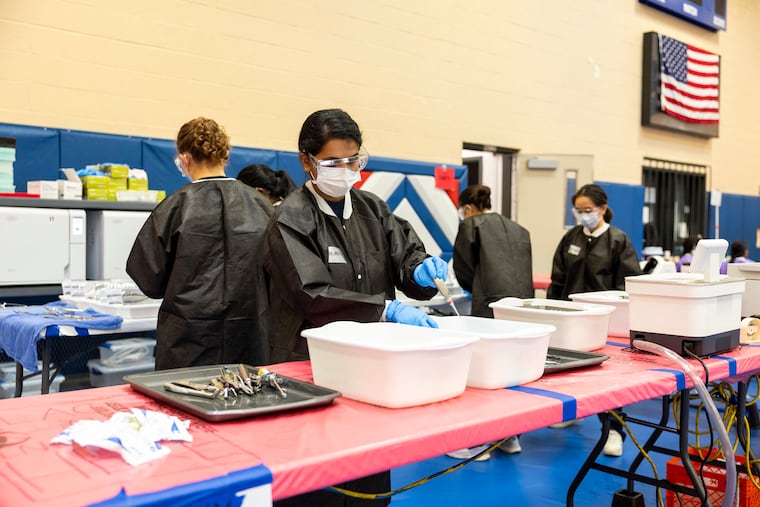
Philadelphia city agencies have launched a multipronged planning and outreach effort to ensure tens of thousands of city residents don’t lose healthcare access as changes to Medicaid take effect now and in the coming months, according to top officials in Mayor Cherelle L. Parker’s administration.
First Deputy Managing Director Crystal Yates-Gale, who oversees much of the city’s health and human services programming, said in an interview that the city is reaching out to thousands of vulnerable people under the new eligibility rules.
The city’s effort, dubbed the One Philly Medicaid Access program, includes a public outreach campaign and plans to assist Medicaid enrollees in maintaining their coverage amid new hurdles, including meeting work requirements.
Yates-Gale said her biggest concern is that residents who are still eligible for Medicaid could lose coverage if they are unaware of new administrative requirements.
“The thing that keeps me up most at night is having someone fall through the cracks,” she said.
What triggered the new Medicaid eligibility rules?
The changes to Medicaid were set in motion last year under the sweeping One Big Beautiful Bill Act, which was championed by President Donald Trump as a cost-saving measure. The state Department of Human Services estimates that more than 70,000 Philadelphia residents could lose Medicaid coverage.
» READ MORE: Across Pennsylvania, more than 300,000 people could lose Medicaid coverage
Some of the changes to eligibility took effect last week. Several groups of legal immigrants, including people who were granted asylum and those who are temporary humanitarian parolees, can no longer be covered by Medicaid. Legal permanent residents, including green-card holders, will maintain coverage.
City officials could not estimate exactly how many residents fall into those categories. Pennsylvania state officials say there are 150,000 noncitizen immigrants with legal status who are covered by Medicaid.

- Pennsylvania Department of Human Services — 877-883-6383
- BenePhilly: Free, one-on-one support to apply for public benefits — 844-848-4376
- Community Behavioral Health (CBH): access to physical and mental health care — 888-545-2600
- Community Legal Services — 215-981-3700 for the Center City office or 215-227-2400 for the North Philadelphia office
Additional changes take effect on Jan. 1 and target Medicaid enrollees who became covered when the program was expanded under the Affordable Care Act. Yates-Gale said the new requirements could potentially impact tens of thousands of Philadelphia residents, including many who may not know that they are covered by Medicaid.
What are the new rules to maintain Medicaid coverage?
Under the new rules, people who are covered by Medicaid under expansion and previously had to renew annually will now need to do so every six months.
In addition, people age 19 to 64 who qualify for Medicaid under expansion must submit proof every month that they worked, volunteered, or went to school for at least 80 hours. Exemptions exist for people who can prove they are too “medically frail” to work.
» READ MORE: Pennsylvania is among 25 states suing over federal Medicaid rules they say ‘overstep’ the law
Despite Medicaid being a joint federal-state program, city officials said ensuring residents know about the changes to their health insurance is a key priority.
“If you don’t know that you have to submit your proof of work, if you don’t know now that you have to reenroll every six months instead of once a year, then you won’t do it, and then you’ll be left without coverage,” Yates-Gale said. “And you may not know until a visit to the doctor, or God forbid, an emergency happens.”
Loss of coverage is likely to happen on a rolling basis rather than all at once on Jan. 1, Yates-Gale said. That’s because Medicaid enrollees are due to reenroll at different points in the year.
What is the Parker administration doing to ensure residents retain their Medicaid coverage?
To plan for next year, Yates-Gale said the Parker administration has convened several “working groups” that are focused on helping eligible people remain covered, identifying people who qualify for work requirement exemptions, and assessing how the city’s social services could be affected.
Some officials said they are concerned not only about individuals losing coverage, but also about the strain that an increase of uninsured residents could place on the city. The municipal government operates eight health centers that thousands of people, many of them in households with low incomes, rely on for primary care.
City Councilmember Nina Ahmad, a Democrat who represents the city at-large, introduced legislation last week to hold hearings on how the Parker administration is conducting outreach to Medicaid enrollees and what impact a mass loss of coverage could have on the city.
In an interview, Ahmad called on the city’s major hospital systems to “chip in” and conduct additional outreach to affected groups and ensure Medicaid-covered patients know how they can receive care, even if they become uninsured.
“The pain is going to be felt by our constituents here in the city,” she said. “This is the time for the city, including our civic leaders in the city, to mobilize on this.”