Duffy wants $50 billion to avert another ground stop. Experts say money isn’t the issue.
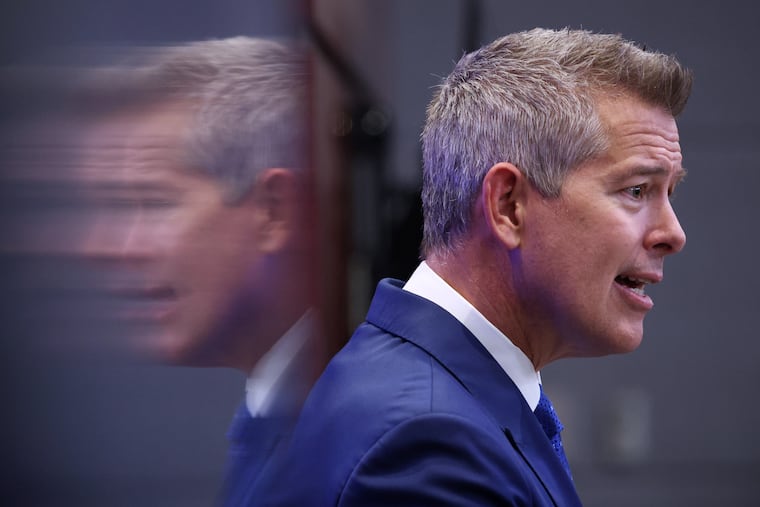
Transportation Secretary Sean Duffy has repeatedly complained about what he says is a lack of money for the FAA to update its systems, implying that Friday’s stoppage could’ve been avoided.
Just two months ago, the nation’s top aviation official sounded pretty pleased with Congress and its financial support for modernizing the nation’s air traffic systems.
“That initial $12.5 billion investment?” FAA Administrator Bryan Bedford said during a House hearing, sounding bullish on the agency’s progress. “Yes, it’s allowing us to build a solid foundation.”
But that $12.5 billion emerged as a contentious flashpoint after Friday’s calamitous 4½-hour nationwide ground stop trigged by a telecommunications failure.
In the days since, Transportation Secretary Sean Duffy, with Bedford often by his side, has repeatedly complained about what he says is a lack of money for the FAA to update its systems, implying that Friday’s stoppage could’ve been avoided if only the agency had received more funding.
Duffy, turning the outage into a fundraising appeal, made his case again Monday.
The FAA needed billions more for the contractors to begin work on the next stage of updating systems, he said.
“They’re ready to go and work with us at a very fast pace. I just can’t tell them to go until we get the money for investment,” Duffy said about the project’s contractors in a CNBC clip he reposted on social media.
But the surprise ground stop was not tied to a lack of funding, according to experts and former agency officials.
“That’s not what caused Friday,” said Tom Lintner, a former FAA air traffic program manager. “Four decades of procrastination and poor program management is what caused Friday.”
Outside experts say transitioning from old systems needs to be done with more extensive planning and care, with backup plans for backup plans, so that a single point of vulnerability — in this case an overactive router in Arkansas — doesn’t bring the nation’s aviation industry to a halt.
Congress gave the FAA $12.5 billion last year as down payment on its efforts, such as replacing old copper wire with new fiber cables — the same work that is believed to have caused the technical issues that resulted in Friday’s decision to close down the airspace.
Duffy acknowledged that first installment of money, but he said the FAA now needed $30.1 billion more for a more extensive modernization effort. On Friday night, he upped the request to $50 billion. He acknowledged the fluctuating figures.
“I was trying to get a number that I think Congress will give me,” he said Saturday.
But the proposed $30 billion funding package — or $50 billion — is only partly aimed at air traffic modernization.
About $10 billion is for a long-range plan to update the air traffic controller computer platform and workstations. Another $10 billion is for renovating air traffic control towers and grants to improve airport runways and terminals. Another $10 billion is to replace or renovate certain airport terminals.
The FAA’s initial modernization push received bipartisan support. At the House hearing in September, Bedford thanked President Donald Trump, Duffy and Congress for passing “a historic $12.5 billion down-payment,” noting that, “We are executing on the most ambitious modernization project of our time and delivering it in record time.”
Now, as the ask has escalated, some Democrats on Capitol Hill have objected that the original $12.5 billion hasn’t even been fully exhausted.
The FAA so far has spent only about $1 billion of the funding it requested, with another $4.3 billion obligated to projects, said Reps. Rick Larsen of Washington and Andre Carson of Indiana.
The ground stop was an expensive interruption for major U.S. airlines, according to report from the brokerage firm Bernstein.
Bernstein analysts estimated the stoppage cost American, Delta, United and Southwest about $345 million. A main driver was the thousands of canceled flights and refunds for passengers who decided not to rebook their flights.