Philadelphia’s historic sites draw tourists from around the world. They’re getting an incomplete version of the President’s House.
Visitors at the site of George Washington's former home responded emotionally to evidence of the largely partisan battle playing out over how to best tell the complicated story of America's founding.
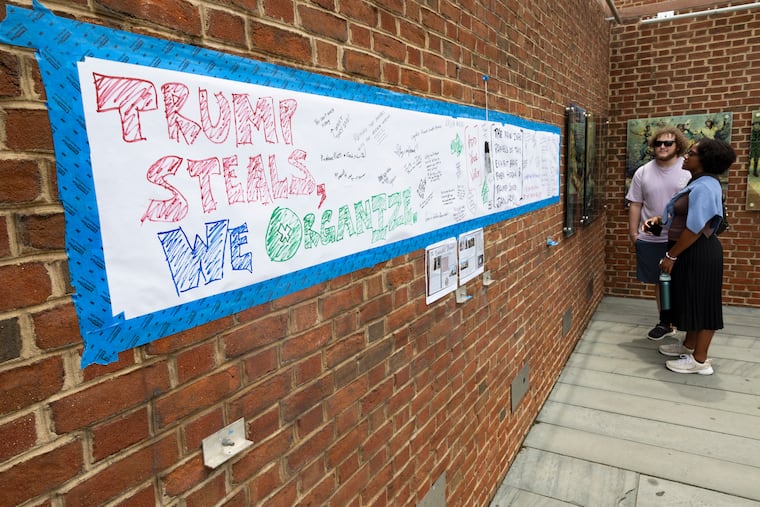
On a sweltering and humid summer afternoon — as tourists and historical reenactors milled about Old City ahead of 250th anniversary celebrations — Cristian Marín guided his family through the President’s House.
Loyal soccer fans, Marín’s family had traveled from Colombia to visit their son in Philadelphia, attend the World Cup matches, and see the Revolutionary Era sites.
But it was up to Marín, 37, to play tour guide last Friday and explain to his family why large gaps of brick wall were covered by paper adorned with handwritten messages expressing their indignation with President Donald Trump after his administration removed exhibits about slavery at George Washington’s former home in Independence National Historical Park.
Marín’s family started laughing from pure disbelief about the “craziness of the situation,” he said.
Marín’s relatives are among an influx of tourists visiting Philadelphia in the lead up to the city’s Semiquincentennial festivities only to find themselves confronted with evidence of the largely partisan battle playing out over how to tell the complicated story of America’s founding.
“For me, it’s shocking to see a country trying to erase that history,” said Marín, a freelance journalist. “I think it’s important to remember our past in order to just not repeat those kinds of things.”
Ahead of the 250th, both Philadelphians who have been engaged in the fight to protect historical exhibits and tourists who have wandered through the President’s House for the first time, have lamented the Trump administration’s changes to the exhibit, which was largely dismantled by the administration earlier this year.
They told The Inquirer that the missing panels, such as those that discuss the brutality of slavery, do a significant disservice to understanding the full picture — even the ugly parts — of U.S. history.
“History is going to be out there, and the more we share history, the better for everybody,” said Hector Vargas, 40, from New York. “For the new generation, and even ourselves, because this is something from the past and we need to understand better — what happened and how this great country basically became the great country it is.”
The Philadelphia Convention and Visitors Bureau estimates that from 250th-related events alone the city will welcome over 1.5 million overnight visitors in 2026.
But the turmoil facing the President’s House is hanging over the celebrations, as the site’s stakeholders and the Trump administration battle over which version of history residents and visitors will see as they celebrate on Independence Mall.
Judges presiding over lawsuits related to the President’s House or other threats by the Trump administration to change historical content at national parks have viewed the Fourth of July as a deadline to set the record straight as to whether the federal government has the authority to rewrite history.
Some advocates believe the Trump administration saw it that way, too.
The Inquirer reported that the federal government also quietly removed mentions of slavery from Independence Hall and a panel under Thomas Jefferson’s portrait at the Second Bank — sending a new wave of outrage among historians and advocates ahead of this weekend.
“In the 250th anniversary of the founding of the Declaration of Independence, there’s probably increased impetus and motivation to get these changes installed before the dawn of the Fourth,” said Paul Steinke, executive director of the Preservation Alliance for Greater Philadelphia.
‘They want to make us believe that slavery did not happen’
Perched on folding chairs bordered by patriotic banners that flapped in the wind, dozens of Philadelphians spent their Friday night at the People’s Plaza, a concrete gathering space just steps away from the President’s House eight days before the 250th anniversary.
A truck displaying a digital screen with the name of the event, “Trump Fascism: Historical Erasure and the Battle Over the Truth,” parked across the street.
With Independence Hall towering behind them, state Rep. Chris Rabb, attorney and advocate Michael Coard, civil rights organizer Masaru Edmund Nakawatase, and visual artist Dread Scott railed against the federal government’s changes to history at an event hosted by Refuse Fascism, an anti-Trump organization.
The gathering is one of many events opponents to the Trump administration’s actions are holding in the days surrounding the 250th. Coard’s group, Avenging the Ancestors Coalition, is hosting its annual Black Independence Day on July Fourth at the President’s House.
“We have so much power and it scares these people. If it didn’t scare them, why would they be worried about this exhibit right here?” Rabb (D., Philadelphia) declared, pointing at the President’s House.
Rabb, who will represent parts of Philadelphia in Congress after winning the Democratic primary for the Third District in May, has often spoken of how he is a descendant of both a signer of the Declaration of Independence who enslaved people and of Black abolitionists.
The Trump administration had spent a year eyeing the President’s House and other exhibits before they abruptly dismantled the site in January, just weeks into the nation’s 250th year. Last year, the president had issued an executive order directing parks to conduct a content review of materials that could “inappropriately disparage Americans past or living.”
Subsequent legal battles have allowed some — but not all — of original panels to be reinstalled, though the administration can now install its own spin on history at the President’s House, the Third Circuit Court of Appeals in Philadelphia has ruled.
But the struggle to confront the full scope of U.S. history is baffling to some visitors, like Camila Ordenana, 24, from Ecuador. Ordenana, who ventured from Guayaquil to Philadelphia to attend a World Cup game, said she has never seen this kind of censorship in her other travels.
“It is weird, because we have been to several places, several historical cities, like, I can remember going to the U.K. or going to Germany, and you can learn about the experience in a very neutral and respectful way,” Ordenana said.
Katrie White, 53, from Illinois, traveled to Philadelphia specifically for sightseeing to learn more about African American history. She said she was disturbed by the removal of the signs.
“They want to make us believe that slavery did not happen,” White said. “And that’s how it affected African Americans, that it wasn’t a big deal, that it made us better. But of course, we all know that it didn’t, and it really did affect us. It was a trauma that is still carried on to this day.”
Many Philadelphians appear to agree.
A recent Suffolk University / Inquirer poll found that a quarter of city residents see preserving historic sites as Philadelphia’s top responsibility to the nation ahead of the 250th.
Gathered by the Market Street entrance of the President’s House last Friday, looking at the colorful illustration panels that remained, Richard Porter grappled with the impact of the removals, saying that without the educational information, “We’ll repeat it over and over again.”
The Michigan resident said that the country is at a point where it needs to move forward but that the changes to the President’s House are sowing further divisions.
“This is an everyday battle. It’s not just today or for the 250; this is all the time,” Porter said.