The Celtics’ blowout win is a wake-up call for the Sixers shooters … though we use that term loosely
Somehow, the numbers were both ugly and not nearly ugly enough. The Sixers shot just 11 of 37 from three-point range, and that only thanks to a 2-for-6 showing from the bench mob.

Are the 76ers a team shooting poorly or a poor-shooting team?
It is a question that mostly lingered in the background during their 9-2 start. That’s no longer the case after a 123-101 loss to the Celtics on Tuesday night. The story wasn’t Jaylen Brown’s lamb chop play-along against Jayson Tatum and his former team. It wasn’t even Paul George, who dropped 36 points in the least-heralded return to Philly since the Season 4 finale of The Fresh Prince of Bel-Air. No, the story on Tuesday night wasn’t personality-driven. It was fundamental. The Sixers couldn’t shoot.
Somehow, the numbers were both ugly and not nearly ugly enough. The Sixers shot just 11 of 37 from three-point range, and that’s only thanks to a 2-for-6 showing from the bench mob in closing minutes of the fourth quarter. Until then, the Sixers were on track to finish shooting under 30% from three for the fifth time in 12 games. Especially notable is the fact that nearly all of their positive production came from two players, one of whom basically needs to be guilt-tripped into taking shots. Tyrese Maxey and Dean Wade combined to hit five of their eight three-point attempts. The rest of the team went 6-for-29 (.206), with two of those makes coming from Anfernee Simons in the last minute of play.

David Murphy alerts
“I really think that, especially in the first half, we were generating really good shots out of their swarming defense,” Sixers coach Nick Nurse said. “We were zinging it out to wide, wide-open guys and we just didn’t hit enough to keep pace.”
It was a problem. As we all know, shooting is a rather important component of basketball. Fast breaks are fun. Defense is key, as are energy and passing and stamina and a bunch of other things the Sixers have excelled at over the first three weeks of the season. That said, the sport is called basketball for a reason. The winning team is often the one that does the best job of making the ball go through the basket. The Sixers were not that team on Tuesday.
» READ MORE: Jaylen Brown faces Celtics for first time, but former Sixer Paul George steals show in Boston’s blowout win
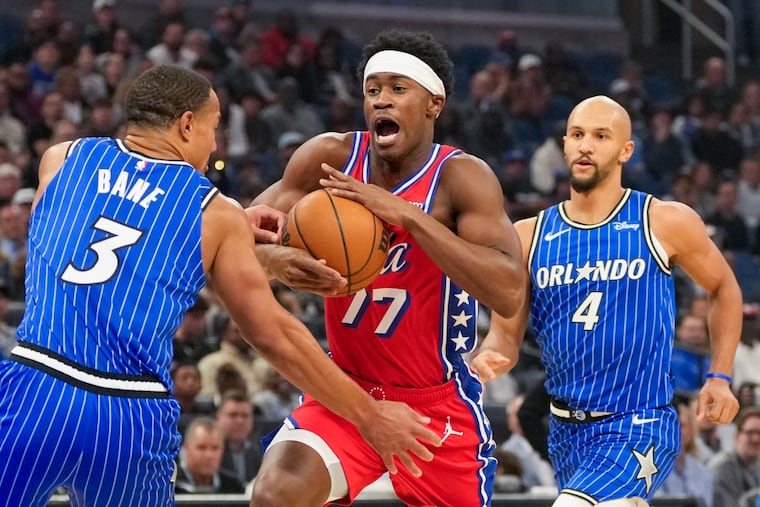
The bigger issue is that they’ve rarely been that team this season. The divide was especially pronounced against the Celtics, who hit 22-of-49 threes and shot 51% from the field overall. Four different Boston players hit at least three threes, with George, Tatum, Sam Hauser and Payton Pritchard combining to go 17-for-32. Meanwhile, four of the five Sixers starters combined to go 3-for-17:
LeBron James: 1-for-6
VJ Edgecombe: 0-for-4
Jaylen Brown: 1-for-4
Joel Embiid: 1-for-3
“They got it going,” said Brown who got into early foul trouble and finished with just 13 points and a minus-27 against his former team. “I don’t know how many threes they hit, but I’ve seen it. I’ve been a part of it for a long time. So I know what it looks like, what it feels like and tonight was one of those nights where they had it going from all angles.”


As good as the Celtics were, and as bad as the Sixers were, the divide was hardly an aberration. This was the seventh time in 12 games that an opponent finished a game with a higher effective field goal percentage than the Sixers. They’ve done an admirable job of making up for it, including in hard-fought victories over the Cavaliers and the Pistons. But it’s an awfully tough way to make a living over the long haul.
It’s an issue that’s more than worth discussing. Before Tuesday, you could have been accused of picking nits for calling attention to the Sixers’ failure to capitalize on the wealth of shooting opportunities that naturally flowed from Maxey’s MVP-caliber play. At 9-2, with a couple of wins over the Knicks amid a fairly tough early-season schedule, the Sixers had somehow managed to surpass expectations with their defensive effort and preternatural chemistry. But their shooting troubles were a major reason to avoid crowning them the Eastern Conference front-runner, at least until they’d played the Celtics.
Heading into the game, most of the attention was paid to the cold war between Tatum and Brown, the latter of whom had earlier disputed the characterization of their frosty relationship as a “beef” while also acknowledging it was at least “lamb chops and gravy.” The more meaningful drama was the Sixers’ opportunity to show that they really were NBA Finals frontrunners. They did not seize it.
Which brings us back to our initial question. How much shooting improvement can we expect to see?
“I think that we’ve got some guys that are shooting lower than their last season or career average,” Nurse said. “Like, almost a handful of guys. And I don’t think it’s because they are shooting fall-away contested ones. They’re shooting shots we want them to take. So I think we’ll continue to take them and I’m pretty sure those will even out into their career averages.”
The most obvious for instance is Embiid, who entered the game having missed a remarkable 21 three-pointers in a row. James is another. A career 34.8% three-point shooter, LeBron is now 9-of-38 on the season.
At the same time, Embiid and James are both in roles where their distance shooting is mostly a bonus. The offensive ceiling of this team lies more in a guy like Edgecombe, who is going to need to take a big step in his catch-and-shoot game given the number of opportunities he sees while sharing the court with the other four starters. Edgecombe entered the night with a solid .388 shooting percentage from three-point range. But he spent much of Tuesday night deferring after misses. Given the nature of the other four starters, Edgecombe’s spot ideally produces a couple of catch-and-shoot threes most nights and multiples of that some nights. He isn’t that player yet. The hope is that he can get there by the end of the season.

Inquirer Sixers reporters Gina Mizell and Chris Hine talk about how LeBron James’ mind is one of the Sixers’ best offensive weapons, and they debate where the Sixers will finish in some key statistical categories. Watch here.
Watch the full interview below and subscribe to the Sixers Extra podcast on Spotify or Apple Podcasts.
Then again, maybe the answer is a guy who’d much rather not shoot. Wade was a lot of what the Sixers needed him to be against the Celtics, connecting on 2 of 4 three-point attempts in addition to his usual standout defense. The Sixers would love to see even more.
“I think he’s getting there,” Nurse said. “We certainly feel like there’s shots that he turned down in the first half a dozen games for sure. But again, I don’t think he’s quite in the mindset to take them. … We need his spacing. That’s obviously why we signed him. He’s a spacing big and we need that for sure.”
Wade’s reluctance is partially a symptom of his positive attributes. He is a hard-wired connector who wants to keep the ball moving and get a better shot for his teammates. But there is a very real and potentially game-changing dynamic that can be unlocked in his pure, frictionless mechanics.
“I’ve always been kind of that guy to pass up a good shot for me to get a better shot for my teammate,” Wade said.
His tone suggested he has long been aware of the downside of such a mentality. His performance on Tuesday suggests he is becoming aware that a good shot for him might actually be better than a better shot for a teammate.
The Sixers clearly need someone besides Maxey to pump up the volume.