Ryan Richter’s journey to Union interim head coach follows a familiar path for the club
The Union have a long road ahead if they want to make the playoffs. But Richter, a Southampton native and La Salle alumnus, is "excited to see how far we can take this" as interim coach.
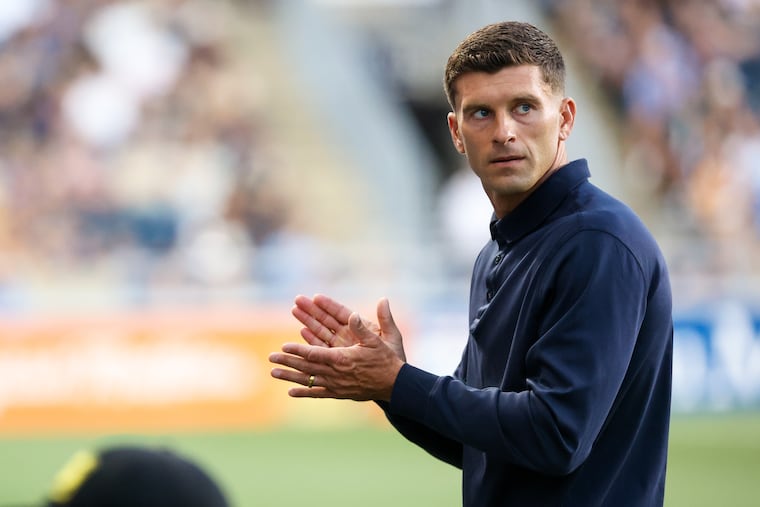
It has the potential of being a dream story, really.
It’s also one the Union have played out before. Stop if you’ve heard this: An area native and former professional climbs the ranks to become the franchise’s manager.
Part 1 of that tale was former manager Jim Curtin. Part 2 is interim head coach Ryan Richter, the Southampton native, 2010 Atlantic 10 Offensive Player of the Year at La Salle, and Union draft pick who played seven professional seasons across MLS and other leagues.
On Wednesday, Richter, 37, stood in the coach’s box on the sidelines at Subaru Park and orchestrated a 3-1 win against rival Red Bull New York.
It was the Union’s first league win at home this season, and, despite their starting centerback holding out, which forced a shift along the team’s back line, the Union (2-10-4, 10 points) looked impressive.
But Richter knows one win doesn’t make him soccer’s Winston Wolf. He’s not quite the fixer yet, but he coaches in a forgiving league. Despite the Union wallowing in the basement of Major League Soccer’s Eastern Conference, there’s still time to chase a playoff run. And that would make it hard for Union brass not to consider revisiting history when it comes to their next full-time manager.
But that’s not on Richter’s mind right now. Well, maybe a little.
“I’ve been a part of this club since 2011 and in pretty much every role, from a coaching standpoint, that you can be involved in,” said Richter, who in addition to coaching the club’s reserve squad, Union II, has coached on just about every level of the club’s youth system, including SWAG, its developmental program dedicated to introducing an underserved population to high-level soccer training.
» READ MORE: Sad that the World Cup is over? Take our quiz to see which EPL team you should support
“I think over that period, I’ve made a lot of good relationships with people, staff in the academy, staff in the second team, ownership, everyone that’s involved in the club … this opportunity for me, personally, is a reflection of all the people that have helped me in this club, all the people that have helped me get to this point.”
For now, all Richter can do is continue to replicate the success from Wednesday and wait. There’s a prevailing belief that the Union not bringing him on immediately is less that they want to conduct a global search for their next manager, than that they don’t want to be on the hook for paying three. They’re still paying Curtin’s buyout and remain on the books with Bradley Carnell, who lasted a season and a half before being dismissed in May, but has a contract with the club through the end of the year.
However, according to a source with knowledge of the proceedings, the Union made few moves to bring in candidates over the seven-week break for the World Cup.
Many within the organization believe Richter already has the respect of the locker room, the tactics to make adjustments within the Union’s playing philosophy, and a “ton of energy,” as Union president Tim McDermott said recently when asked about the team’s coaching situation.
But McDermott’s words felt less like a deflection and more like admitting that right now the club’s on-field leadership is in wait-and-see mode, and part of that is waiting to see whether Richter can turn around the team’s fortunes.
» READ MORE: This summer created World Cup fans, but that's not the same as soccer fans. MLS must bridge the gap.
“He interacts and communicates and relates incredibly well to our players,” McDermott told The Inquirer. “He is a guy that’s not too far removed from playing himself, and that brings a lot of credibility. He carries himself in a way that’s highly respected, and he’s good at simplifying messages to the players so they get it. They understand what he’s trying to do.”
Listen to Richter speak about the game, and it becomes clear that the guy knows ball.
“The philosophy is not going to change,” Richter said. “As someone who’s worked in this club for eight years … three of those years, the Union has had the most points in the league. So what I’ve learned and what I’ve seen produce a winning product is playing this style [and] using this methodology.
“I know it can lead to success when it’s done in the right way. Your job as a coach is to put your players in a position where you only see their strengths. So whether that’s a [4-4-2] diamond [formation], whether that’s a 4-2-2-2, we’re going to try to put the players in a position where we can see their strengths in the game.”
Playing to strengths is a novel idea, considering that Richter had to adapt to a new role when he played for the Union. A striker with a nose for goal, Richter often was used as a more defensive player and even played outside back at times. It may not always have felt comfortable, but he was effective and filled a need that got him playing time.
What did look comfortable? His transition to the sidelines, particularly Wednesday. He stood toe-to-toe with former U.S. soccer stalwart Michael Bradley, Richter’s former teammate in Toronto and now the manager of Red Bull and son of U.S. coaching legend Bob Bradley, and outperformed him.
There are a lot of games left, and the Union likely will take their lumps as they look to write history as one of the few teams that bounces back from the bottom of the standings to squeak into the playoffs.
» READ MORE: People are selling the free World Cup bracelets they waited hours in line for
They’ll need more goals, more opportunities. Communication. And, of course, stacking wins. And there are intangibles, too: timing, luck, leadership.
On Wednesday, Richter made a team down on its luck believe it can bounce back. Time will tell if all those stops along the way have made that last one, leadership, his most significant contribution in their run toward the top of the table.
“The opportunity to take on Union II was something I was really grateful for because it’s so important to learn how to lead a staff,” Richter said. “It’s different when you’re speaking to the players as an assistant coach than when you’re the one making the final decision of who plays on the weekend. Learning that communication piece and learning how to lead people forces you to be honest with yourself every day.
“But, really, it comes down to how you communicate to your players and realizing that everyone’s different. Getting them to do what’s required to be successful is great, and when it all comes together, that’s when you realize that the goals you have for yourself, for them, and for the club are attainable. So, yeah, I’d be lying if I didn’t say I’m excited to see how far we can take this.”
» READ MORE: Follow the Inquirer's complete soccer coverage right here!