Andy Dalton? Tanner McKee? Please. The Eagles lack a real backup quarterback. Unusual. Unsettling.
For a second straight year, the Eagles are without a solid Plan B at the most important position in sports.
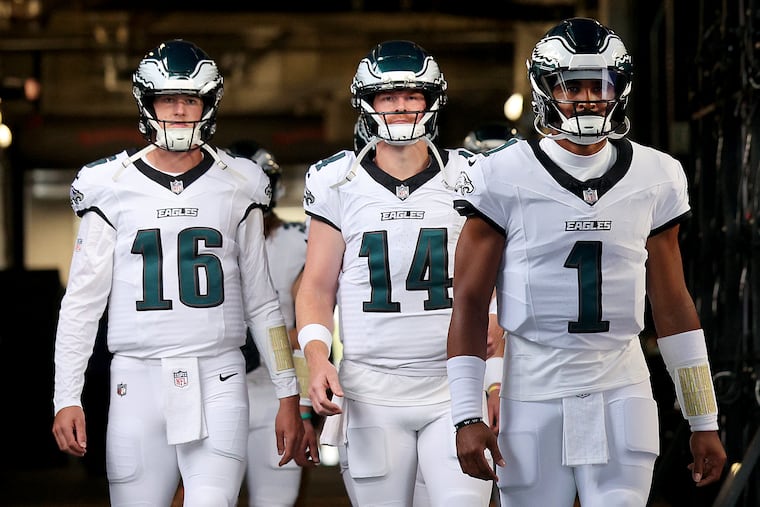
The Eagles used to value the backup quarterback position, perhaps more than any other team in the NFL. Looking at their rosters in 2025 and 2026, it’s hard to believe they still do.
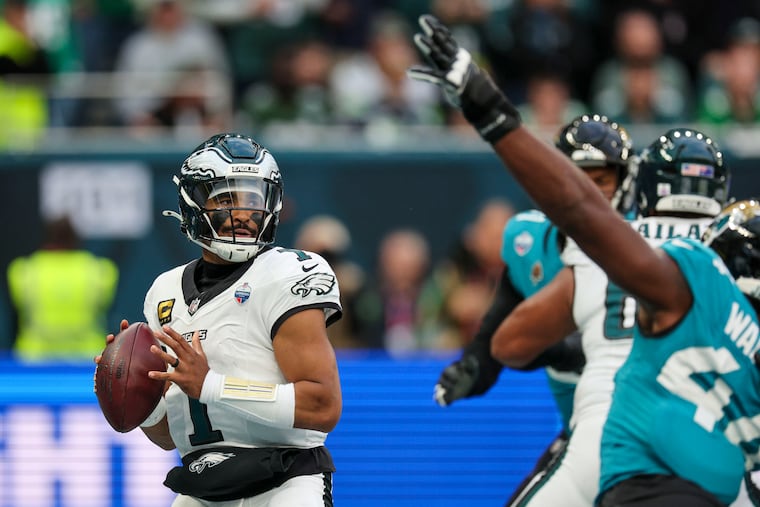
This might not matter at all, except Eagles starter Jalen Hurts gets hurt a lot, and quarterbacks are the most important players in all of team sports.
Still, it seems like a lot of energy to spend on a guy who won’t play much. Backup quarterback angst: The sort of nattering matter that makes the NFL preseason interminable; the sort of infuriating football geek-talk that fantasy nerds Snapchat about.

Marcus Hayes alerts
You know. Guys like Lurie and Roseman.
In 2017, the Eagles committed $11 million to their backup quarterback spot. So important was the position to owner Jeffrey Lurie that he told GM Howie Roseman to sign Nick Foles, whom Andy Reid had just cut from the Chiefs. It meant eating $7 million of the contract of Chase Daniel, whom the Eagles promptly released.
Despite missing the playoffs in 2016 with rookie Carson Wentz at quarterback, Lurie saw 2017 as a real chance to win the franchise’s first Super Bowl, and he considered Foles, who’d had a strong run as an Eagle, to be a better option than Daniel, who’d never had a strong run anywhere.
The rest, as they say, is history: Wentz got injured, Foles replaced him, played well down the stretch, and won the MVP award inSuper Bowl LII where he outplayed Patriots legend Tom Brady and outfoxed coach Bill Belichick.
“Our priority, as you’ve seen, is to make sure we have the very best possible other starting quarterback,” Lurie said during Super Bowl week.
That’s generally been true, and it’s generally made sense for the Birds, since Lurie prefers mobile quarterbacks, who, of course, are more likely to get hurt.
Lurie signed Michael Vick out of prison in 2009, and Vick supplanted Donovan McNabb the next season and went to the Pro Bowl in his second of four years as an Eagle. Lurie drafted Hurts in the second round in 2020 with plans that Hurts would be the long-term backup to Wentz, but that’s before Ginger Jesus lost his job, and maybe his mind. Lurie sanctioned the recent, sensible acquisitions of Gardner Minshew, Marcus Mariota, and Kenny Pickett.
But in 2019, Lurie also approved the signing of Josh McCown, a 40-year-old with a 79.7 passer rating with eight other teams. McCown replaced Wentz early in the Eagles’ home wild-card playoff game, played atrociously (predictably), and cost the Birds their postseason.
Last season, Lurie allowed the Birds to enter the season with third-year sixth-round pick Tanner McKee as the backup of a team defending its second Super Bowl title. It didn’t matter, since Hurts stayed healthy. But McKee got to start game 17 against the Commanders, and he was poor: 21-for-40, 241 yards, one touchdown, one interception, with a forgettable fourth quarter that cost the Eagles their chance to win the game and capture a better seed. It looked OK in the moment, but upon further review, the Eagles (and I) decided that McKee is not the answer.
The Eagles (not I) determined that Andy Dalton is the answer.
They were wrong.
The Birds in March traded a seventh-round pick to the Panthers for Dalton.
No player at Eagles preseason work or in training camp has been a bigger disappointment than Dalton.
That isn’t really fair. There should have been minimal expectations of Dalton.
He’ll be 39 in October. He’s 1-6 in his last seven starts over the past three years, during which time his passer rating is 84.5. Aberration? No. In the five seasons before that, his rating was 85.5 in 57 games. He’s been the backup in Carolina the past three seasons, essentially a big brother for Bryce Young, the underperforming No. 1 overall pick from 2023, and an assistant coach of sorts.
That’s the role he was expected to serve in Philadelphia, where new offensive coordinator Sean Mannion has installed a new scheme. Dalton can help with the adjustment for Hurts, and you’d think Dalton would have a significant advantage over McKee in executing the offense.
But no. Dalton has looked appreciably worse than McKee — so much worse that McKee’s unremarkable performance looks good by comparison.
Entering the third and final preseason game Friday, the competition, such as it is, for the backup job clearly tilts in McKee’s favor. Which delivers this uncomfortable truth:
The Eagles, who have made the playoffs five years in a row, don’t really have a viable backup quarterback. That’s the fault of the front office.
Roseman.
Lurie.
What should they have done?
Maybe they should have signed Mitch Trubisky, who got two years and $10.5 million to back up Cam Ward in Tennessee. Maybe another dance with Minshew, who got $8.25 million to back up Jacoby Brissett in Arizona. Both would have cost a lot more than Dalton’s $1.5 million, but that’s also just about what Tua Tagovailoa got from the Falcons to be the emergency plan if Michael Penix Jr. wasn’t back in time from his knee injury.
All three of those QBs are in spots where they will have a likelier chance to resurrect their careers. Maybe that’s why the Eagles weren’t able to land one of them, and why they had to trade a pick for Dalton.
To be fair to Roseman and Lurie, the Birds also drafted a quarterback in April: Cole Payton, in the fifth round, out of North Dakota State, who currently is not close to being an option.
To be fair to Payton, he might be as good an option as the other two.

For over two decades, one of the guiding personnel principles of the Philadelphia Eagles organization has been to prioritize the offensive line. Through four games, and this past week in particular, the group has undergone dramatic turnover. Hall of Fame-caliber tackle Lane Johnson retired. Cam Jurgens was shipped to Baltimore in a trade. Their respective replacements have potential, but, compared to how general manager Howie Roseman has stockpiled talent on the line in the past, the options now seem less optimal. Did Roseman and the Eagles stray from a long-held philosophy? The Inquirer’s Jeff McLane retraces key decisions that brought the team to this point. Listen here.
Listen to all episodes here or wherever you get your podcasts.