From Northwest Philly to Olympic hopeful, Maurice Scott used rowing as an outlet: ‘The water gave me strength’
For Scott, rowing was an outlet to get away from dangers in his neighborhood, and he became a trailblazer in the process.
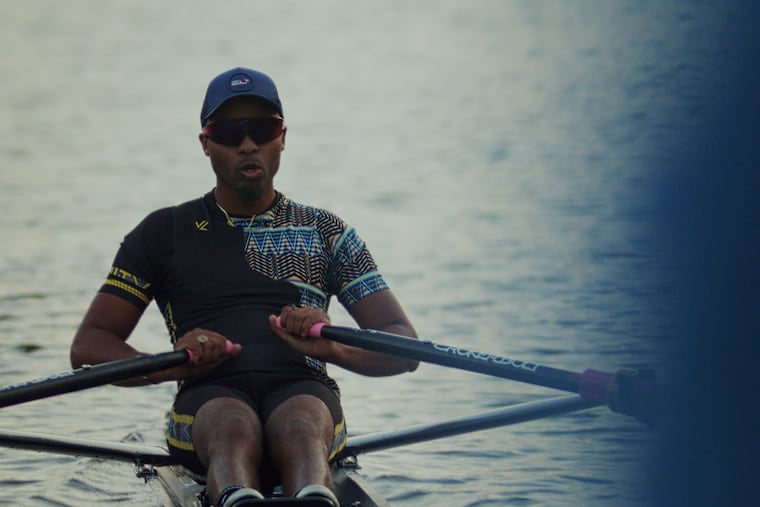
Two years after a Learn to Row program at Boathouse Row, Maurice Scott was reintroduced to the sport when his father took him to his first race. As a spectator, Scott carefully observed each competitor as they walked toward the water.
And as they competed, it wasn’t the technique or the speed of the athletes that stood out to him most. Instead, Scott, who was 14 at the time, was focused on the fact that nobody looked like him and nobody shared his background as a Black kid from Northwest Philadelphia. When he voiced his concerns to his father, Maurice Scott Sr., he responded, “You know, that doesn’t mean that you can’t do it.”
Those words have lived with the younger Scott for the past 18 years.
» READ MORE: What’s life like as a Black student-athlete at a predominantly white institution? Awkward.
Since then, he’s become a Philadelphia city champion and a four-time national champion, has notched multiple Head of the Charles wins, made history as the first Black governor of the Potomac Boat Club, and was honored in the “Philadelphia Rowing: Breaking Barriers” display at the Independence Seaport Museum.
Now Scott, 32, is making a push to compete in the 2028 Olympics in Los Angeles. And as he embarks on his journey to chase his Olympic dream, he’s inspiring other inner-city kids who have a desire to compete in a sport lacking representation.
“It was just silencing the noise on both ends,” Scott said. “And continuing to believe in what I knew and believing that I belong there. That this is where I needed to be. And so just really staying focused on that and keeping the main thing the main thing; Jalen Hurts always said that. That’s legit. And knowing that later down the road, my story will be a story for others to see and to follow and know that it’s no longer a joke. We’re actually legit in the sport, too.”
‘I was the black sheep’
Scott acknowledged the challenges when you don’t see yourself represented.
“It’s just like, ‘Why is that? Is it because the sport wasn’t made for me?’” Scott said. “And when I did step into the realm, people were looking at me sideways because I’m an anomaly. People [didn’t] see athletes of color within the sport of rowing back then. It wasn’t a thing.”
Even his peers questioned why he wasn’t playing basketball or football.
» READ MORE: Philadelphia City Rowing is inspiring public school students to take up a new sport
“It became a joke, honestly,” Scott said. “Like, people would laugh at me actually doing this sport. When people like a sport that isn’t a part of the ‘culture,’ people kind of look at them like, ‘Yeah, whatever.’ I can guarantee you folks laughed at Venus and Serena. I can guarantee you folks laughed at Tiger Woods.
“I was like the black sheep. I didn’t fit the mold. So for me personally, being around the water and doing something around the water gave me strength and provided me something that I could be proud of because I knew that I could be good at it.”
‘A safe haven’
At just 7 years old, Scott witnessed his first drive-by shooting. He’s been robbed, had people close to him killed by gun violence, and stepped over bullet casings as he walked through neighborhoods.
He felt safe in only two places: in church and on the water.
”Being in church, it was like a safe haven, a safe place that I can be myself, and I’ve also created a community there,” Scott said. “I was surrounded by a lot of wrongdoing, but it allowed me to really have that confidence to make sure that I did the right thing as I carried myself through my younger childhood years.
“And rowing was one of those outlets where I can really just get away from all of that. I was scared to go off to school or walk to the bus. I mean, it was that bad. Finding that outlet is important because it just takes your mental state out of the negativity and the picture that’s being painted of the city that you constantly see on a daily basis.”
As Scott struggled to find his place among his community, he always felt a connection to the water.
“The water has always been part of me,” Scott said. “Anytime I’m around it, I just feel strength and happiness. So that’s what kind of drew me to the sport itself.”
» READ MORE: This La Salle rower built an app that’s changing the way athletes train — and the future of rowing
Scott grew up sailing, swimming, kayaking, and rafting. So in fifth grade when he heard about the Learn to Row program at Bachelors Barge Club on Boathouse Row, he thought he would give it a shot. But after the two-week program ended, he didn’t know where to go next with the sport.
“[My father] knew that I just loved the water and he knew how much fun I had when I initially did it,” Scott said. “But it was pretty closed off back then. Boathouse Row in general was very pretentious; there weren’t really wide-open doors. But I think he may have felt something was coming later down the line, and he just wanted to make sure that I didn’t forget it.”
‘Building that one heartbeat’
Philadelphia City Rowing was founded during Scott’s junior year of high school. The nonprofit was designed to provide access to the sport for inner-city youth. He was one of the organization’s first athletes, and it inspired his commitment to diversity in rowing.
“We try to eliminate a lot of the barriers and obstacles that a lot of kids may face in trying a new sport,” said George Rowley, the director of programs and community inclusion at PCR. “I think it’s important to really highlight [alumni] pathways to provide some inspiration for the kids that are just starting out.”
PCR quickly became part of Scott’s family.
“It was all about rowing together and having that unit and having that rhythm and building that one heartbeat within the boat,” Scott said. “And that was something that I really loved and enjoyed because there was no other sport that is really like that, at least that I’ve done. And trauma bonding. Rowing is a painful sport. Rowing started off as a form of torture, and we’re doing it for fun.
”We didn’t look like any other boat on the water. We literally had kids from all over the city. And it was really cool because I got to meet people that weren’t just from my neighborhood, but were from all over and all walks of life.”
» READ MORE: Philly-area rowers Nick Mead and Justin Best struck gold and made history at the Paris Olympics
After his first year with PCR, Scott was recruited to the Naval Academy. But a few weeks before graduating from the Naval Academy Preparatory School, he was told he had a sleep disorder. They said he could graduate but wouldn’t be able to move on. So he decided to accept a scholarship from Arcadia and graduated from there in 2017.
While there, he studied abroad in Australia (2015-16) and competed with the University of South Wales.
Olympic aspirations
As people left the nightclubs at 4 a.m. in Australia, Scott would be heading to the gym. That discipline, which sustained him throughout college, is powering his dream of competing at the LA Olympics in 2028.
Scott moved to Long Beach, Calif., in March 2024 to train at Belmont Shore for beach sprints, a fast, head-to-head race that combines sand runs with a 250-meter slalom boat course. The race will make its Olympic debut in 2028.
“There’s no better way than training on the actual course and really understanding what goes into beach sprints,” Scott said. “One day, I’ll be doing a total of 16 to 30,000 meters depending on what’s going on. One day I could be doing an 8x500, which is full sprints, just back-to-back sprints.”
Growing the sport
Through his talent and telling his story on social media, Scott received a number of sponsorships and partnerships. Now, he’s trying to help other athletes do the same through his name, image, and likeness agency, Rowfluencers.
And he is bringing even more eyes to the sport with his four-part docuseries, FORGED: The Kid from Philly, on NBC Sports Philadelphia.
“Representation is so important,” Scott said. “So, I’m hoping they see this and are like, ‘Hey, it doesn’t have to be wrong. But this challenges me to really find what I like to do and not care about what other people think about because I’m going to do this and be a trailblazer for it and bring in others with me to allow them to not only just live, but thrive within whatever space that may be.’”