This La Salle rower built an app that’s changing the way athletes train — and the future of rowing
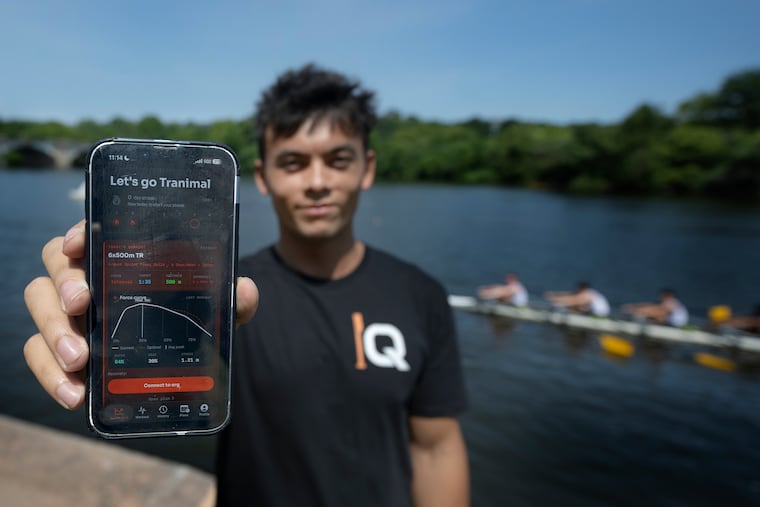
Will Tran, a rising senior rower and computer science major, created RowIQ, which provides an in-depth look on how rowers can improve with “data that’s never been seen before.”
La Salle rowing coach Ivo Krakic had a problem.
The app he was using to track his rowers’ stroke length and the amount of force they were using from the team’s ergometer rowing machines stored the information in different locations. Krakic wanted it on one screen.
Eventually, Krakic contacted and paid the app’s developer to make the fix — which caught the attention of one of his rowers.
“I was like, ‘Dang! My coach is paying $500 for something I could have done in 20 minutes,’” said Will Tran, a senior who primarily rows in the second varsity eight boat. “There’s a real gap in the market here. I used the app as well. I know I could improve this in so many different ways.”
» READ MORE: Breast cancer survivors from Whitemarsh Boat Club are rowing like ‘an athlete’
Tran, a computer science major, decided to build his own app.
The final product became known as RowIQ. The app is an all-encompassing data ecosystem that uses artificial intelligence to pinpoint where and how rowers can improve. The app processes data from Concept2 ergometer rowing machines, smartwatches, and RowIQFuel — Tran’s nutrition app. In the future, RowIQ will also be able to collect data from on-water rowing monitors.
“We have hundreds of thousands of data points that no one ever looks at,” Tran said. “In rowing, these races are sometimes won by a hundredth of a second, so you need that 1% sometimes. Actually, a lot of the time you need that 1%. What we’re aiming to do is give rowers a complete picture of their training with data that’s never been seen before.”
The app also allows rowers to create groups, so coaches have access to their entire team’s data in one location. Tran noted that this feature lets coaches “see trends in less than a second,” allowing them to understand areas of improvement and create lineup decisions with ease.
“It gives you really good data feedback on your [rowing] curve, how you’re rowing, and essentially what you’re doing and how you’re transferring your power,” Krakic said. “We’re able to match the guys indoors and then transfer that onto the water. We’re lucky to have it. It puts us ahead a little bit.”
In the last two months, the app has received over 1,000 downloads. More importantly though, the app boasts impressive user retention. Tran noted that top users are logging over 200,000 meters per week on the app.
Yin and yang
For the first few months of RowIQ, Tran worked alone. But while he tinkered with the app’s coding, Tran found that he had little time to dedicate to RowIQ’s marketing, so he put together a small team. Fittingly, they all have a background in rowing.
A few members from Penn’s lightweight crew team are developing a telemetry system to fully integrate RowIQ’s data into one central location. Meanwhile, former Harvard lightweight rower Zarret Mills is working as a consultant for the app.
One of the most important members of the team has been Sergej Čipak, a former La Salle rower who moved back to his home country of Serbia to pursue electrical engineering. Tran and Čipak spent one year as teammates at 20th and Olney.
“You spend a lot of time together, even when you’re not like racing or training,” Čipak said. “You’re eating together. You go to parties together. So I really grew close with Will over some time. Will has a very interesting personality. He can be kind of cold sometimes and give not-detailed-enough instructions. But I think we have some kind of dynamic that makes us really productive.”
After starting part-time, Čipak’s role with RowIQ has grown exponentially. While Tran focuses on more big-picture endeavors, Čipak leads the app’s development. With the app’s success, Tran has been able to compensate Čipak — something Tran did not think he “would ever be doing at 22.”
“It’s a yin, yang,” Tran said. “On one side, it’s awesome that someone pays for their apartment and their food via your idea and creation. It’s such a wonderful feeling to be able to provide that for someone and do it through something that you are so passionate about.
“And then the other side of it is, I never want to go to sleep and I never want to get outworked because this person is relying on me, and I feel an obligation to always be on, always be working, always progressing. I never feel off. Sometimes I’m with my girlfriend and I say I’m present, but I’m not. I’m thinking like, ‘Shoot, we got to pay Sergej his monthly paycheck so he can pay his rent and buy his groceries.’”
» READ MORE: Malvern Prep and Mount St. Joseph capture historic USRowing Youth National Championships
While Tran is adjusting to the added pressure of managing employees, Čipak is working full-time for a company that is not aligned with the career path he expected to pursue in Serbia. Still, he is on board with RowIQ for the foreseeable future.
“We just crossed 1,000 users a few days ago, so I mean it’s really exciting,” Čipak said. “I never really worked on something like this in my life, and I do plan on keeping on working on this.”
Can’t tell this kid no
In the tech world, “college dropout” is somewhat of a lauded title.
Mark Zuckerberg dropped out of Harvard to run Facebook full-time; Bill Gates did it before him, leaving Cambridge to co-found Microsoft; and Jack Dorsey left NYU a semester before his graduation to move to California, eventually starting Twitter.
The list goes on and on.
Today, chasing the AI boom, tech venture capital firms like Y Combinator and Antler are known to provide college students with hundreds of thousands of dollars to fund their startups. Meanwhile, industry giants like Palantir and Elon Musk’s xAI encourage students to ditch their formal education to work for them instead. Tran is no exception to this pressure.
“I’ve seriously debated taking this fall semester off,” Tran said. “Like genuinely — we’re continuing to close deals with high school clubs, college clubs, recreational clubs. We’re onboarding probably 70 new athletes a day from clubs. It’s huge, and I don’t know if I will have the time in college to do schoolwork, be a Division I athlete, be a boyfriend, and run RowIQ at the same time.
“I have seriously debated taking the fall off and joining some sort of Y Combinator, coming back to school later. Do I think I’m going to do this? Probably not.”
Tran has already sacrificed opportunities to focus on RowIQ. This summer, he turned down an internship offer from a data analytics company. For now, even if the balancing act can seem impossible at times, Tran will try to have it all at La Salle.
“You can’t really tell this kid ‘no’ or ‘you can’t do it,’” Krakic said. “The more you say ‘don’t do this’ or ‘it’s not possible,’ the more he tries to prove you wrong.”