SEPTA’s comeback captain
A year into his role as SEPTA's general manager, Scott Sauer might be the leader Philly needs amid canceled trains, court battles and emergency funding.
SEPTA was teetering when Scott Sauer became the permanent general manager last June. He seemed made for the moment: a homegrown Philly guy, started as a trolley operator in 1990 and worked his way up. A lifer who followed his father into public transit.
It’s considered unusual for a former operator to run a transit agency. No one remembers it happening in SEPTA’s 52-year history.
“If we’d brought someone in from outside, it would have taken them a year to begin to understand how SEPTA is organized,” SEPTA board chairman Ken Lawrence Jr. said.
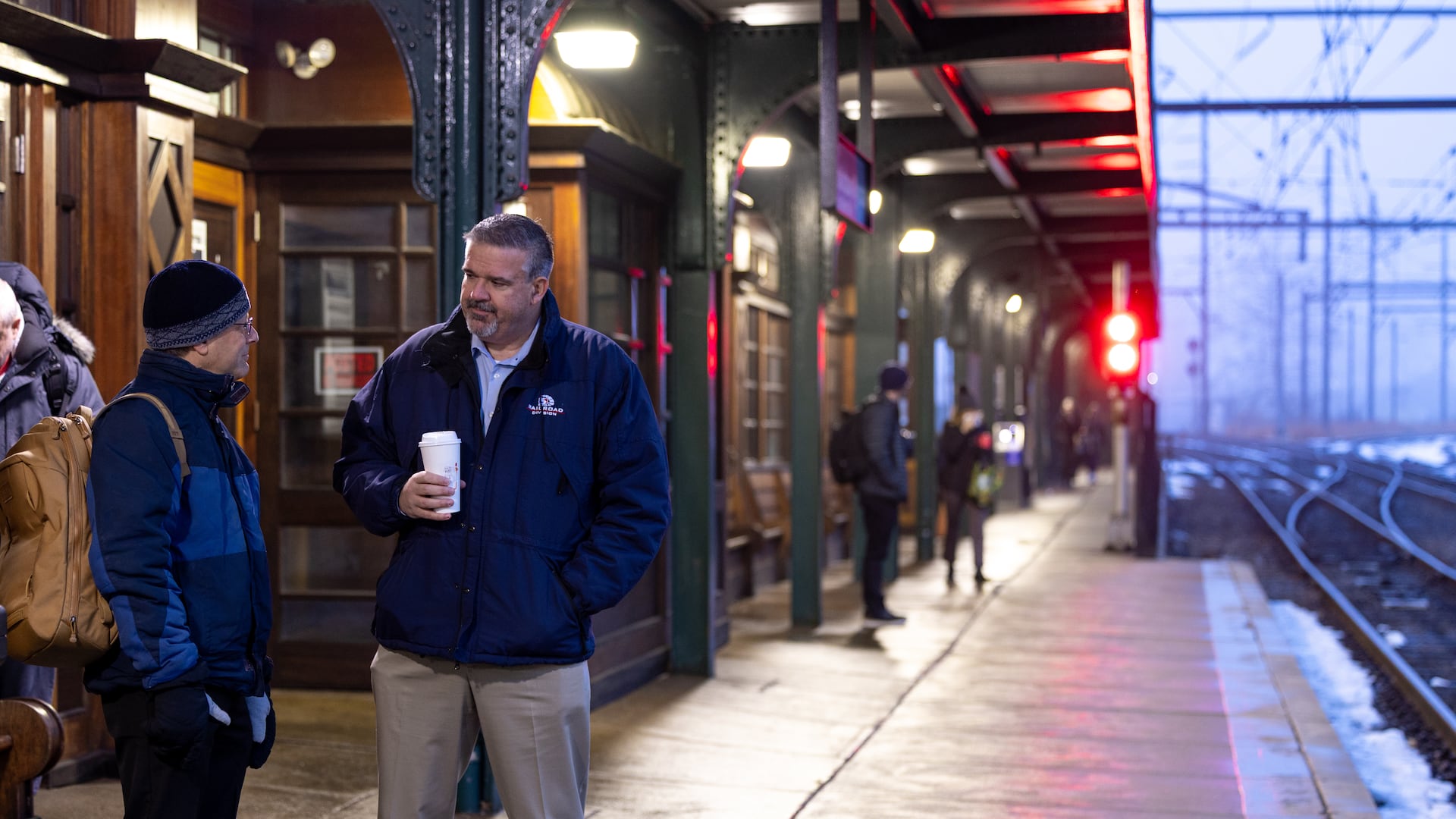
Carrying a 20-ounce paper cup of coffee, Sauer, 55, greeted commuters at Jenkintown Station, performing an act of penance on the platform for SEPTA’s recent failings.
“How’s your experience with us?” Sauer, SEPTA’s general manager, asked a woman as the sun rose on a late February day.
Rough, but better than a month ago, she said.
Regional Rail had been plagued by canceled trains and delays since October 2025, when federal safety regulators ordered 223 rail cars pulled for inspections and emergency repairs after five caught fire earlier in the year.
“I can’t imagine what you guys had to go through every day,” Sauer said. “What can I help with to make it better?”
Just make the trains come on time, she said.
People were taken aback to find the transit boss chatting with them. They didn’t withhold criticism, but most were polite about it. It’s hard to breathe fire at a person who’s looking you in the eye and wants your opinion.
Back from the brink, Sauer now must guide the transit system to a credible showing during the World Cup and the nation’s 250th; implement a postponed new bus network; and simultaneously manage purchases to replace old El cars, trolleys and much of the Regional Rail fleet.
Next year, the fight for state funds begins anew.
‘Hair on fire’
“I came into the job with my hair on fire,” Sauer said. The crises never paused.
Just after he stepped in, the Philadelphia region’s mass transit system began 2025 with recurring $213 million operating budget deficit. After a year of fighting, Gov. Josh Shapiro and the legislature couldn’t agree on sustainable new state subsidies for transit.
SEPTA slashed service to save money. Then a Philadelphia court ordered the cuts reversed.
In September, Shapiro’s PennDot allowed SEPTA to take about $400 million from a state trust fund for transit infrastructure to operate for two years.
Relief? No. Years of deferred maintenance and aged infrastructure hit home, with the Regional Rail fires and, later, safety problems that shut the trolley tunnel for two months. Shapiro sent another $220 million in emergency funds.
It has taken months, but SEPTA is relatively stable — for the moment.
Sauer said he has no time for deep breaths, though.
“I’m always a little bit on edge, to a fault — looking for the next problem to arise,” he said. ”I never feel completely satisfied.”
Political growing pains
So far, Sauer gets credit for improvements in transit operations and a tighter focus on safety, two areas in which he has specialized after he became a manager.
He stresses the basics: service and customer satisfaction.
He has long-standing relationships throughout the organization, though many managerial and administrative employees remain upset at Sauer’s directive they return to in-office work five days a week.
He’s been known to try to have his hands on everything, insiders say, but is learning to delegate.
Mastering some of the public aspects of being head of the nation’s sixth-largest transit agency is taking time, according to Sauer himself and SEPTA sources. Navigating politics has been rough.
“Talking to legislators last year was a new experience for me, and it was stressful, and nerve-racking — I didn’t know what to expect and how I should act,” Sauer said.
He said he feels more natural visiting SEPTA transit depots and other job sites and mixing with employees, or hearing directly from riders.
“Put me in a room with 25 people from your business, pointing cameras at me and recording every word I say … makes me a little nervous,” Sauer said.
But both of those things come with the territory, so he prepares and does them. He thinks he is more comfortable now.
On a mid-August night last year, Sauer was working the Capitol halls in Harrisburg when he got embarrassed in a political collision.
The Senate GOP majority, which was skeptical of pouring more money into a troubled urban transit system its leaders considered inefficient, passed a proposal to tap a surplus in an obscure fund.
In a quick news conference with Shapiro, Sauer opposed the idea. Then he spoke with Republicans and told reporters the idea was worth considering, but he had questions. By the end of the night, he walked that back and opposed the measure.
“I think he was unwittingly used by the House Democrats and the governor to tank our transit proposal,” Senate Majority Leader Joe Pittman (R., Indiana), a fierce opponent, said in an interview.
Pittman said he was not impressed in their initial meetings but that his relationship with Sauer has grown.
“I think he’s a genuine man,” Pittman said. “He was handed a very bad situation, and I think he’s very dedicated to trying to turn the organization around.”
The family business
Sauer stood in a cold rain and fog outside the trailer that is Marcus Hook Station, awaiting the 7:30 a.m. Wilmington/Newark train to Jefferson Station. He held a soft-sided lunch box; it will be a peanut butter day.
“It’s about an hour door-to-door, home to the office,” said Sauer, who lives in Chichester.
Settling into a seat, Sauer scrolled through the 18 text bulletins he’s received from SEPTA comms since 5 a.m. “Normal things, nothing serious going on so far.”
There were a couple of canceled trains on the Broad Street Line, a mechanical issue with a Wawa Regional Rail train, a signal power loss on the Cynwyd Line.
Southwest Philadelphia, Sauer’s neighborhood, appears as the train rolls north.
Neighbors would identify with their block, or the Catholic parish. Sauer grew up on 65th Street and Chester Avenue, near the former Good Shepherd Church.
“It was a tight neighborhood,” he said. “Everybody’s dad was a cop, a firefighter, or worked for the city.”
With SEPTA families in the mix. Sauer’s dad, Robert, drove trolleys. His aunt on his mother’s side also was a trolley operator.
When he graduated from Bartram High School in 1990, Sauer said his dad told him it was time to “get a real job” and suggested SEPTA. He applied in May, was hired in August, attended operator training and was assigned to the Elmwood depot. He could walk to work.
“I like to say SEPTA’s been feeding me since I opened my eyes,” Sauer said.
He was a natural for the top job after a national search, Lawrence said. He also thinks Sauer is a stronger communicator than he gives himself credit for.
“The great thing about Scott is he’s a straight shooter,” Lawrence said, recalling his clear explanation of the doomsday budget in early 2025. “If you ask him a question, he answers the question. … His job is telling people not what they want to hear but need to hear.”
Getting ‘upped’
Willie Brown, the longtime president of Transport Workers Union Local 234 who has known and liked Sauer since they operated trolleys together, remembers one betrayal: Sauer abandoned Elmwood depot’s employee softball team.
“He transferred to trains and wanted to play with their team,” said Brown, now vice president of the TWU international. ”We were mad. He was our best player.”
“He’s a decent dude, a good human. I’ve got no complaints about Scott Sauer,” said Brown, now the vice president of the TWU international union.
Sauer’s background gives him credibility with TWU members, Brown said.
“He understands both sides,” Brown said. “We both have our different jobs to do, and that is going to involve disagreements and arguments …[but] he listens.”
Ron Newman, a TWU business agent who often represents members in disciplinary cases, remembers Sauer as firm but fair when he was a trolley supervisor.
“If Scott wrote somebody up, they deserved it,” Newman said.
When Sauer was named general manager, John Lipscomb recalled texting him: “Well, they opened the books and you got upped.” It referred to a mob soldier’s elevation to “made” man, from the 1997 movie Donnie Brasco.
Lipscomb, 58, is a yard motor operator for SEPTA, moving Market-Frankford El trains to and from their base. From 1993 to 1999, he worked often with Sauer when El trains had two-person crews.
“I never felt like when he became a boss, that he changed. He was the same guy,” Lipscomb said.
They’d hang out during breaks at the end of the line and over lunch, mostly on night shifts, taking about everything. They both loved Star Wars. “We were nerds,” Lipscomb said.
The Disney model
A couple of days after visiting customers at Jenkintown, Sauer took a tour of job sites, from City Hall Station where workers were mounting tall, evasion-resistant fare gates into the floor, up the Broad Street Line to check progress on an elevator project that will make the 1905 Erie Station accessible to people with disabilities.
The tour ended at the Fern Rock Shops, where workers were shaping new railroad wheels to a tolerance of 1,000th an inch.
Being on the ground is central to Sauer’s management philosophy, and it comes from his experience as a Disney Dad.
He and his wife, Robyn, have traveled at least a dozen times to Disney World in Orlando with their sons Scott Jr., now 26, and Eric, now 24. Recently they visited there as empty nesters.
He admires the way Disney runs its theme parks.
“Walt Disney mandated that his engineers, what he called Imagineers, would go stand in lines with the customers and listen to what they did not like,” Sauer said. “And then he charged them to go fix it.”
Sauer said he wants staff “to get out in the field,” find out what’s wrong “and then go fix it.”