Once Upon Main Street: Portraits from Darby, Pa.
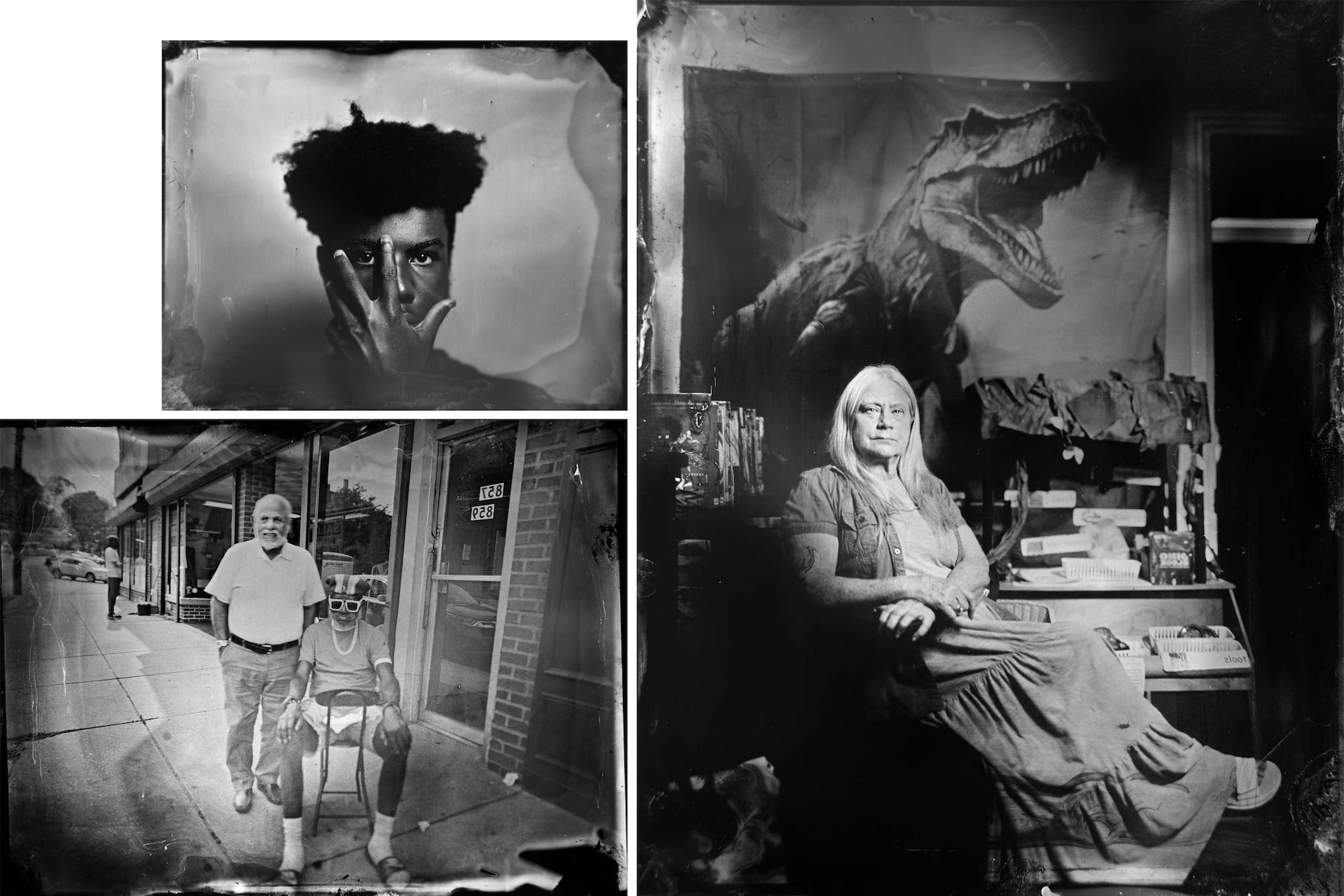
Armed with a vintage camera, the photojournalist John Pendygraft spent several weeks approaching people along Main Street in Darby, Pa., to ask if they’d like to collaborate on creating a photograph. Specifically, he asked if they wanted to create a tintype, a photographic process invented in the 1850s.
Tintypes need to be developed immediately on-site in a portable darkroom, and each one is a unique creation. It is a purely chemical process that takes time, embraces inefficiency, and is open to surprises.
During the process, subjects were invited to share their stories with Pendygraft. Together, the words and photos create a complex portrait of a changing town.
Main Street originated along the Great Minquas Path, and was settled by Quakers in 1682. Along the way, Main Street was a 1777 battle site, a historic foundation for the Underground Railroad, center of a boom town that busted, home to a growing African diaspora community, and ground zero to Hurricane Floyd’s destruction.
Through it all, Main Street in Darby has consistently been a place defined by the grit of people who call it home.
Susan Borders
The Darby Free Library is the country’s oldest library in continuous operation. The library was established in 1743 by 29 Darby Quakers. It was modeled after Benjamin Franklin’s Library Company of Philadelphia, which formed in 1731. The Darby library claimed the title “oldest library in continuous operation” when Franklin’s Library Company closed for repairs after a fire. The librarians who work there claim it is haunted.
For 34 of its 283 years, Susan Borders has been the heart and soul of the nation’s second-oldest library. She knows a nearby homeless shelter closes between 9 a.m. and 4 p.m., and makes sure the library is a welcoming place, rain, shine, or snow.
“I meet people who other people might be afraid of. The community needs us and we need the community.”
She takes a call about late fines: “Just bring the books in and we’ll waive the fees. I just want you to keep reading.” The caller got off easy. Normally, she makes people tell her a story before she waives the late fees.
She deals with a flustered dad and a grumpy toddler trying to make a letter-size print from an email attachment on an iPhone. “Just try to send it and we’ll see if the size is right. First one is on me.”
“The history of this place isn’t about dates. This is a living library. It is about 280-something years of days with people.”
Harold Finigan
Harold Finigan is untroubled by the sweat saturating his shirt or the record-breaking summer heat. He paces an open lot at 1000 Main St. with a cell phone to his ear, walking first toward the historic library, on the southwest side of the lot, and then toward the historic Darby Friends Meeting house on the north side.
Finigan is supervising renovations on both. He guides his days through time-honored Quaker principles: simplicity, peace, integrity, community, equality, and stewardship.
He traces his own Quaker values to 1682 — one year after King Charles II granted William Penn a charter for the land that would become Pennsylvania. That year, the Darby Quaker meeting was established along the Great Minquas Path by John Blunston as a foundation for Penn’s “holy experiment” — a country unified by a commitment to freedom of religion, equality, and democratic government.
Bernard Freeman
As Bernard Freeman, assistant foreman for Darby Borough Public Works, rides his lawnmower across the now-vacant lot at 870 Main St., he remembers when it was Woolworth. He points to the corner of the lot where the cafeteria counter used to be. “Main Street back then was bustling. We had jewelry stores, hardware stores, shoe stores. You didn’t have to go to the mall for nothing. Christmas time? You did all your shopping here. Everything was right here in Darby. You could get everything you needed. Everything. Man, it was bustling. But now? People don’t do the small towns anymore. At least, not here.”
There was a huge Christmas parade, a Memorial Day parade with a tank kids could climb on, a parade to open Little League season, and a parade for the high school homecoming football game.
“Last parade I can remember must have been 15, 20 years ago?”
Freeman has five children, born between 1987 and 2006. Only the child born in 1987 had the opportunity to play Little League, PAL football, or was able to join a swim club. Local organizations dried up in the ’90s.
“We didn’t have the volunteers and parent participation. Recreation-wise, we didn’t have anything anymore.”
And then Floyd hit. The storm took one life, impacted 330 homes and 59 businesses. Many of the businesses never reopened. Scores of properties were purchased by the government, who relocated families and leveled homes.
Freeman was hired by the city as part of the cleanup. The job, which he still holds today, hit home. “I have aunts, uncles, sisters, cousins, all kinds of family here. 10th Street is named after my uncle, Marine Lt. General Ronald S. Coleman.”
This is his hometown, come what may. “If you can make it here you can make it anywhere. Darby makes you tough. It’s a no-nonsense type of town.”
James Vani
James Vani, 71, who is also with Darby Borough Public Works, fled Liberia’s civil war with his wife in 2002. They joined his parents in Florida. “My wife went to nursing school. She graduated and everything, but she couldn’t find a job. She tried to find a job in Florida, but she couldn’t because of our accent,” Vani explains. “A friend of my wife was here [in Darby] and she said ‘Come over here. You will be able to find a job because there are a lot of Africans here.’”
There are. According to Data USA, 20% of Darby Township is foreign-born, and 79% of that population comes from Africa. If you drive down Darby’s Main Street a short distance to the Philadelphia city line, the road turns into Africatown. The organization website touts the area as “the premier destination for the global African Diaspora, celebrating arts, culture, and business.”
As soon as Vani’s wife got a job, she called her husband to join her. “I’m lucky,” he says. “I have a job in Darby and I live in Darby. Thanks be to God.”
Machi Hall
“Almost nobody from my generation is going to be able to buy a house,” laments Machi Hall, 17. His family moved to Darby two years ago from West Philly because “the crime here is lower and the houses are cheaper.”
Hall worries about AI replacing jobs, a future that might soon spin out of human control, and the possibility that current conflicts will escalate into a global war. He dreams of a career in 3D film animation, but what if AI takes those jobs?
He has also made plans to enroll in a four-year electrical contractor apprenticeship program, with an eye to joining a union. “I won’t get rich, but it will put food on the table,” he says.
Jan and John Haigis
Jan and John Haigis, who jokingly describe themselves as “vaguely Victorian,” pose in front of their home at 1006 Main St. The home was once owned by Passmore Williamson, who, along with “Father of the Underground Railroad” William Still, was jailed in 1855 for helping Jane Johnson and her two sons escape slavery.
Early on in any conversation with the couple, you will very likely hear about at least one of their two quirky obsessions. They will either sing a duet of one of the hundreds of songs they have written together (“I can always make a harmony,” Jan explains. “I don’t know what key he is going to be in, but we never stop singing.”) or they will dive into the minutiae of Darby history.
Their shared love of Darby history began in 1985 when John rode his bicycle past the Blue Bell Inn, a crumbling tavern at the very end of Main Street. He didn’t know that it was once frequented by George Washington, housed troops during the American Revolution, or was the site of an epic battle in 1777 led by Lord Cornwallis and 2,500 soldiers. But he was curious.
The couple learned the Blue Bell was on a list to be destroyed and approached the city about saving the inn.
“The city council told us ‘it would cost money to tear it down, so let’s see what they can do,’” John explains. They leased it to the couple for $1 a year.
A small grant allowed Jan and John to replace doors and windows and find a caretaker. The couple created Friends of the Blue Bell. The group of new friends became a kind of family.
They leased the inn from 1985 until 1999 and did what they could. Then Hurricane Floyd hit and flooded the interior. Today, the city maintains the exterior and the Haigises curate a website to preserve Darby history.
The Sulollari family
In 1990, Artan Sulollari was serving in the Albanian army. One day, they brought him in for questioning. At the time, he had no idea that one of his brothers had fled the communist country.
“They beat me up very good, to tell them what I knew. I didn’t know anything,” he says. He still suffers from hearing loss as a result of his injuries.
“It was a crazy life there. The communism was the worst communism. They would say ‘this guy does propaganda, this guy is a spy.’ They would arrest you. They’d beat you. They put you in jail. They’d take your family. They’d incarcerate you far, far away.”
The Sulollari family was granted political asylum in the early 1990s. Today, Tony and his brother run Main Street Pizza in Darby and care for their aging parents, who live just a few houses down from the restaurant.
“Have you ever seen the movie The Outlaw Josey Wales? Clint Eastwood says to the Apache chief, ‘I’ve come to live with you, because the government will follow you. I’ve come to live with you or fight with you. To die is easy. To live is hard. Because life is hard, and death is easy.’ That’s how it is.”
Paul Feldman and William Hall
Paul Feldman was born Sept. 18, 1947, one day before his father opened Benett’s menswear store on Main Street. “I remember as a kid my dad giving me a check to deposit in the bank on Friday night. I had to walk in the streets because the sidewalks were so crowded,” he remembers.
“You know how many stores there were in Darby that were run by a father and a son? I am the only one that is still around. Everyone else closed.”
Feldman looks around. “This place is starting to fall apart. I am, too.”
William Hall, 73, works a couple of days a week at the store. He remembers coming in as a young boy.
“My mother used to do a day’s work for $6 a day. So, I used to collect cans and bottles to take them back for the refund. I would bring my money here and put my clothes on layaway,” he said. “Heavens to Betsy, I didn’t know I’d be working here today.”
Two years ago, Hall was diagnosed with throat cancer. As the treatments wore on him, he turned to store manager Bud Teaford, who has navigated his own health challenges, for advice and support. Hall believes the friendship helped save his life.
“Now when I come in, I won’t say to him, ‘Hi.’ I say ‘Bud I love you.’ Every day.”
“I love you too,” Bud answers.
“If you don’t have love, you don’t get no love. You get that mental aggravation.”
Bud says with a laugh, “We get plenty of that here, too.”
John Pendygraft is a photojournalist who teaches visual storytelling at Penn State University.