Eastern State Penitentiary stands as a somber reminder of America’s brutal carceral system
It is the country’s first penitentiary which Charles Dickens called "dreadful." Today it offers many programs about prison reform and its history.
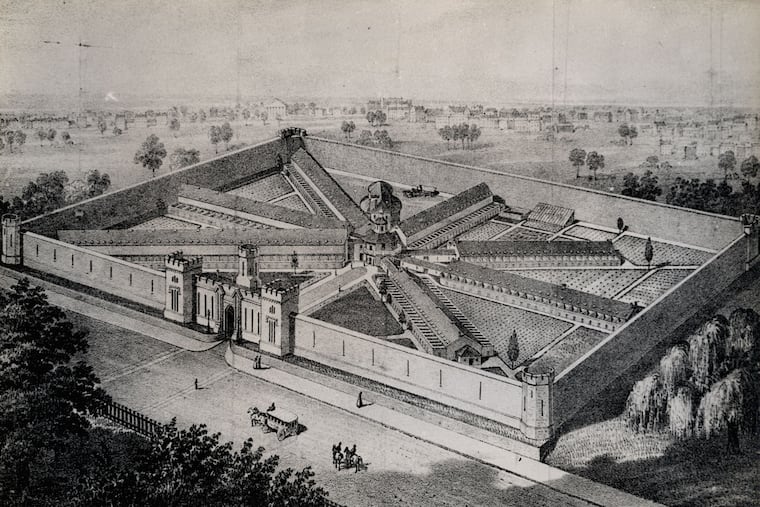
Crime and punishment in colonial America was a brutal business. Incarcerated people were barely fed, were often beaten, and fell ill from unsanitary conditions.
Inspired by the benevolent Quaker tradition, Benjamin Rush and Benjamin Franklin decided, in the late 17th century, to institute a new system through which people in prison could atone by reflecting and reading the bible.
The catch was they had to be “penitent” all alone, without any human contact. With the birth of solitary confinement, came Eastern State Penitentiary.
Construction started in 1821 and in 1829, the 11-acre institution opened on what was once a cherry orchard situated at the intersection of Fairmount Avenue, Corinthian Avenue, Brown Street, and 22nd Street. Nestled behind a 650-foot stone wall were 250 rooms.
The intention was that every man, woman, and child would have their own cell and would neither see nor talk to another human being.
“Eastern State is considered the first penitentiary in America because it is the first institution that uses solitary confinement for the entire length of the inmate’s incarceration,” explained Kerry Sautner, president and CEO of Eastern State Penitentiary Historic Site, Inc.
America’s first penitentiary — the country’s first true correctional facility — will be remembered Saturday from 11 a.m. to 1 p.m. at Eastern State Penitentiary.
The observance is part of the Philadelphia Historic District’s 52 Weeks of Firsts Celebrations. The weekly day parties, or firstivals are part of a yearlong citywide celebration of America’s 250th birthday.
Eastern State Penitentiary’s legacy of torturous solitary confinement makes this a somber celebration.
The institution’s first prisoner was 18-year-old Delaware County burglar Charles Williams. Within a few years after his arrival, Eastern State became a model for prisons and penitentiaries throughout the country, Sautner said. Still, its controversial methods of rehabilitation were considered cruel.
During his first visit to America, author Charles Dickens, who toured the penitentiary, wrote, “I believe that very few men are capable of estimating the immense amount of torture and agony which this dreadful punishment, prolonged for years, inflicts upon its sufferers.”
“People quickly learned that solitary confinement was a cruel form of punishment,” Sautner said. “But they didn’t to let it go easily.”
Despite the formation of the Pennsylvania Prison Society — responsible for part of the state constitution that stressed on the rights of incarcerated people — solitary confinement lasted through the late 19th century. It remained a part of the prison’s culture until it was completely removed from the books in 1913.
During the early 20th century, each cell housed two people.
“We have evidence of a proclamation banning solitary,” Sautner said. “And we found evidence of small Christian gatherings celebrations [within Eastern State] of Jewish holy days in September.”
(Although the penitentiary was founded in the Quaker tradition, there is evidence that prisoners worshipped in Christian, Jewish, and Muslim faiths within its walls by the 19th century.)
In 1965, it was designated a national historic site by the federal government. By the early 1970s, Eastern State Penitentiary was immensely overcrowded with more than 2,000 prisoners. It closed in 1971 and its population was moved to Graterford.
Throughout the 1980s, the building remained mostly abandoned except for a few sporadic instances like when it served as the set for the filming of Tina Turner’s 1985 single “One of the Living” from the Mad Max soundtrack.
In the late 1980s, the city began looking at ways to restabilize what many considered an eyesore in the center of Fairmount, a neighborhood that was in the midst of being revitalized. Planners considered turning the space into condos, a shopping center, and even a youth hostel.
In 1988, at the urging of a task force of concerned architects, preservationists, and historians, Philadelphia Mayor Wilson Goode halted the process of selling the site. And in 1994, it opened as a nonprofit historic site offering group tours under the leadership of Sally Elk.
1997 marked the first “Terror Behind the Walls” the annual haunted house attraction. In 2021 it was rebranded as “Halloween Nights,” a less spooky, more gentrified version with a beer garden.
This week’s Firstival is Saturday, Oct. 3, from 11 a.m.-1 p.m., at Eastern State Penitentiary at 2027 Fairmount Ave
Each week, The Inquirer is highlighting a “first” from the Philadelphia Historic District’s 52 Weeks of Firsts. A “52 Weeks of Firsts” podcast, produced by All That’s Good Productions, drops every Tuesday.