Both NY Philharmonic and the Philadelphia Orchestra played Mahler’s ‘Symphony No. 5′ recently. Who did it better?
In this Gustavo Dudamel vs Yannick Nézet-Séguin face-off, both conductors' strengths are on full display
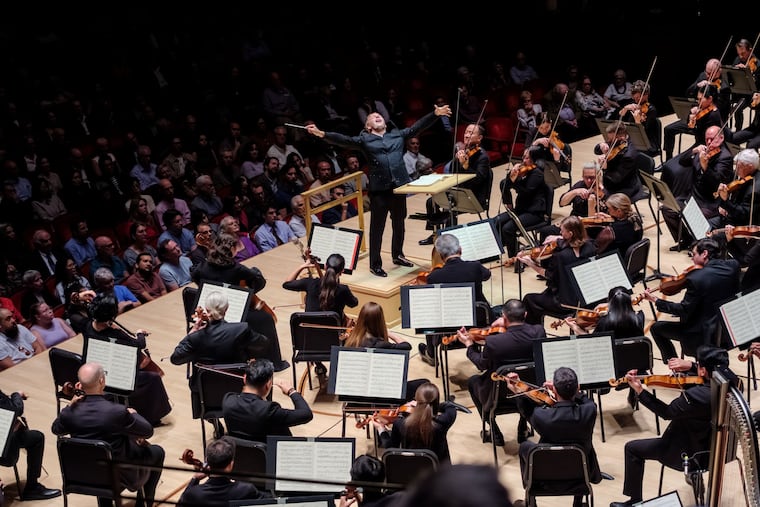
The symphonic world has evolved into an ongoing Mahler festival, so much that the composer’s Symphony No. 5 surfaced in adjacent performances this week — the New York Philharmonic under its new music director Gustavo Dudamel and the Philadelphia Orchestra under Yannick Nézet-Séguin.
I heard both — Dudamel on a livestream Tuesday at Lincoln Center and Philadelphia on Friday at the Kimmel Center.
Then there’s Mahler 7th in Boston and Mahler 3rd in Paris, available on radio broadcasts.
Is Mahler ruling the world?
Only a few years ago, any Mahler symphonies beyond the amiable 1st and 4th were heard occasionally. But the stormy 5th symphonies being heard almost simultaneously (Philadelphia’s will be repeated at Carnegie Hall Oct. 13) show that Mahler performances are rarely redundant experiences.
Even with expansive running times from 60 to 100 minutes, Mahler symphonies are packed with content. With so many performance instructions (the composer was a micro manager) any conductor/orchestra combination connects the dots quite differently.
Consider the contrasting personalities of the PHL and NYC orchestras.
NYC’s hot, Dudamel-appointed hornist David Cooper nearly turned the 5th Symphony into the world’s biggest horn concerto. He seemed to lead the Tuesday performance almost as much as Dudamel.
That wouldn’t do in Philadelphia with its tradition of blended sonorities dating back more than a century. The NY Phil has been called an orchestra of soloists. The Mahler 5th encourages that with high-profile incidental solos. But the amassed sonorities in Philadelphia have one-of-a-kind power.
Consider, also, the different conductor personalities: Nézet-Séguin’s treatment of the opening trumpet solo — at the start of a funeral March — felt like a dire warning. Dudamel’s was like a requiem. (Considering what his home country of Venezuela has been through lately, could it be any other way?) Nézet-Séguin generates excitement, often uses speed and clarity of intention. Dudamel creates a kind of frenzy seldom heard since Leonard Bernstein. But not always. The final moments of Dudamel’s Mahler 5th had it. But while his performance had solid playing and steady electricity, there were few surprises.
It was safe, which is understandable.
The pressure on Dudamel is enormous. His mandate isn’t just great music making but outreach, including concerts at Radio City Music Hall. He’s building an ensemble whose last three music directors, most recently Jaap van Zweden, didn’t make the orchestra their own. Dudamel himself recently came off a curtailed tenure at the Paris Opera. And he has left his longtime comfort zone, the Los Angeles Philharmonic.
At the end of Tuesday’s Mahler 5th, the floor-to-ceiling livestream video screens at David Geffen Hall showed Dudamel looking relieved, not joyful.
On the other hand, few orchestras have a history of stable leadership as the Philadelphians, and it shows with artistic consistency and ability to take risks with confidence. At this point, the Philadelphia Orchestra commands as much attention with supersoft playing as with fortissimos.
But the orchestra has not grown so refined that it can’t rock ‘n’ roll in the final section of Julia Wolfe’s Liberty Bell, co-commissioned by the orchestra, and also in Friday’s program. It’s apocalyptic as well as celebratory. Having grown up in the area, Wolfe spent formative weekends on South Street, and you hear that in this piece. But then, in the middle of the last section, comes an explosion sounding like World War III. Say it isn’t so.
Explosions, softness bode well for Mahler.
In the symphony’s long spans of music, Nézet-Séguin finds an underlying element that makes them more cogent, whether the underlying bass lines, the waltz rhythms of the third movement, or something less discernible in the finale where everything is happening at once. Layers of counterpoint, fugues plus antiphonal effects between upper and lower strings all tumble out at warp speed — and not with the light touch Nézet-Séguin employed in past years.
In Nézet-Séguin’s Carnegie Hall concerts with the Metropolitan Opera Orchestra, every symphonic motif behaves like a stage character. It comes naturally to those players, and I’m hearing more of that in his Philadelphia Mahler. It’s a great fit. These are some of the more fully realized Mahler performances I ever hope to hear.
The program will be repeated at 8 p.m. Saturday at the Kimmel Center. Tickets: $29-232. philorch.ensembleartsphilly.org