Manayunk is embarking on another new era after decades of evolution
Manayunk’s Main Street has evolved from Banana Republic to boutiques. Its future depends on neighborhood support.
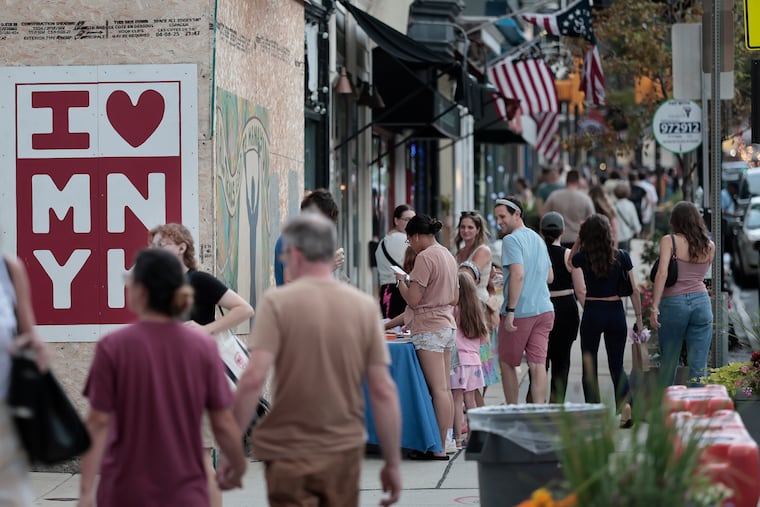
On the last Thursday of July, during Manayunk’s summertime Stroll After Hours event, throngs of young families pushing strollers and couples walking dogs roamed the business corridor.
Some stopped at art vendors with frames sprawled across the sidewalk, while others meandered down Grape Street to grab a bite from a food truck or claim a seat at the outdoor screening of Toy Story.
On such an evening, Main Street Manayunk’s evolution is on full display.
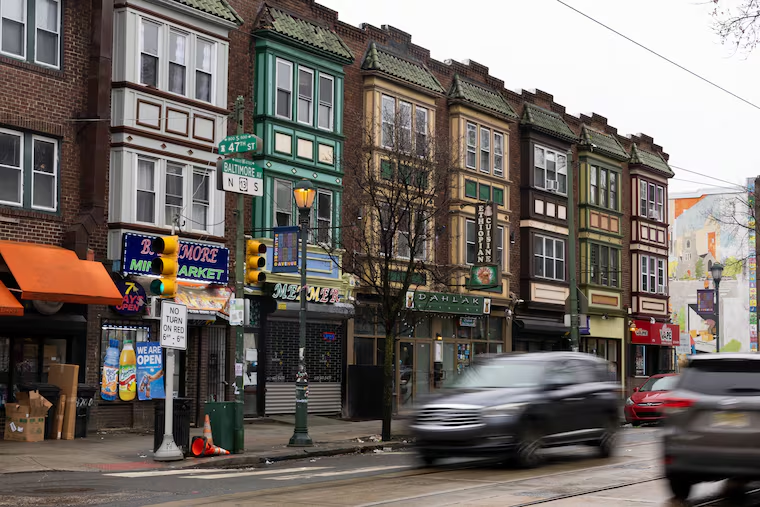
The riverside neighborhood in Northwest Philadelphia has seen many eras, from textile mills in the 19th century to chain retailers in the 1990s, to today’s collection of local upstarts.
“It’s the best it’s ever been,” said Jen Wankoff, 51, of Roxborough, who turned out to Stroll After Hours with her friend, Jen Filip, 50.
“It used to be a lot more commercial. There was a Banana Republic, a Pottery Barn, but then once one left, they all left,” said Filip, who has lived in Roxborough since the early 2000s. “Now it’s all small businesses.”
More changes are coming to Manayunk. Even as apartment development has slowed in much of Philadelphia, over 1,800 new residential units are proposed along or adjacent to Main Street. All that additional population stokes neighborhood anxiety about traffic and parking, but retailers expect it will be good for business.
“There’s probably going to be 1,600 new people living in those units, and they’re all going to come to Main Street to shop and eat,” said Dan Neducsin, 83, who has long been the largest property owner on Main Street and helped shape the identity of the corridor.
“The restaurant scene has been strong [since the 1990s], and now I think it’s even going to get stronger,” said Neducsin, who has sold 12 of his properties in recent years to long-term tenants and small-business owners like Tim Spinner, owner of Taqueria Amor.
“I just want to see the people who I have in there now do well, and my tenants have welcomed the opportunity,” said Neducsin, who emphasized that his company is not closing or selling all its holdings. But “it does make sense now for some new people to come in and take advantage of what’s here.”
Manayunk’s Main Street appeal
In the past two years, 12 new businesses opened along Main Street.
One of them is Riptide Tavern, opened in June by Spinner, who also owns Taqueria Amor next door.
Spinner said he wanted to open a neighborhood bar with creative cocktails and a cheap beer menu — much like a dream restaurant he conceived for a culinary school project years ago.
“I wanted to be in the Caribbean or down the Shore, but along the Schuylkill River with the canal back there is close enough,” Spinner said.
Eleanor’s Consignment is set to open on Main Street in October. Owner Emily Mannix, a former paralegal who has lived in Manayunk for two years, named the consignment store after her late mother, who died in 2023. They shared a love of secondhand-shopping.
“This has been something that has been on my mind for the past four years,” Mannix said. “Life is short, and I might as well jump in and try.”
It’s not a bad place to do that. Realtor Christine Ertz notes that while rent is not low, it’s more affordable than in areas like South Street and Queen Village.
“Manayunk has the demographic businesses want,” said Ertz. “It has the younger folks, but also the more mature folks that have expendable income, and we’ve got the 27-to-35-year-olds that really enjoy the niche, smaller stores.”
The apartment boom in Manayunk promises to add even more. Many of the new developments have smaller units, which are likely to attract single people or younger couples. The price points of the new rentals, while lower than Center City or Northern Liberties, also suggest that tenants will have disposable income.
Those changes haven’t been without controversy. The Manayunk Neighborhood Council has pushed back against development it deems as out of scale with the community, and that’s often lacking new commercial space, affordable housing, and parking while being weighted to small apartments.
John Hunter, an architect and zoning chair of the Manayunk Neighborhood Council, says few of the new buildings have commercial space to add to the neighborhood’s daytime vitality. He disagrees with the idea that the apartment boom will boost local businesses.
“We have heard that misrepresentation for years now — that new apartments will generate pedestrian traffic along Main Street,” Hunter said. “Fifteen years of those promises has proved that is not the case.”
But some neighborhood observers see the development interest along Main Street as a concrete example of the area’s ability to attract people and investors.
“We’re seeing a diverse group of experienced, well-regarded developers all making independent decisions to put their capital and time into Manayunk,” said Veronica Blum, a retail broker with MPN Realty who has been working with Neduscin on leasing and sales.
“When that many smart people come to the same conclusion about a neighborhood, it says a lot,” said Blum. “It’s a real vote of confidence in Manayunk’s future, and I think we’re just beginning to see what’s possible.”
The cost of staying open
Still, the commercial corridor has seen turnover and closures.
Pizza Jawn closed and Kismet Bagels came in its place — Pizza Jawn’s owner bought the former Manayunk Tavern down the street, which became Bar Jawn. Smiley’s closed and Blu Zone Cafe moved in; and Iron Works Fitness opened up in the former Kismet Cowork.
A large restaurant space sat empty for months after Winnie’s closed last November. But, two Roxborough natives recently leased the space for a new “punk French” restaurant, planned to open in late fall.
Joan Boroff Denenberg, who does marketing and retail strategy for the Manayunk Development Corp. (MDC), said a few storefronts remain empty because the property owners aren’t local and are backed up with other projects throughout the country.
Neduscin says he isn’t struck by an unusual number of vacancies along Main Street. But maybe that’s because when he began buying properties there in the late 1980s, much of the commercial strip was vacant to the southeast of Cotton Street.
“Anytime I saw a property that was available in Manayunk I ended up buying it because I thought if I owned enough properties, I could kind of set the direction of the street,” Neduscin said. “I got to handpick who my potential tenants would be. I tried to bring tenants that I thought would bring additional people here.”
The bustle of Main Street now extends all the way down to Shurs Lane, roughly double its occupied length when he started.
Neduscin also says he really tried to find independent entrepreneurs to lease to — “I didn’t want a McDonald’s on Main Street” — and those restaurateurs and small-business owners gave Main Street a unique identity.
More than 30 years later, that’s why he wanted to sell some properties to one-time tenants like Spinner.
Still, business owners say myriad challenges remain. The permitting process is notoriously slow, especially if a trip to the Zoning Board of Adjustment is necessitated. That can leave business owners paying rent without being able to open their doors as they wait for permission.
“When it takes longer, you have to have deeper pockets, and I think that does scare some prospective businesses,” Neduscin said.
Further, owners on Main Street face the macro challenges affecting small businesses throughout the region. Brandy Deieso, who opened the gift boutique the Little Apple in 2010, said the cost of goods has increased due to tariffs, shipping costs, and rising gas prices.
“Being a street full of locally owned small businesses is great,” said Melissa Walter, co-owner of Love City Brewing, which just opened a second location in Manayunk. “But as we all know, running a small business is really hard.”
Building a business community
The bubblegum pink Cupid’s Bookshop storefront has built a following and even attracted customers from Baltimore and New York since opening last year. Now, it’s upgrading to a bigger location on Main Street.
“The growth we’ve had, it’s been amazing,” said owner Tina Long.
Cupid’s capitalized on the insatiable demand for bodice rippers and love stories, and Long says the bookshop benefited immensely from the MDC’s incubator program. Cupid’s was the first participant.
The program allowed Long to lease a storefront at 106 Grape St., owned by the business association, for a below-market monthly rent of $1,000 for up to three years, and the MDC provided guidance and support. With her new storefront opening in August and a five-year lease, she’s graduating from the incubator space early.
“We loved the idea, but it turned out beyond our wildest dreams,” MDC executive director Gwen Mccauley said. “She’s now becoming part of the fabric of our district.”
Baby Face Studio also ended up on Main Street in part because of the MDC.
Artist and owner Kim Canefield in 2022 applied for the MDC’s emerging artist tent at the Manayunk Arts Festival, where she could set up shop for $100 instead of operating a $500 tent on Main Street. The festival draws over 300 artists and 150,000 visitors each June, McCauley said.
She set up a full-time vendor tent at the next three Arts Festivals. Each time, she was stationed in front of an art gallery, not knowing that the same space would eventually become Baby Face Studio.
“I just kept looking at it, and peeking through the window,” Canefield said. “The whole time I was staring at the future of what the studio was going to be.”
Love City Brewing already has a foothold in Callowhill, but saw Manayunk as a place to grow. Its second spot opened in the former Fat Lady Brewing. When searching for a new location, co-owner Walter was attracted to Main Street’s critical mass of small, independent businesses.
“Seeing them succeed, we thought: ‘Oh, we’re a small, local Philly business too,’” Walter said. “We can make it work there.”