Trump threatens to halt some trade unless the Fed cuts rates
The president’s ultimatum could prove costly to the economy if he were to carry it out. The remarks were his latest attempt to pressure the Fed, even after securing confirmation of Warsh, his handpicked chair.
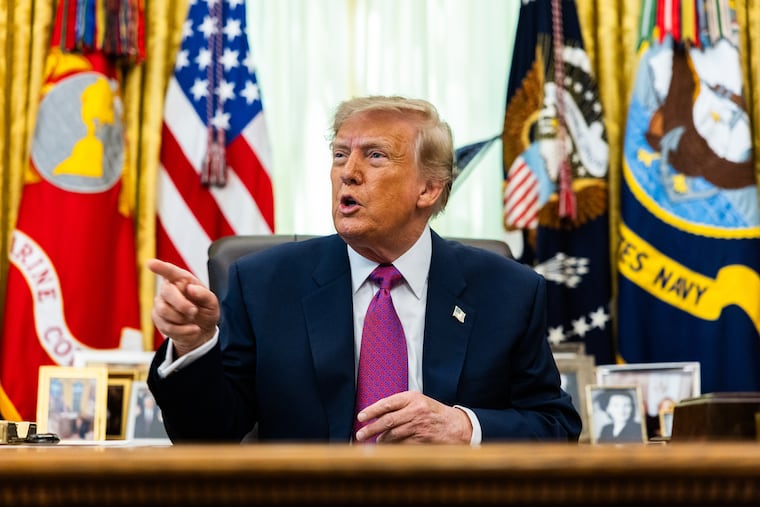
President Donald Trump threatened Friday to halt a broad swath of U.S. trade unless the Federal Reserve slashed interest rates, issuing a sweeping ultimatum that could prove costly to the economy if he were to carry it out.
The Fed is a politically independent institution, and it has long kept rates steady as it tries to tame years of persistent inflation. Trump’s demand risked undermining that work, while choking off commerce in ways that could harm American families and businesses.
The president delivered his threat on a day that began on a positive note for the White House. Hiring figures showed that employers added about 162,000 jobs in August, evincing a labor market that has weathered a range of shocks under Trump — from the global trade war he commenced last year to the war with Iran that has intensified recently.
On social media, Trump heralded that development before seizing on it to issue his demands. He called on the Fed to reduce borrowing costs to “the LOWEST RATE of any country in the World.”
The Fed has kept rates steady since December as it tries to discern whether recent economic turbulence represents a short-term problem or a longer-term driver of higher prices. In fact, policymakers have actually signaled that they are considering whether to raise rates as soon as this month, after failing for more than five years to bring inflation down to the central bank’s 2% target.
But Trump insisted Friday that the U.S. economy was “STRONG” and, as a result, could afford to lower borrowing costs. Such a move could actually worsen inflation. But absent a cut, Trump signaled that he could interrupt global trade.
“LOWER THE RATE OR I’LL STOP TRADING WITH COUNTRIES WITH WHICH WE HAVE A DEFICIT, which the U.S. Supreme Court, in its ridiculous and very costly Tariff decision, strongly acknowledged ‘the President’ has an absolute right to do,” Trump said.
The list of countries with which the United States has a trade deficit is lengthy, including its neighbors, Canada and Mexico, nations in the European Union, and others including China, according to federal data. That represents a substantial amount of the goods bought and imported by American families and businesses.
Globally, the U.S. trade deficit in goods and services rose to its biggest gap in 16 months in July, data released this week showed. Some economists see that activity as a sign of strength for the United States, one caused in part by surging domestic demand for the electronics that help to power artificial intelligence. But Trump disagrees and has sought to apply substantial tariffs globally in the hopes of driving down the imbalance.
“The Fed Board, with its great new leader, must get smart — BE PATRIOTS for a change,” the president said. “High interest rates put the U.S.A. at a very unfair disadvantage, and I won’t allow that to happen!”
Trump’s remarks were his latest attempt to pressure the Fed, even after securing the confirmation of his handpicked chair, Kevin Warsh. The president has made no secret about his views on monetary policy or the lengths he is willing to go to achieve them, even targeting — and trying to oust — Fed officials who do not share his stance.
The Fed’s decision on interest rates later this month hinges in part on inflation data coming out next Friday. Investors started to ratchet up bets about a possible increase after Warsh signaled in a speech last week that he was open to the idea. He did not explicitly call for a rate increase.
Other top policymakers this week conveyed different degrees of urgency around the need to raise rates.
On Thursday, Christopher J. Waller, a governor, said that a “hot” report on inflation from the Bureau of Labor Statistics would compel him to support a rate increase. But if there was further evidence that inflation was not getting worse, he said he would be inclined to hold rates steady.
“What’s the cost of waiting one meeting? Hiking 25 basis points one meeting right now is not going to bring the CPI down to 2%,” Waller said, referring to the bureau’s Consumer Price Index. “You want to take a chance to see if disinflation continues, but I’m not taking a big chance on it.”
Michael S. Barr, a Fed governor, said Tuesday that if inflation data showed continued signs of progress, then the Fed could afford to take more time to assess if rate increases are needed.
“However, if inflation appears not to be moderating sufficiently, then I think we should act decisively to raise rates,” Barr said.
This article originally appeared in the New York Times.