One of the fastest-growing jobs has a wage theft problem. Pa. will now fast-track investigations
Nearly 40% of minimum-wage complaints in Pennsylvania are from home health workers.
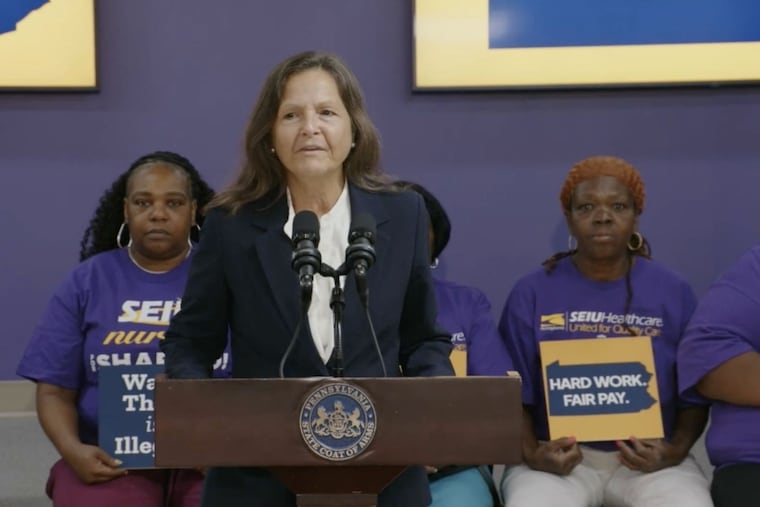
One of the fastest-growing occupations is also a hot spot for wage theft complaints in Pennsylvania. A new initiative by state regulators aims to help change that.
Nearly 40% of the minimum-wage complaints sent to Pennsylvania’s Department of Labor and Industry are from the home healthcare industry, State Labor Secretary Nancy Walker said at a news conference Tuesday.
Under the new initiative, the state won’t wait to receive new complaints, said Walker. Instead, regulators will audit home healthcare agencies, making “legal demands for wage and hour information,” said Walker, to find potential wage violations.
“We’re here today because these workers are not receiving the wages they earned, and that changes now,” Walker said.
Demand for home healthcare is expected to continue growing, but attracting workers to the industry has been a challenge.
Many home healthcare workers, who help patients with daily living needs, have been shorted on their overtime pay in Pennsylvania in recent years and employers have ultimately had to pay back millions in some instances. One contributing factor is that Medicaid doesn’t pay home healthcare employers extra for overtime.
“The workers doing this care are not always treated the way we should be,” Marshene Ellis, a home care worker for over 17 years, said at Tuesday’s news conference. “I’ve worked for different agencies and seen the broken promises and low wages.”
Making ‘good jobs’ in home healthcare
Pennsylvania is home to more than 257,000 home care workers, according to the Bureau of Labor Statistics, but more are needed to meet demand, especially as the population ages.
Nationally, home health aide is expected to be one of the fastest growing jobs in the coming decade, according to BLS, which predicts 847,300 more home health jobs by 2035.
In Pennsylvania, some 112,000 care shifts go unfilled every month, according to Matt Yarnell, president of the SEIU Healthcare Pennsylvania union.
“That means somebody who cannot get themselves out of bed, is laying in that bed hoping someone shows up,” said Yarnell. “We have a lot of work to do in this space.”
Those in need may find themselves in the emergency room instead, Yarnell added.
“When families cannot find a home care worker, the impact is immediate,” said Gabrielle Szymanski, of Pennsylvania’s Department of Aging. “Family caregivers are forced to leave work or take on additional responsibilities, and providers struggle to meet demand — and too often people end up in more restrictive and more costly settings.”
Attracting and retaining home-health workers has been challenging. Turnover is high in the industry, and wages are low. The median wage in Pennsylvania is $14.14 per hour.
Workers deserve higher wages, said Mia Haney, CEO of Pennsylvania Homecare Association in a statement on Tuesday and pointed to low Medicaid rates as part of the issue.
“We support holding bad actors accountable, but they should not define an industry overwhelmingly made up of providers committed to their workers and the people they serve,” said Haney, whose organization represents nearly 700 home care and hospice providers.
» READ MORE: Pennsylvania’s home care industry is in crisis, with low pay and unfilled shifts driving it toward collapse
Gov. Josh Shapiro’s administration recently added $21 million to the state budget to boost home healthcare wages.
“It is really really critical that these become good jobs, and that will not happen on its own,” said Yarnell.