Q&A: Temple coach K.C. Keeler’s second-year expectations, his Delaware foundation, and more
Keeler spoke with The Inquirer about his coaching philosophy, the importance of fostering relationships in a locker room, and how Temple took a step forward after his first season at the helm.
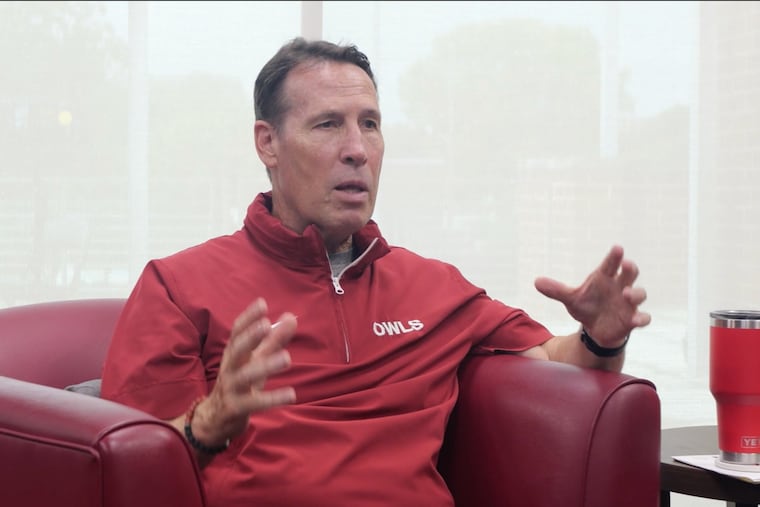
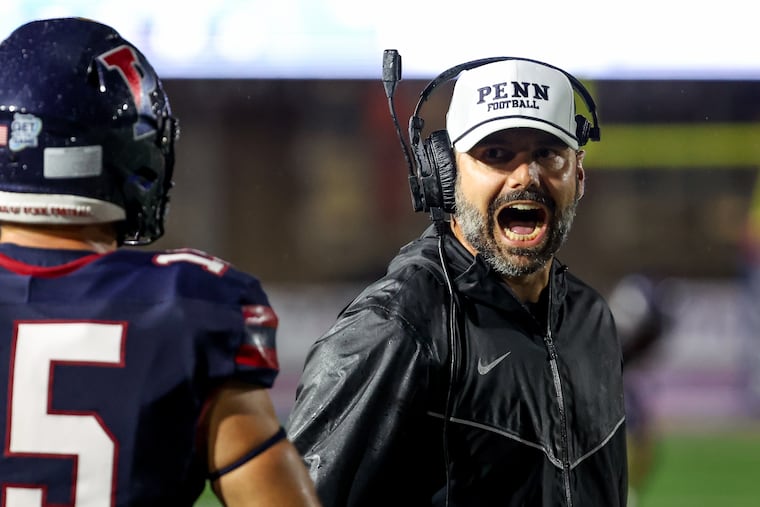
K.C. Keeler is a family man who has built his coaching foundation on the lessons and influence of those he played and coached under.
He has, what some would say, an old-school approach when it comes to running a football program: Juniors and seniors deserve the opportunity to play, academics and community service are just as important, and building a locker room starts with relationships.
As the winningest active head coach across all divisions of college football, Keeler’s philosophy has certainly worked. The second-year Temple coach surpassed 275 career wins (currently at 276) last season and is turning around a program that before last season finished 3-9 for four consecutive years.
» READ MORE: K.C. Keeler earned his 275th career win. The first-year Temple coach recounts how he got there.
In 2025, Temple posted a 5-7 record — one game short of reaching a bowl game, which it hasn’t made since 2019 — and had one-point losses to Navy and Army.
So, where does the program go from here? Well, for the first time in a long time, this program has a real sense of cohesion.
Before Temple’s season opener on Saturday against Rhode Island (2 p.m., ESPN+), Keeler sat down with The Inquirer, where he expressed his commitment to the Owls. He purchased a home in Wilmington, becoming the first Temple coach since Bruce Arians in the mid-1980s to do so. Keeler, who turned 67 in July (and is the third-oldest active FBS coach), wants to finish his college football coaching career on North Broad. But first, his focus is bringing back greatness to Temple.
Q: [Throughout] your coaching career [at] Rowan, Delaware, and Sam Houston State, you’ve established a track record of building winning programs. How have you shifted or changed as a coach to stay competitive?
A: One of the things that I’ve always done a really good job of is problem-solving. The other thing I’ve always done a really good job of is recognizing talent, not just on the field, but also coaches I’ve worked with. When I got to Rowan, and I got an opportunity at 34 years of age to be a head coach, I had some really good players I had recruited when I was an assistant there. … I learned from my former coach Tubby Raymond [at Delaware], a lot about building a culture, understanding that when you play for, at the time Rowan University, you play for the people who played before you, you play for the people you’re with in that locker room right now, you’re also playing for the people who are going to come after you. You try to develop this sense of belonging, so everywhere I’ve coached, I’ve always tried to emphasize this is a family. It’s its own unique family, but it’s a family, and this family ranges beyond just the guys in this locker room.
Q: You spent more than a decade at Delaware. How special was it to coach at the school you once played for?
A: Well, nowadays there’s no way that Delaware would hire a Division III coach, just with the headhunters and all the things that people go through now to figure out what coach they’re going to hire. But I was blessed that I had a president and an athletic director. The athletic director — Edgar Johnson, didn’t believe that. … For 11 years, when I pulled up to that stadium, in my office, I pinched myself. I probably had black-and-blue marks for 11 straight years. People always wondered who was going to follow Tubby. I mean, they have his name on the field. He had 300 wins, three national championships, and a guy that I respected in terms of creating that culture. I always say that his 300 wins or him inventing the Wing-T with Ted Kempski, those weren’t his greatest accomplishments. His greatest accomplishment was the culture that he developed.
Q: You’ve also dealt with adversity and losing seasons during your time at Delaware before you were let go in 2012. What was that departure like?
A: Me being fired had nothing to do with wins and losses. It was really more I had become a bit like Tubby did in that small state. Everyone knew what car I drove. Walking in a restaurant, my wife and children would go to the back for dinner, and I would have to stop at all the booths. There was a sense that maybe the administration, the people who were running the place at the time — they didn’t stay much longer after they fired me — they didn’t embrace the fact that I had developed a legacy there. It was hard. It was hard being fired, and I remember very vividly my daughter coming home after me being fired, and she said to my wife and I, ‘You guys are in your uniform, huh?’ Still had our pajamas on. … Then when we were out and we ran into an acquaintance on the street, and I went into my woes of being fired, and I said, ‘How are you doing?’ [They replied], ‘I’m battling cancer right now.’ My wife and I were like, let’s put this in perspective. We got fired from a job. We need to move on.
» READ MORE: First-year coach K.C. Keeler is committed to Temple, Philly, and his ‘grandpa’ dance moves
Q: What was your biggest lesson learned from Year 1 at Temple?
A: I told the guys when I first took over, I don’t want you to be realistic. [Temple] winning whatever it was, 13 games in five years, no one thinks we’re going to do much because we weren’t changing the roster much. It wasn’t like we came in, gutted the roster, brought new players in. We just felt there were so many upperclassmen that wanted to get their Temple degrees and that wasn’t the right thing to do. I still believe in education, and I believe that even though I wasn’t the coach that signed their scholarship papers when they came to Temple, I still represent Temple, I’m not going to cut you and try to get a player who’s that much better. So 5-7 was very disappointing, because we were so close to being a 7-5 team. But at the same time, I do know that there were some limitations because of how much we could change the roster. Those limitations actually led to us keeping all of our starters [this year].
Q: Your team was one of the few Group of Five schools to keep their starters from entering the portal. What does that say about what you’re building here?
A: We believe that our program is built on love and trust. I always explain that you can’t love somebody, you can’t trust somebody, until you know somebody. We work really hard at knowing each other. We’ll do the three H’s: Who’s your hero? What’s your hardship? What’s your history? We’ll do a trivia night where the guys are all mixed up with different positions and different players and coaches, and Clayton [Barnes, Temple’s general manager] leads it. It’s a lot of fun, and it’s a way to be together. … We work really hard in these four walls to develop relationships with our players. The great thing about us going into this year is that the whole strength staff is together, whole coaching staff stayed. … This building has a lot of cohesion.
» READ MORE: Temple coach K.C. Keeler didn’t lose any starters to the transfer portal: ‘They saw the vision’
Q: With the rising power of Name, Image, and Likeness, how have you managed the new landscape of college sports?
A: I wouldn’t have taken this job unless [Barnes] came with me. I know my skill set. I am a problem solver, but I’m not going to be the guy who’s going to be dealing with the agents. I’m not the guy who’s going to figure out the charts in terms of how much money we should allocate to each position and what starters are making at different positions. … That’s not my skill set. That’s [Barnes’] skill set.
I don’t call the offense anymore. I don’t run the defense anymore. I was an offensive coordinator, scored a ton of points — I got too many other things going on. … I’ve turned those things over; same thing with Clayton and the roster. Now we talk about it every day. It’s not like I’m not making final decisions, but I have enough trust.
Q: Your sunglass look became a trademark at Delaware. What is the backstory about the sunglasses?
A: I have very sensitive eyes, so the lights really bother me — and I like sunglasses. I have six pairs of Ray-Bans in my backpack right now, so I like to change them up a little bit too. They have a bobblehead of me with my sunglasses on. I’ve been known to support the sunglasses. It’s a little bit of a trademark, but also the sensitive eyes go along with it.
Q: As someone who grew up in Lehigh County and spent the bulk of your coaching career out East, what does it mean to come back after 11 years at Sam Houston State?
A: My wife’s a Penn grad, we met in the city. I was with the Eagles as a last cut [under] Dick Vermeil, and so we met in the city, fell in love in the city. … We have three grandchildren, and my wife and son-in-law are in Wilmington — this is home. I always tell the story that when the deal was finally done, we had just beaten Liberty Friday night to clinch a 9-3 season and a good bowl game. It was [my wife’s] birthday. I get the call from my agent that the deal’s done. I come back in and tell her, “Hey, listen, we are going back East,’ and she cried for an hour. I’m trying to explain to everybody in the restaurant, these are happy tears.
Q: There’s a lot of anticipation around this team. What would you say to fans about the direction of where this program is heading?
A: There’s been greatness here before. It’s not like I’m trying to reinvent anything. … One of my most vivid memories of any situation in my entire career was a locker room after we played Temple. We [Delaware] were the No. 1 team in the country in 1978 — don’t do the math — going to play Temple at the old Veterans Stadium, and they just embarrassed us. It was a different, physical brand of football that we weren’t used to, and they also just had this tremendous talent. Then the next year, that team I played on at Delaware, we won the national championship. We went 13-1. Our loss? To Temple. I have a pretty good perspective of where this place has been — and Temple can do it again. We had the No. 1 recruiting class in the conference. I don’t remember Temple doing that recently.
Q: This year will mark 10 years since Temple last won an American championship. What stands at the forefront when you think about goals this season?
A: We want them to think about winning enough games to go to a bowl, winning a bowl, and maybe we can win enough [games] to get [to] that conference championship game. That’s kind of where I’m trying to set their sights. … If you’re realistic, don’t play for me. I want you to be unrealistic. I want you to dream dreams that are bigger than you possibly could imagine, because life is short. When I was at the FCS level in my first press conference at Delaware and Sam Houston, I talked about winning a national championship. … Our goal here at Temple is to be the best football program in the country. … I do believe we can become a team that can be playing in that conference championship game, and there’s a good chance that team plays in the big tournament.
The reality is that everyone knows we play Penn State the second week. I know it because that’s all I got asked when I was at media day. … But we got to worry about playing Rhode Island.