Painting a new chapter
Some pro athletes say they lose their identity after retiring. Former Villanova football star and Phillie Matt Szczur found a new one.
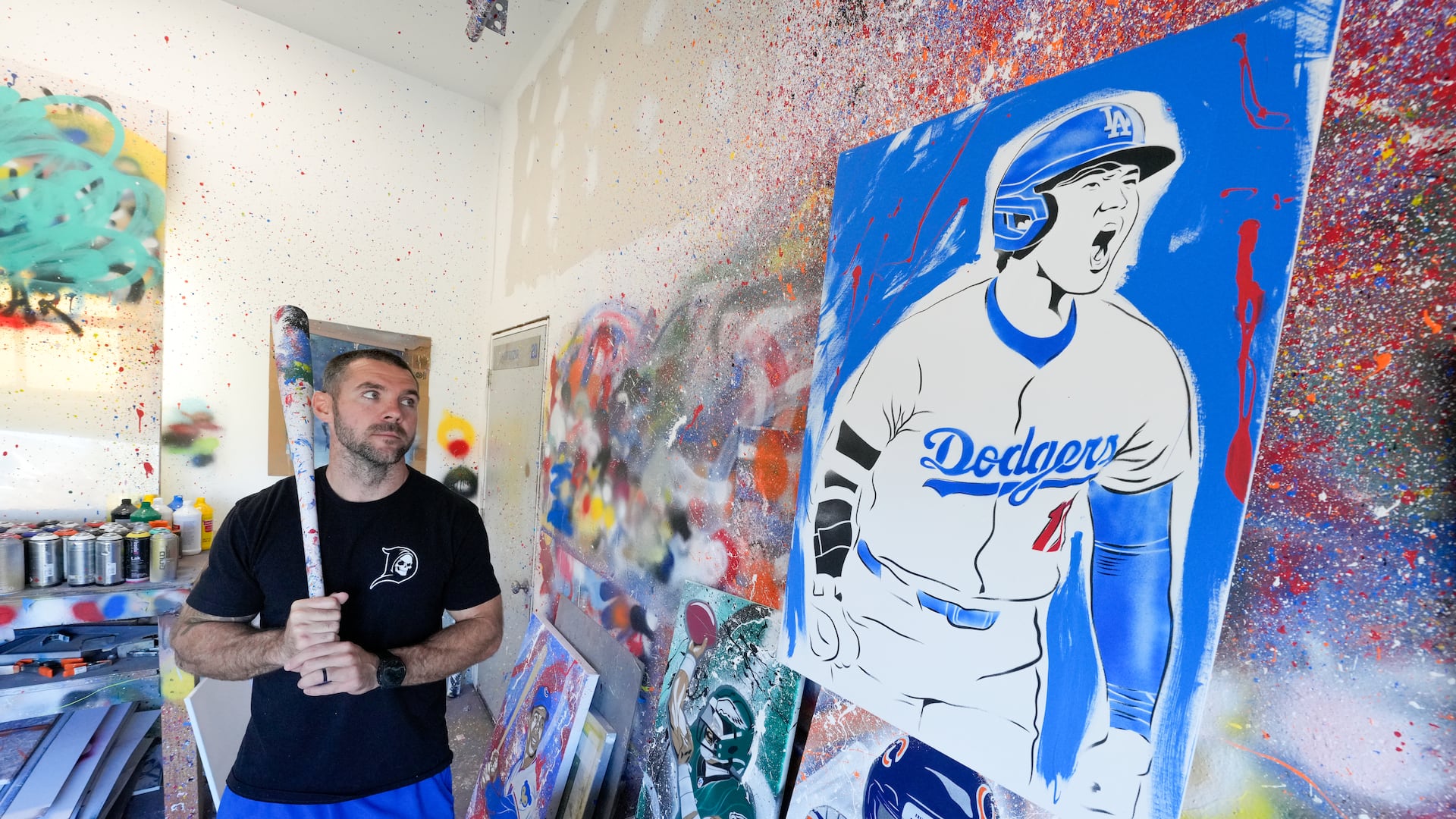
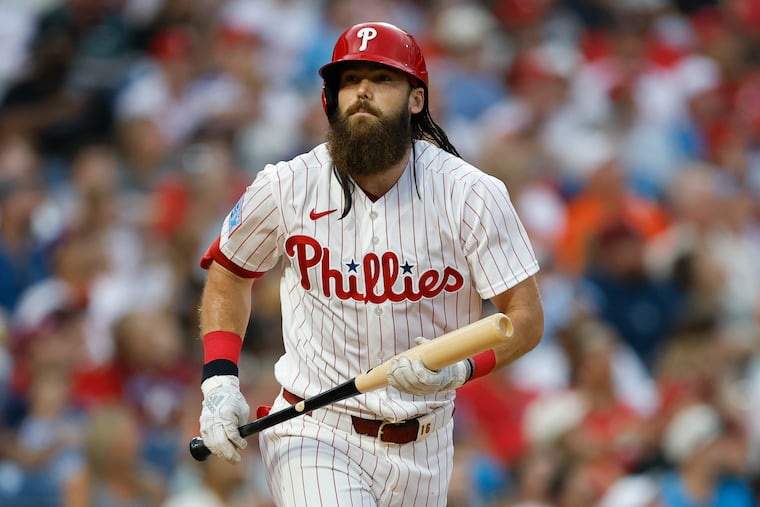
Matt Szczur stood in his garage last month, knees bent with a baseball bat raised in his hands. He played parts of five seasons in the majors and won a World Series in 2016 with the Cubs. But Szczur — a former football and baseball star at Villanova — retired from baseball to do this: hit cups of paint off a batting tee in his Cape May home.
The former big leaguer became an artist. He found a second career, helping to ease a transition that proves difficult for so many professional athletes once they leave the game. He pours paint into cups, places the cups on a tee, and then crushes the cups like they were a grooved fastball. The paint splatters in his garage studio and sprays onto a canvas, which Szczur then uses as the backdrop for his next portrait. He turns batting practice into a masterpiece.
Szczur, 37, knew he had something five years ago when he was making more money selling art than he was playing triple-A baseball. He sells his art on his website, stays busy with commissions, has a partnership with Fanatics, and Topps recently turned his creations — the ones he makes in the garage with a bat — into baseball cards that are prized by collectors and resold for thousands on the internet.
As a kid, Szczur watched his dad come home from his construction job, sit in his recliner with a cup of coffee and sketch. It was how Marc Szczur relieved stress.
Years later, the son found himself doing the same when he reached the majors in 2014 and pressure mounted. Szczur sketched on his iPad, drawing anything that came to mind. Sometimes he just drew his hand in different positions to practice. Art became Szczur’s escape. And now it’s his career.
Pro athletes spend decades obsessively dedicated to their craft, which leaves a void once they walk away. Some say they lose their identity. Szczur found a new one.
“I didn’t want to be the guy who’s 33 years old in triple A trying to fight his way back to the big leagues to come off the bench,” Szczur said. “I’m not interested in that. I didn’t want to be that guy. I’m cool moving on. A lot of those guys have to stay in baseball. They have nothing else afterward. I’m so lucky to be able to do this. Because when guys finish playing, they’re like, ‘What next?’
“If it wasn’t for this, I would’ve kept playing. I would’ve had nothing else. And it could’ve been good. I could’ve made it back to the big leagues and signed a $100 million deal. Maybe? Probably not. But you never know. But I’m happy here. I’m happy working hard every day at my house with my family.”
Leaving the game
In 2015, Tommy La Stella, Szczur’s teammate with the Cubs, saw some of the sketches Szczur did and asked him if he could create something for him. It was Szczur’s first commission.
“I had no idea what to charge,” Szczur said. “I just had no idea.”
La Stella wanted a piece featuring Jesus, Buddha, and Lao Tzu. Szczur used spray paint and stencils to create something. He did a first draft of cardboard — “I’m cheap,” Szczur said — and showed La Stella. He liked it. So Szczur went to work, filling a Wildwood Crest apartment with paint fumes.
It was a humble start, but Szczur figured it out. Szczur took art classes in high school and college, as he always loved creating.
“My friends used to make fun of me because they’d be studying and I’d be painting. ‘Well, you could’ve picked my class,’” he said.
Szczur gave the finished painting to La Stella in the Cubs clubhouse, which allowed other teammates to see it. He was soon getting more work, and the Cubs asked Szczur to paint something for their charity event after the 2016 World Series. It sold for $40,000.
“I remember looking at my wife [Natalie] and saying, ‘I have to do more of this in the offseason,’” Szczur said.
Szczur signed with the Phillies before the 2020 season, hoping to return to the majors with the team he grew up rooting for after spending the previous year rehabbing an injury in triple A. Then, he tore an oblique muscle in spring training before the pandemic paused the season.
Szczur returned home to Cape May during the shutdown and started painting again. He spent hours in his garage, painting athletes, superheroes, and anything else he thought of. Szczur loved it. He wanted to share his work on social media but felt strange posting about it.
“One of the things I was nervous about was other people’s opinions,” he said. “I asked my wife, ‘Should I post this?’ She said, ‘Yeah, who cares?’”
His business took off during the pandemic, and he missed the 2020 season after undergoing surgery to repair his oblique. He signed in 2021 with St. Louis but struggled in triple A after missing the previous year.
The team took a 12-hour bus trip from Memphis, Tenn., to Toledo, Ohio, for a series in June. He was 0-for-4 in the final game of the series when the manager asked him in the eighth inning if he wanted his last at-bat of the game.
“I was like ‘Yeah, I don’t know when it’s going to be my last at-bat so I’m going to take it,’” Szczur said. “I hit a double off the wall.”
The team bused back to Memphis, and the manager told Szczur that the Cardinals were releasing him. Couldn’t that have happened in Toledo? Szczur said. He flew home and told Natalie he was finished. Other teams checked in, but Szczur was content with his career.
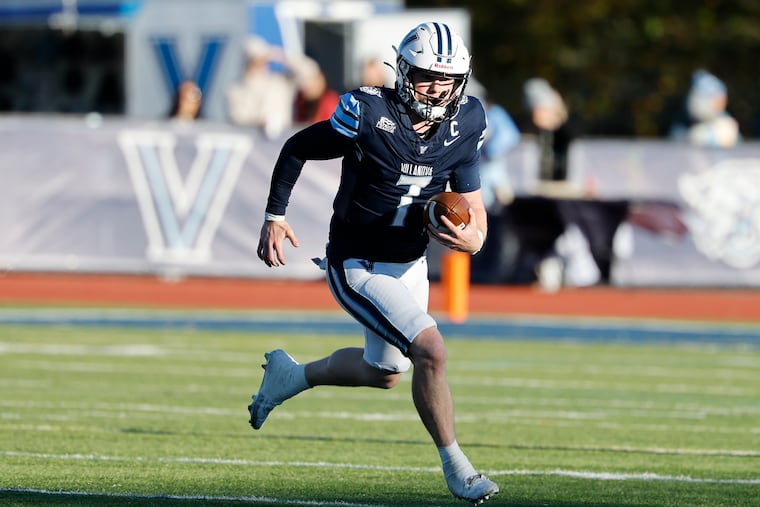
He won a national championship in football at Villanova and signed with the Cubs as a fifth-round draft pick in 2010 instead of entering the NFL draft. He played professional baseball for 12 seasons, played with All-Stars, and earned a World Series ring. Szczur was 31 years old and ready to try something new.
“I’ve never been someone who continues to beat a dead horse. I can move on pretty fast,” Szczur said. “There was light at the end of the tunnel.”
Figuring it out
Szczur was driving to Penn State to watch Villanova play football in September 2021 when Fanatics called. They already commissioned him to do a painting of Tom Brady and wanted to see if he could paint portraits onto jerseys.
“I was like, ‘Yeah, send them to me. I’ll see if I can figure it out,’” Szczur said. “I had no experience.”
He painted onto a Ronald Acuña Jr. jersey, and it looked terrible. Szczur wasn’t sure if he could do it. The representative from Fanatics told Szczur to reach out to some other artists who paint jerseys. Szczur bugged artists he found on Instagram — “usually people don’t respond,” Szczur said — and found someone to help. He told him what paint to use, and Szczur finally had the secret.
“It took like six months to figure things out, which is fine,” Szczur said. “There was a point where I wanted to quit because I couldn’t figure it out, but I was like, ‘These guys have to respond to me.’ I hated trying to figure things out. But I always tell people I leave my ego at the door. I know that I need help. I’m the first guy pulling over at the gas station asking how to get to the next stop. I’m not going to try to figure it out by myself. It just takes so much longer. Find someone who has done it before, who knows where they’re going, and they’re going to tell you. If they don’t, then go to the next person.”
Fanatics sends Szczur signed jerseys of players like Allen Iverson, Emmitt Smith, and Dominique Wilkins. He then paints a portrait of the player onto the jersey and sends it back to Fanatics. Szczur used to spend hours locked in his office or in his basement while he painted the jerseys. But then he realized his second career was taking him away from his two kids. So he paints now in his dining room, turning the table off the kitchen into an art studio. His son, Matthew, builds Legos while Szczur paints another Hall of Famer.
“They get to see dad doing something he enjoys doing,” Szczur said.
Szczur saw someone on social media hitting paint with a golf club, which gave him the idea to use a baseball bat. He figured it out — Szczur shattered plastic cups before trying Dixie cups — and made it his thing.
“Do I need to hit paint with a baseball bat? No. Do I need to throw paint with a glove on? No,” Szczur said. “But it adds to it. And with the stencils and the uniqueness of it, people can tell that’s my art. That’s Andy Warhol, LeRoy Neiman, Banksy, all the top guys. You know that’s a Warhol. That’s a LeRoy Neiman. That’s how my mind thought. When someone sees my art now, they know it’s me. Because no one else does it like me.”
Szczur sold a portrait of Shohei Ohtani at auction for nearly $50,000 and negotiates his own deals and partnerships. He would love to have a manager who could secure him business so he can just paint. For now, Szczur does it all. The former big leaguer moved on. His batter’s box is now in his garage.
“I pinch myself every day,” Szczur said. “I didn’t grow up with a lot of money. And everything I have, I feel like I’ve earned by myself. Yes, I’ve had help along the way. Coaches, parents, family. But it’s weird to say it, but I’m proud of myself. Never in a million years did I think I would have a second profession.”