Don’t panic over Eagles rookie tight end Eli Stowers. Here’s where he can improve and who he might become
The second-round tight end out of Vanderbilt has not had a standout training camp. Patience might eventually reveal a capable player.
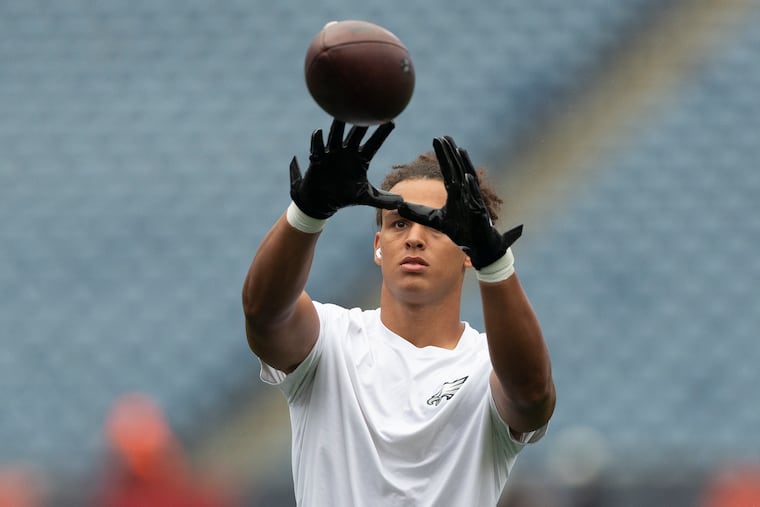
Optimism is generally high this time of year, especially for an Eagles offense that struggled throughout the 2025 season with consistency and continuity. New offensive coordinator Sean Mannion’s offense has shown flashes of encouraging play along with concerning stretches during training camp, but most fans are excited to watch the offense in full when the season kicks off in a few weeks.
For second-round rookie tight end Eli Stowers, the confidence in his potential role this season seems to be far less positive. He hasn’t been a standout player much this preseason, which has caused some angst among fans.
As history has shown with mid-round tight end prospects, the range of outcomes is wide, and most have the same thing in common: They required patience and time to adjust to the NFL game. Very rarely over the last five drafts has a tight end taken after the first round made an immediate impact. Those who have, like the Lions’ Sam LaPorta, Cardinals’ Trey McBride, and Packers’ Tucker Kraft, quickly ascended to become major receiving weapons with in-line blocking ability.
» READ MORE: What the film predicts about Dontayvion Wicks’ and Eli Stowers’ impact for the Eagles in 2026
To provide some perspective on what Stowers can ultimately become, here are three buckets the Eagles tight end could fall under at a position that typically requires patience to see the player’s finished product.
Improved in a key area
Dawson Knox, Buffalo Bills
Though Knox and Stowers are different styles of players — Knox was a more rugged run blocker and not quite as explosive of an athlete — they share a similar background. Both were high school quarterbacks who had to learn a new position in college.
Knox walked on at Ole Miss after missing most of his senior high school season, and didn’t get true tight end reps until his junior season. Stowers switched to tight end just three years ago and is still relatively new to the position.
What helped Knox see the field early on in Buffalo was the blocking ability he displayed in college, but his key area of improvement has been his reliability in a passing game where he’s averaged 50 targets across his seven-year career.
Knox’s two highest receiving success rates have come in the last two years, even though his numbers aren’t eye-popping. In Knox, Stowers can see a player that has adapted to the NFL game, and by the Buffalo tight end’s third year — his best statistical season — he became a much more prevalent receiving threat.
Sam LaPorta, Detroit Lions
We added LaPorta here because since his rookie season, when he exploded for 889 yards on 86 catches and 10 touchdowns, he has continued to add more to his game — including becoming a more reliable in-line blocker, which was a weakness in college. It even showed up early on in his NFL career, especially with one-on-one blocks against defensive ends.
LaPorta was limited to nine games last season because of injury — he missed the last eight games with a herniated disk in his back — but showed some progression as a blocker for the Lions.
Though Brock Wright handled more of the blocking duties, LaPorta, when healthy, has been a dynamic field stretcher and creator after the catch. What Stowers can learn from LaPorta — who also entered the league at sub-250 pounds — is that blocking can be improved, even in the NFL. Stowers likely will not reach the same level of involvement in the Eagles offense as LaPorta had in Detroit as a rookie, though.
Struggled to block, contributed as part of a rotation
Mike Gesicki, Cincinnati Bengals
Among current players, there may not be a closer comparable to Stowers than Gesicki. Both were dynamic receiving tight ends who did their damage in college when split out wide, in the slot, or as off-the-ball tight ends.
They share another commonality too: struggling to block in one-on-one scenarios against defensive linemen and generating displacement at the line of scrimmage. Gesicki’s best years of production — from 2019-21 — are likely behind him. Since leaving the Miami Dolphins in 2022, Gesicki has averaged about 45% of snaps across his time with the New England Patriots and Cincinnati Bengals.
The former 2018 second-rounder has been relatively healthy throughout his career, but never improved even marginally as a blocker, which limits how much he can be on the field in the modern NFL.
Jonnu Smith
The Philadelphia native, currently a free agent, was best known for his ability to create explosive plays with the ball in his hands, though he has surpassed 600 receiving yards in a season just once. His usage in Arthur Smith’s offenses, first in Tennessee and then in Atlanta, made him a threat to turn a routine play into a big gain after the catch.
But across his five NFL stops, the one inconsistency of his game has been his blocking. He showed much more promise than Gesicki as a blocker, but Smith has never consistently been able to block as an in-line player, and it’s a big reason he likely has not drawn a ton of interest entering Year 10.
His last stop, in Pittsburgh last season, produced career-worst numbers in a loaded tight end room: 38 catches, 222 yards for a 5.8 yards per catch average.
Smith, a former third-round pick, never assumed the top tight end role at any of his stops but has played nearly a decade in the league. He has carved out a niche role as an undersized tight end that is a run-after-catch threat , but he isn’t a fit for every offense as he ages.
Receiving skills kept them on the field regardless of blocking struggles
Jared Cook
When you look up Stowers on Mockdraftable, which draws comparisons to previous players at a position, Cook’s name is his third-highest match at 73.9%, and for good reason. Cook was a nonfactor as a blocker and just not valuable when asked to handle defensive ends and linebackers in those blocking situations.
When you look back at the receiving numbers, though, he was a matchup problem for linebackers, safeties, and even some cornerbacks. But his success took a while as he struggled early with the Tennessee Titans, but by his third year, he was consistently contributing as a receiver. In the last 10 years of his 13-season NFL career, Cook averaged just over 600 receiving yards and four touchdowns, including a career-best 896 receiving yards in Year 10 with Oakland.
If Stowers never truly develops as a reliable blocker, a career similar to Cook’s, who was a second-round pick in 2009, would be an ideal outcome.
Isaiah Likely, New York Giants
Like Stowers, former fourth-rounder Likely walked into a veteran-laden tight end room as a rookie, and though there was excitement around the Baltimore Ravens tight end early on, his development took time, as did the production. Likely didn’t truly get going until the back half of his rookie season, with 26 of his 36 total catches and 279 of his 373 total receiving yards coming from Week 8 through the rest of the season.
Blocking in space was a strength for Likely at Coastal Carolina, but translating it to the NFL game as a full-time in-line player has never materialized. It didn’t in Baltimore, with Mark Andrews and later Charlie Kolar taking more of those responsibilities.
Likely, who signed with the New York Giants in the offseason (three years, $40 million), is best known for his receiving ability, specifically stretching the field vertically. Despite a down season last year, Likely’s greatest abilities are finding soft spots in zone coverage and winning his one-on-one matchups downfield.
If Stowers can be serviceable as a blocker, similar to how Likely was in Baltimore, that can help the Eagles rookie earn more snaps early in his career.
Patience, patience, patience
It’s too early to write off Stowers, even if he isn’t productive in Year 1 in Philly. As we wrote on the night the Vanderbilt tight end was drafted, his true impact could come three or four years down the line. And leaning on previous examples, those breakouts for non-first-round tight ends often happened in Year 3 or 4.
With Dallas Goedert and Johnny Mundt likely filling the top two roles for the Eagles tight end room, there should be no rush to force Stowers onto the field. The season is long, and should he make an impact in 2026, it’ll likely come deep into the season.