What the film predicts about Dontayvion Wicks’ and Eli Stowers’ impact for the Eagles in 2026
Though Wicks and Stowers likely won’t be high-volume pass-catchers in 2026, their varying skill sets should help make the Eagles’ offense less predictable than years past.
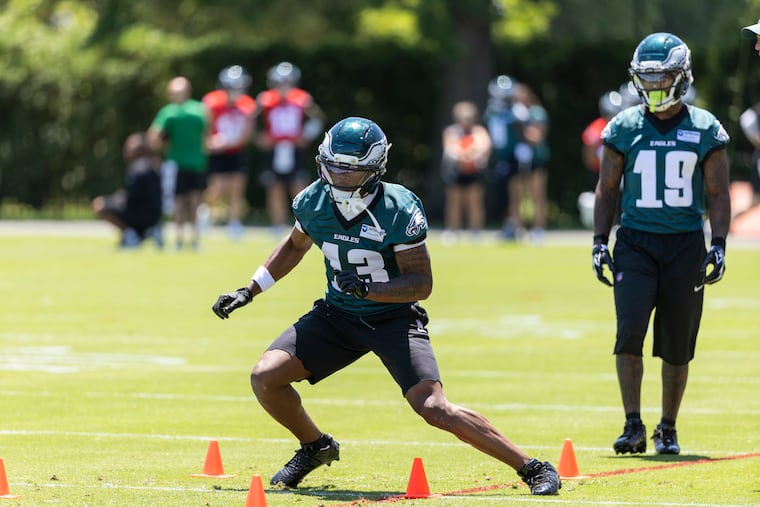
No position group saw more changes on offense for the Eagles than wide receiver, from drafting Makai Lemon in the first round in April to trading A.J. Brown to the Patriots earlier this week.
Brown’s departure leaves a large gap in production from last season. DeVonta Smith is the unquestioned top wideout and Dallas Goedert will return for at least another season at tight end, but a room mixed with veterans and young players will be expected to produce.
Among those players are Dontayvion Wicks, whom the Eagles acquired in a trade from the Packers this offseason, and rookie tight end Eli Stowers, who is more of a receiver than in-line player as he enters the NFL.
» READ MORE: What the film says about Eagles first-round draft pick Makai Lemon
While plenty of attention will be paid to Smith and Lemon, what contributions can Wicks and Stowers bring to the offense, and how might new offensive coordinator Sean Mannion deploy them? We dove into each player’s film, and highlighted aspects of their skill sets that will be beneficial for the offense in 2026 and beyond.
Wicks’ thankless impact
A few stats to keep in mind before we get to Wicks’ receiving contributions: He hasn’t yet surpassed 40 catches or 600 receiving yards in his three-year NFL career, he went 16 games between receiving touchdowns from the end of the 2024 season until the final month of the 2025 regular season, and he was the Packers’ most targeted receiver while in motion with a 34.1% target rate, according to Next Gen Stats.
Wicks has been a role player and played just under 50% of offensive snaps for Green Bay. He hasn’t been an every-down player, and that trend will likely continue in Philly. But one thing the Eagles have desperately needed in their receiver room is a willing blocker, and Wicks not only displays the effort to do so, but has proven effective.
Part of Green Bay’s offensive attack was taking the “free” yardage by throwing bubble screens, flat route screens, or swing routes to get playmakers in space, and Wicks was often tasked with blocking on the perimeter. It wasn’t always pretty, but proved effective in springing big gains. That effort extended downfield, when passes went to his teammates and he sprinted to block defenders in the open field.
That trust also overlapped in the running game, with the Packers’ staff asking Wicks to be an insert blocker to secondary players or linebackers inside the box.
From working to seal off the front-side edge rusher to moving out the extra defender in the box, whether it be a safety or nickel, Wicks would throw his body in the way to allow running back Josh Jacobs to pick up a few extra yards.
With more pre-snap motion coming and a familiarity with the scheme Mannion is trying to implement, Wicks seems a likely candidate to earn playing time, especially early in the season, on running downs because of his willingness to do the dirty work as a blocker.
» READ MORE: What the film says Eagles pass rusher Jonathan Greenard does best, and how it will lift Vic Fangio’s defense
Creating subtle separation
Though Wicks has not been a high-volume receiver in his short NFL career, he understands how to set up defensive backs, create leverage to open up throwing windows, and work back toward the football as the throw is coming his direction.
Wicks particularly made defenders pay in man coverage last season. According to TruMedia, on 63 routes run against man, he finished with 11 catches on 18 targets, including two drops, 122 receiving yards, two touchdowns, and a 63.2% success rate.
Wicks was a scheme-versatile receiver who ran routes both as an outside and inside receiver. According to Pro Football Focus, the wideout had 197 snaps come as an outside receiver, and 190 from the slot.
Focusing particularly on Wicks’ work from the slot, he was really effective making tough catches over the middle of the field and with defenders draped on him. Per TruMedia, Wicks finished with 13 catches on 23 targets from the slot for 150 yards and a 58.3% success rate.
One area he can improve is finishing at the catch point. PFF has Wicks with 12 drops over the last two seasons, including nine in the 2024 season. Those drops prevented big plays downfield when Wicks got behind the defense.
He has enough speed and downfield ball tracking to become more of a factor as a vertical receiver, but most of his damage comes in the intermediate passing game.
On in-breaking routes, Wicks attacks the defensive back’s leverage in both man and zone coverages, opening up the middle-of-the-field throwing window.
To prevent passes from being deflected or put in harm’s way, Wicks works across the field without drifting upfield. In an Eagles offense that will likely throw across the middle at a much higher rate, Wicks will likely play a big role in achieving that.
Racking up Stowers’ yards
Stowers, the Eagles’ second-round pick in this year’s draft, brings a completely different skill set than Wicks. A former quarterback turned tight end, the rookie’s average depth of target in college across New Mexico State and Vanderbilt, per TruMedia, was 7.6 yards. Wicks’ over the last two seasons: 11.6 in 2025, 12.7 in 2024, per PFF.
The Vanderbilt standout Stowers is a linear athlete that thrived with the ball in his hands after the catch. That should be the focus of the Eagles’ staff early in his career, giving him a runway in the passing game and allowing him to generate big plays with his athleticism and 4.51-second 40-yard dash speed. Of his 752 receiving yards last season, 377 came after the catch, per PFF.
That speed also showed up when he threatened the seams of defenses by making them pay between the hashes. TruMedia credited Stowers with 68 targets between the hashes across his college career. He particularly elevated and stretched out his 6-foot-4 frame to snag throws away from his body across the middle of the field.
Stowers was especially effective in the red zone at New Mexico State and Vanderbilt. Per TruMedia, Stowers caught 16 of his 25 red zone targets for 13 touchdowns and had a success rate of 60% in that area of the field.
One area he needs to continue to refine is his route running, though he showed flashes of nuance and setting up secondary players.
Adjusting his route-running tempo and being more forceful in attacking a defender’s coverage space will allow Stowers to unlock more in that department as he makes the transition to the NFL.
Against man coverage in particular, Stowers was a difficult cover for college defenses because his size allowed him to outmuscle secondary players, and his speed made it difficult for linebackers to stay connected to him.
According to TruMedia, Stowers had a 56.3% success rate against man coverage. Being as consistent in those scenarios at a pro, especially as defenses devote more attention to other, more high volume pass catchers like Smith and Dallas Goedert, could be the difference in Stowers earning snaps early in his career.
Scheme creativity
Through two organized team activities that were open to the media, it’s clear that Mannion’s scheme will be utilizing more under center formations and pre-snap motion. Creativity also seems to be of priority, which should benefit Stowers and Lemon, both of whom are excellent after the catch.
Vanderbilt’s offense utilized Stowers all over the formation, from outside receiver to an in-line tight end, and occasionally in the backfield. The coaching staff also found several ways to get Stowers the ball, including via screens, shovel passes, and jet-sweep handoffs to the tight end.
Wicks has seen plenty of offensive creativity himself from playing in Matt LaFleur’s scheme. He has been used on pre-snap motion that included running behind the quarterback to the other side of the formation, aligned in the backfield, and even took a shovel pass himself near the goal line in 2024 with the Packers, Mannion’s first year on staff. Last season, Wicks was in motion more than any other Green Bay receiver.
Though Wicks and Stowers likely won’t be high-volume pass-catchers in 2026, their varying skill sets should help make the Eagles’ offense less predictable than years past, and help usher in a new scheme that could attack defenses in different ways, which Mannion alluded to in his opening press conference.

The Eagles seem reluctant to address the handling of the Jalen Hurts blood clots saga, but the key questions involved in the story aren’t going anywhere. Throughout the week, in the absence of remarks from general manager Howie Roseman or team medical personnel, head coach Nick Sirianni was peppered by reporters. He’s offered few details in return. After speaking with high-ranking medical officials currently or previously employed by NFL teams, The Inquirer’s Jeff McLane frames four central issues that remain unanswered, while also looking at what this situation means for Hurts’ future in Philadelphia. Listen here.
Listen to all episodes here or wherever you get your podcasts.