City Council members are trying to save Lankenau High School from closure with zoning legislation
City Councilmembers Curtis Jones Jr. and Nina Ahmad introduced restrictions that would prevent the city's environmental sciences magnet from being turned over to the city for affordable housing.
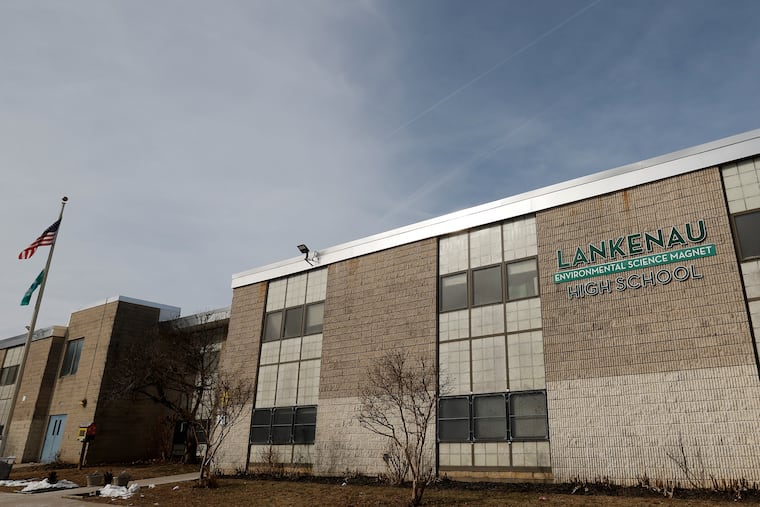
The fight to save Lankenau High from closure came to City Council on Thursday.
City Councilmembers Curtis Jones Jr. and Nina Ahmad introduced legislation that would change the Upper Roxborough school’s zoning, blocking the planned redevelopment of the site.
Lankenau, the city’s environmental-sciences magnet school, is one of 18 schools proposed for closure by the Philadelphia School District. Superintendent Tony B. Watlington Sr. has cited the school’s low enrollment as a reason for moving the school into Saul High School, the city’s agricultural magnet.
But students, teachers, parents, and community members — including Ahmad — have mounted fierce opposition to the plan, which calls for giving the school property to the city to use for affordable housing or job creation.

Wholesale changes are coming to the Philadelphia School District, with the school board passing a $3 billion facilties plan that aims to close 17 schools permanently, and renovate 169.
Superintendent Tony B. Watlington Sr. presented the plan to the school board Feb. 26 and it immediately faced strong opposition. After some amendments, the board passed the plan April 30. Here's what we do and don't know about it.
And to see the proposed list school closures and check how your school could be impacted, use our interactive charts.
Each of the schools proposed for closure has its own story. Find them all here.
The 17-acre Lankenau parcel currently has residential zoning; Jones and Ahmad want to change it to a zoning designation that would limit its use for “development and preservation of public-serving institutions” such as schools and libraries.
Councilmember Jamie Gauthier proposed similar zoning restrictions in March for several schools in her West Philadelphia district. The legislation, if passed, could snarl the planned closures of Paul Robeson High and Blankenburg Elementary.
Typically, the tradition known as councilmanic prerogative means that all members honor the wishes of the district Council member on real estate matters in their district.
Mayor Cherelle L. Parker, who has endorsed the school facilities plan and would like to use former school properties to support her housing plan, could then sign the legislation, veto it, or allow it to become law without signing it. Council can override a mayoral veto with a two-thirds vote.
The mayor’s office did not immediately respond to a request for comment Thursday.
Ahmad, a scientist by training, said closing Lankenau, a “crown jewel” of the school system, would be a grave mistake. It is crucial to have a free-standing high school educating students about the environment, she said.
“I am really interested to have a school system that is producing students who understand what role they play in life across the board, and what can they do to make things better,” Ahmad said. “This is my passion. We need to have people looking at evidence-based ways of engaging with the world.”
Perhaps more importantly, Ahmad said, Lankenau is high performing, with a 100% graduation rate, a wealth of meaningful community partnerships, and a robust population of students with special needs.
That it is small — just 225 students in a building that can hold almost 500 — is on the district, Ahmad said. Lankenau’s enrollment dropped significantly after the district ordered changes to its special-admissions policy.
“It seems deeply unfair that you will be holding them accountable for a problem they did not create,” Ahmad said.
District officials have said the closure of Lankenau and the 17 other schools is necessary in an underfunded school system that has 70,000 unfilled student seats. Shutting schools will allow for improved academics, extracurriculars, and building conditions in the schools that remain open, Watlington has said.
Another question mark
The City Council legislation, which was referred to committee by Council President Kenyatta Johnson, is not the only question mark hovering over the Lankenau closure.
The Schuylkill Center for Environmental Education, which borders Lankenau and is an active partner with the school, believes that under the terms of a 1973 legal agreement, it holds the right to repurchase the Lankenau land if it ceases to operate as a school.
Schuylkill Center officials, who also oppose the school’s closure, have said they would repurchase the property if the school is closed.
Ahmad acknowledged that the zoning change might be precluded by the Schuylkill Center claim. But, she said, the restriction is an important safeguard.
Lankenau’s closure is now in the hands of the school board, which has not scheduled a vote on Watlington’s facilities plan, though one is expected sometime this spring.
Representatives for the school board could not immediately be reached for comment.