Councilmember Jamie Gauthier moves to restrict zoning for four West Philly schools slated to close
Gauthier said she wants to ensure the Philadelphia school district’s decisions about closures are not motivated by potential financial rewards from reselling the properties.
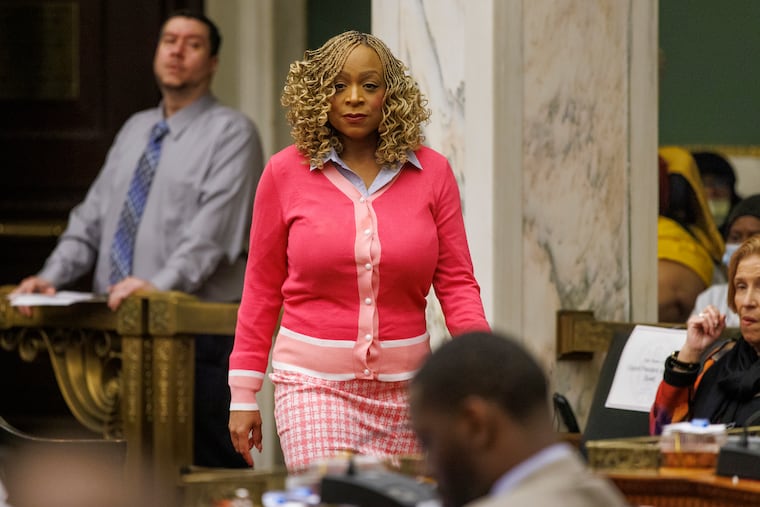
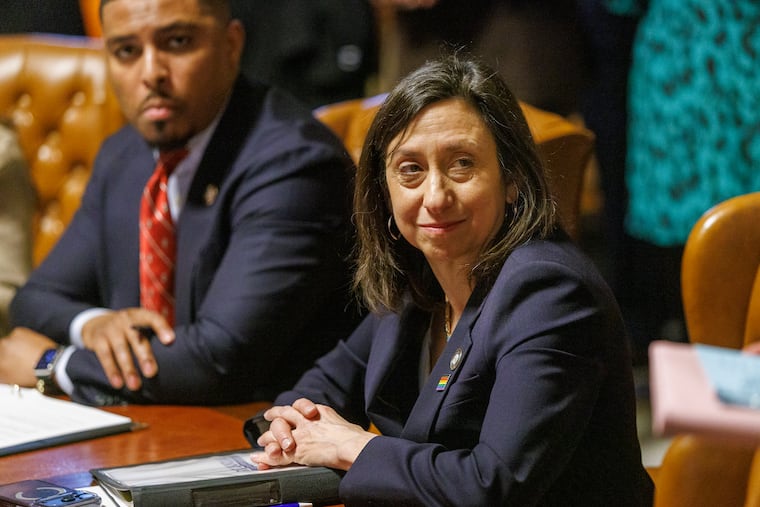
In an escalation of the fight over the Philadelphia School District’s plan to close 18 schools, City Councilmember Jamie Gauthier on Thursday introduced zoning bills that would restrict potential redevelopment of four school buildings slated for closure in her West Philadelphia district.
Gauthier is also moving to rezone the property of a fifth school, Motivation High School, which was spared from potential closure in a revised version of the facilities plan. Gauthier’s office said she is going ahead with the proposal because she doesn’t want to take “any chances.”
The parcels currently have zoning that allows redevelopment for residential or commercial uses. Gauthier is seeking to limit the properties’ use for “development and preservation of public-serving institutions” such as schools and libraries.
The zoning revisions could potentially derail plans for two of the five buildings in question. Paul Robeson High and Blankenburg Elementary would be given to the city for potential use as housing under the district’s proposed plan. The other three buildings are slated to remain in district hands for use as schools or swing space.
Gauthier said she wants to ensure the district’s decisions about closures are not motivated by potential financial rewards from reselling the school properties.
“Our schools belong to our communities, not developers, and the school district does not get to hand them over to developers while our children’s backs are turned,” Gauthier said in a speech to Council on Thursday. “My legislation says: Not on my watch, and not without a seat at the table for the people who built these communities, who filled these classrooms, and who are still there and still fighting.”
Many Council members reacted critically to the district’s facilities plan when it was announced in January, and Gauthier’s move marks a new level of opposition. Her legislation is likely to pass due to the tradition known as councilmanic prerogative, in which all members typically default to the wishes of the district Council members concerning real estate matters in their jurisdictions.
Mayor Cherelle L. Parker’s office did not immediately respond to a request for comment. If Council approves the bills, Parker can sign them into law, veto them, or allow them to become law without her signature.
A veto would be unlikely to succeed if the vote is unanimous, as is often the case with prerogative bills, because Council could override the veto with a two-thirds vote.
» READ MORE: The Philadelphia school district’s facilities plan did not go over well in City Council
The school system has said that its decisions are not real estate-based. Instead, Superintendent Tony B. Watlington Sr. has said the facilities choices are driven by a desire to improve academic outcomes and extracurricular opportunities system-wide.
Philadelphia has 70,000 empty seats in its public school system, with some schools more than half empty and others, particularly in the Northeast, overcrowded. Though finances are not the primary driver of the plan, Watlington said, he and the school board have indicated that in the long term, the historically underfunded school system cannot afford to pay for the system at its current size.

Wholesale changes are coming to the Philadelphia School District, with the school board passing a $3 billion facilties plan that aims to close 17 schools permanently, and renovate 169.
Superintendent Tony B. Watlington Sr. presented the plan to the school board Feb. 26 and it immediately faced strong opposition. After some amendments, the board passed the plan April 30. Here's what we do and don't know about it.
And to see the proposed list school closures and check how your school could be impacted, use our interactive charts.
Each of the schools proposed for closure has its own story. Find them all here.
The district, which lacks the ability to raise its own revenues, has a structural deficit and Watlington has ordered $225 million in cuts to balance the budget going forward.
The five West Philadelphia school buildings that would received “Special Purpose Civic” zoning rules under Gauthier’s legislation are:
Paul Robeson High School for Human Services, which is slated to closed and merged into Motivation High School, with its building given to the city or sold.
Blankenburg Elementary, which is set to be closed and its building given to the city or sold.
Martha Washington School, which would be co-located with Middle Years Alternative under the district’s plan. Its building would become a district swing space.
Parkway West High School, which would close and be merged into Science Leadership Academy at Beeber. Its property would be renovated for use as the co-located building for Martha Washington and Middle Years Alternative.
Motivation High School, which was removed from the list of potential closures in the most recent version of the district’s plan.
The “Special Purpose Civic” zoning category Gauthier is seeking for the properties is relatively new. Many district properties still retain outdated zoning designations, according to Gauthier’s office.
West Philly battleground for school district plan
Watlington‘s $2.8 billion facilities plan initially proposed closing 20 schools and modernizing 159. After receiving significant pushback from members of the public — and politicians — he amended it to 18 closures.
West Philadelphia remains one of the most impacted parts of the city, and Gauthier has said she feels the district is brushing off community concerns.
“Until you show a real response to these concerns, I will stand with my community and I will fight these closures with everything that I have,” Gauthier said at a school board town hall meeting this month.
Gauthier indicated she believes the district was motivated to close some of the school buildings in her district in part due to their potential value.
Robeson, for instance, has a prime location near the University of Pennsylvania and Drexel University. While the district wouldn’t stand to benefit financially by transferring it to the city, the Parker administration could potentially use the property for housing development or job creation, Watlington said in January.
“The building is likely among the most lucrative assets owned by the district, but we should not be making decisions about education based on real estate values,” Gauthier said at the school board hearing. “And maybe there were other factors weighing into this decision, but this is exactly why I’m asking you to show your work. Show the actual factors that … you used to make these decisions.”
Gauthier recently visited Robeson and talked to students about the district’s plan.
“What I’ve heard from Robeson students, teachers, staff, parents, and community members over and over again is that they see the proposed closure for what it is: the latest chapter in a long story of pushing working class, Black and brown families out of University City,” Gauthier said. “This is not paranoia. This is pattern recognition.”
Watlington’s plan is now in the school board’s hands; a vote is expected this spring, though a date has not yet been set.
School board president Reginald Streater declined, in a statement, to weigh in on Gauthier’s legislation or her comments around it.
But, Streater said, the underlying issues remain — roughly $8 billion in deferred maintenance on the district’s 300 mostly-old buildings, the $300 million structural budget gap, and shifting enrollment trends.
“We continue to navigate these challenges in the most responsible and efficient manner,” said Streater. “However, we can’t continue on with the status quo.”
Why zoning matters
By changing the school zoning categories to only allow public facilities, Gauthier’s legislation could make redevelopment substantially harder and reduce the property values.
Currently, Robeson is covered by one of the most liberal zoning categories in the city, allowing denser and taller development. Gauthier’s proposed zoning would restrict those possibilities, ensuring, a new type of use would not be allowed.
The four other schools in Gauthier’s legislation are in parts of West Philadelphia that have weaker residential markets than Robeson and are currently zoned for rowhouse development.
If Gauthier’s proposal becomes law, any new owners wishing to convert the properties to commercial or residential use would have to get a variance from the Zoning Board of Adjustment, an added layer of uncertainty that may scare off some potential buyers.
Gauthier’s legislation also cuts against the Parker administration’s hopes for using old school buildings as a means of mitigating the city’s housing crisis.
The mayor has said she plans to put forward legislation to institute a 20-year tax abatement for the redevelopment of defunct school buildings as a way to add apartments to neighborhoods. (Gauthier has said she is skeptical of the legislation unless it includes an affordability component.)
“After significant engagement with both impacted school communities and the district, it’s become clear that having a conversation about closing and merging schools at the same time the district is talking about redeveloping current school buildings limits our ability to have a productive dialogue,” Gauthier spokesperson Harrison Feinman said.