Negotiations continue ‘around-the-clock’ ahead of Thursday board vote on 17 Philly school closings
The school board plans to vote Thursday on a $3 billion facilities plan to close 17 schools, co-locate six, and modernize 169. City Council members are threatening to hold up school funding over it.
The school board on Thursday is scheduled to cast the most consequential vote it’s taken since the Philadelphia School District returned to local control in 2018.
It will consider Superintendent Tony B. Watlington Sr.’s $3 billion facilities plan to close 17 schools, co-locate six, and modernize 169.
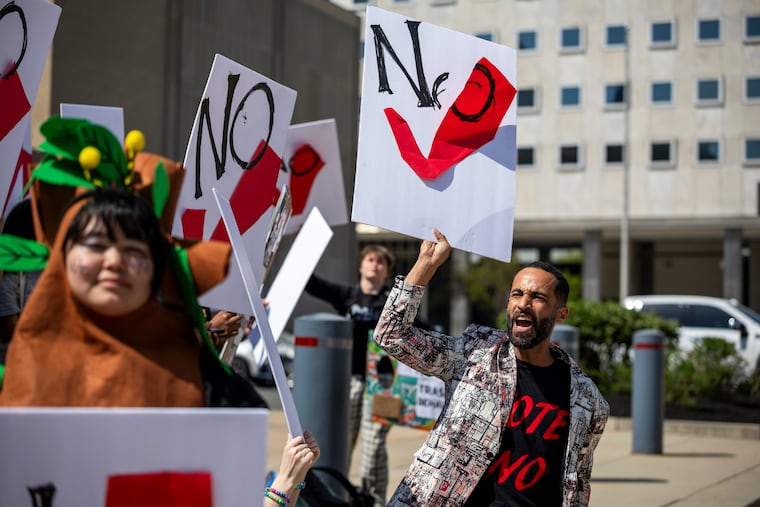
The stakes are incredibly high: Some city and state lawmakers are still negotiating to save some schools from closure, saying the plan disproportionately hurts Black communities. And they’re threatening to hold up funding if certain schools — including Lankenau and Robeson — don’t come off the closure list.
In a system that cannot raise its own revenue, that’s a cataclysmic possibility.
And though district officials say the facilities plan and Mayor Cherelle L. Parker’s proposed $1-per-trip tax on rideshare services — money that Parker wants to use to stave off classroom cuts amid the district’s $300 million budget gap — are unrelated, Council has said the fate of the two politically unpalatable decisions are intertwined.
“You’re not getting my vote unless you fix this situation at Lankenau,” City Councilmember Curtis Jones Jr. said last week. “I love you, [school board president Reginald] Streater, but don’t make me show you: mess around and find out.”
Streater and eight other school board members have the final say on Watlington’s facilities plan. But two City Council members said this week that the plan is still in flux.
“We are still in the process of negotiating,” Councilmember Isaiah Thomas, chair of the education committee, said. “I’ve been talking to people and working around the clock on this issue.”

Wholesale changes are coming to the Philadelphia School District, with the school board passing a $3 billion facilties plan that aims to close 17 schools permanently, and renovate 169.
Superintendent Tony B. Watlington Sr. presented the plan to the school board Feb. 26 and it immediately faced strong opposition. After some amendments, the board passed the plan April 30. Here's what we do and don't know about it.
And to see the proposed list school closures and check how your school could be impacted, use our interactive charts.
Each of the schools proposed for closure has its own story. Find them all here.
Parker made her wishes on the subject plain: “We have to work together in order to get it done, and I want us to figure out a way to get to yes,” she told Council and district leaders in an hour-plus public appeal last week.
Thomas said this week he was “in constant communication with the school board as well as the school district to try to put us in a position to get to a plan that we feel like we can live with. The plan that exists currently, there’s a lot of legislators who just can’t live with a few of the decisions.”
Agreement on about half the plan
It’s clear that some school closings are coming.
The school system has 70,000 empty seats, with some schools overfull and others with 1,000 or more empty seats.
Watlington has said the plan is centered on improving academic and extracurricular opportunities for all students, and that the school system cannot afford to run very small schools.
Bottom line? The school system has a once-in-a-generation opportunity to make large-scale change, according to Watlington.
Lawmakers and district officials agree on about half of the plan, Thomas said, “and another 40%, we’re willing to tolerate. I don’t really agree with your decision around Parkway West, but I’m living with it. But I can’t live with your decision around Lankenau.”
Lankenau is the city’s environmental science magnet and has only about 200 students, but a 100% graduation rate, and sits on a unique, wooded campus that offers hands-on education.
And Councilmember Jamie Gauthier has been pressing Robeson’s case on multiple fronts, she said.
The district has already been responsive to some community concerns. Twenty schools were initially on the closure list, but outcry and political support helped Conwell, Motivation, and Ludlow come off the list, and the recommendation for Moffet to merge catchments with Hackett and become a middle school was rescinded.
Watlington’s plan for Robeson, once hailed by former Gov. Tom Wolf as a model for Pennsylvania schools, has also shifted. Initially, the University City school was planned to be given to the city. Now, Watlington wants it to remain in district hands for future use for community-directed science, technology, engineering, and math purposes.
But Gauthier says that change doesn’t go far enough, and that using the site to benefit some future students, while shutting out current students, is not the right move.
In a letter to the school board, Gauthier, Thomas, Councilmembers Kendra Brooks, Rue Landau, and Nicolas O’Rourke, State Sen. Vincent Hughes (D., Philadelphia), and State Rep. Rick Krajewski (D., Philadelphia) urged officials to temporarily co-locate Robeson and Motivation, with an eye toward building a new school for Robeson in the future on the old site.
“To the local community, Paul Robeson is more than a school — it’s one of the few remaining institutional footholds for the Black community in University City,” the lawmakers wrote in the letter, which was obtained by The Inquirer. “Voting to close Robeson after promising to preserve the building and increasing your facilities investment in the surrounding community by $120 million would make the Board complicit in the displacement that this community has been suffering since the razing of the Black Bottom.”
Lawmakers and education advocates have called a news conference for Thursday morning outside Robeson to put further pressure on the school board ahead of the vote.
The school board meeting is scheduled to begin at 4 p.m. Thursday.