‘I shouldn’t have to be asking for this’: Southwark Elementary school kids beg grown-ups for working bathrooms, pest control
Students held a rally and testified before City Council this week about poor conditions at the school. Their outcry comes as the school board prepares to vote on a sweeping facilities plan.
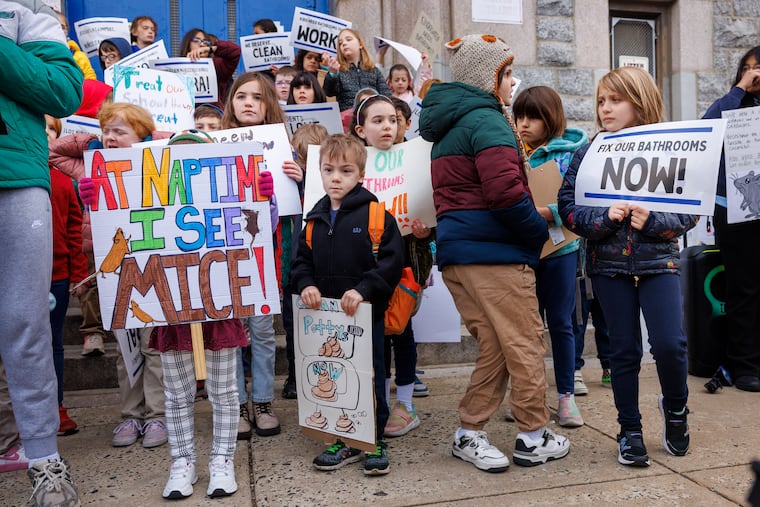
Seventh grader Vallery Flores sat in front of the city’s top lawmakers and the Philadelphia School District’s top officials last week with a grim message.
“I’m here today because of the conditions of our school bathrooms,” said Vallery, a student at Southwark Elementary in South Philadelphia. “They suck.”
Vallery rattled off a list of things that are wrong with her school: just a handful of working toilets for hundreds of students; “repulsive” smells; raw sewage; mystery puddles; broken stalls that do not lock; flooding toilets; and not enough functional soap dispensers or toilet paper.
For months, parents, staff, and politicians have been writing letters and holding meetings to air their concerns about Southwark’s alarming building conditions, including the bathroom issues and mouse and cockroach infestations. They have asked the district to accelerate its timeline to fix the otherwise well-regarded, bursting-at-the-seams K-8 school, which is scheduled to undergo a $46 million renovation project beginning in 2032.
Last week, it was the kids’ turn to tell people what it’s like inside — first at a rally outside the school, then at City Council.
“Before I even got here, my classmates even said, ‘Tell them to fix our bathrooms,’” Vallery told a packed City Council chamber Wednesday. “I seriously have to go out of school and go all the way here for decent bathrooms. I shouldn’t have to be asking for this.”
The Southwark building crisis lays bare a fundamental problem for the district: It cannot keep up with its old buildings, even for a school community that has been organizing and has multiple political backers amplifying its calls.
The Southwark asks come as the district fights an uphill battle to pass Superintendent Tony B. Watlington Sr.’s sweeping facilities plan. The $3 billion blueprint would close 17 schools and upgrade 169 aging buildings, but it would require $2 billion in yet-unsecured state or philanthropic funding for many of those renovations.
The school board was supposed to vote Thursday on the plan, which would take a decade to implement if funded. An angry City Council pressured the board to delay its vote, which is now scheduled for this Thursday.
Some have said the plan does not go far enough, or fast enough, in a school system with many buildings in conditions like Southwark’s. But board president Reginald Streater, at a City Council budget hearing Wednesday, said the district is dealing with financial realities.
“Without a supercharge of capital investment, the plan looks the way it looks because that’s our confidence in getting the level of investment we would need at the time that we would need it,” Streater said.
‘Everything we can’
District officials had promised toilets in trailers to help the Southwark situation, but the community balked at using that emergency patch through 2032 — or whenever the renovations are finally complete.
But on Wednesday, as students testified directly to Council, Watlington suggested quicker help was on the way.
“We are exploring how we can get significant improvements made at Southwark, in particular through the capital improvement budget, ahead of that timeline with the facilities plan,” the superintendent said.
Southwark needs emergency help around both bathroom and pest problems, but also is in line for an annex with a new gym and classrooms to help ease crowding.

Wholesale changes are coming to the Philadelphia School District, with the school board passing a $3 billion facilties plan that aims to close 17 schools permanently, and renovate 169.
Superintendent Tony B. Watlington Sr. presented the plan to the school board Feb. 26 and it immediately faced strong opposition. After some amendments, the board passed the plan April 30. Here's what we do and don't know about it.
And to see the proposed list school closures and check how your school could be impacted, use our interactive charts.
Each of the schools proposed for closure has its own story. Find them all here.
The district is now on an “expedited timeline,” Watlington said, and hopes for a clear answer in the next week or so on whether major bathroom repairs can be completed this summer. And it is looking at options for moving up the annex construction, he said.
“We will do everything we can to expedite those problems as quickly as we can and we’ll give you a more definitive timeline,” Watlington told Council. “I don’t want to sit here and give you an artificial deadline that we’ve not been able to confirm that we absolutely can do it just yet, but we’re moving as quick as we can, I promise you.”
Student testimony underscored the importance of moving fast. Southwark, on South Ninth Street, has more than 900 students — and just three working toilets on two floors for 600 students in prekindergarten through fifth grade.
Aurora Lopez, another Southwark student, told officials about the time a bathroom drain became clogged and began to spew dirty water.
“That section of the restroom flooded,” Aurora said. “Can you imagine what it’s like to have to walk on water fearing that your shoes might get dirty or that you might fall into the water filled with waste and bacteria? Now imagine how difficult it must be for the little children. No child should ever have to go through that, but you know what? We didn’t even have to imagine it.”
Another time, Aurora said, she and her classmates had to lift their feet from the floor in their classrooms and keep them elevated because of cockroaches running across the floor.
“Today,” she said, “we bring together our small voices to be heard, and to bring a great change into our school.”
State Rep. Elizabeth Fiedler (D., Philadelphia), who represents the Southwark district and sends her children to the school, said she was gratified by the clearest promises yet that the Southwark repair timeline is finally accelerating.
“Southwark is a success story — it shows what’s possible when you have super dedicated staff and high-quality programming, and a strong community,” Fiedler said. “Students should not have to be walking around looking for a working bathroom.”